The Domestic Wall That Disappeared Into the Grid
Japan's exposure through 100m connected household fixtures shows how domestic architecture became an unguarded electrical threshold.
SINGAPORE
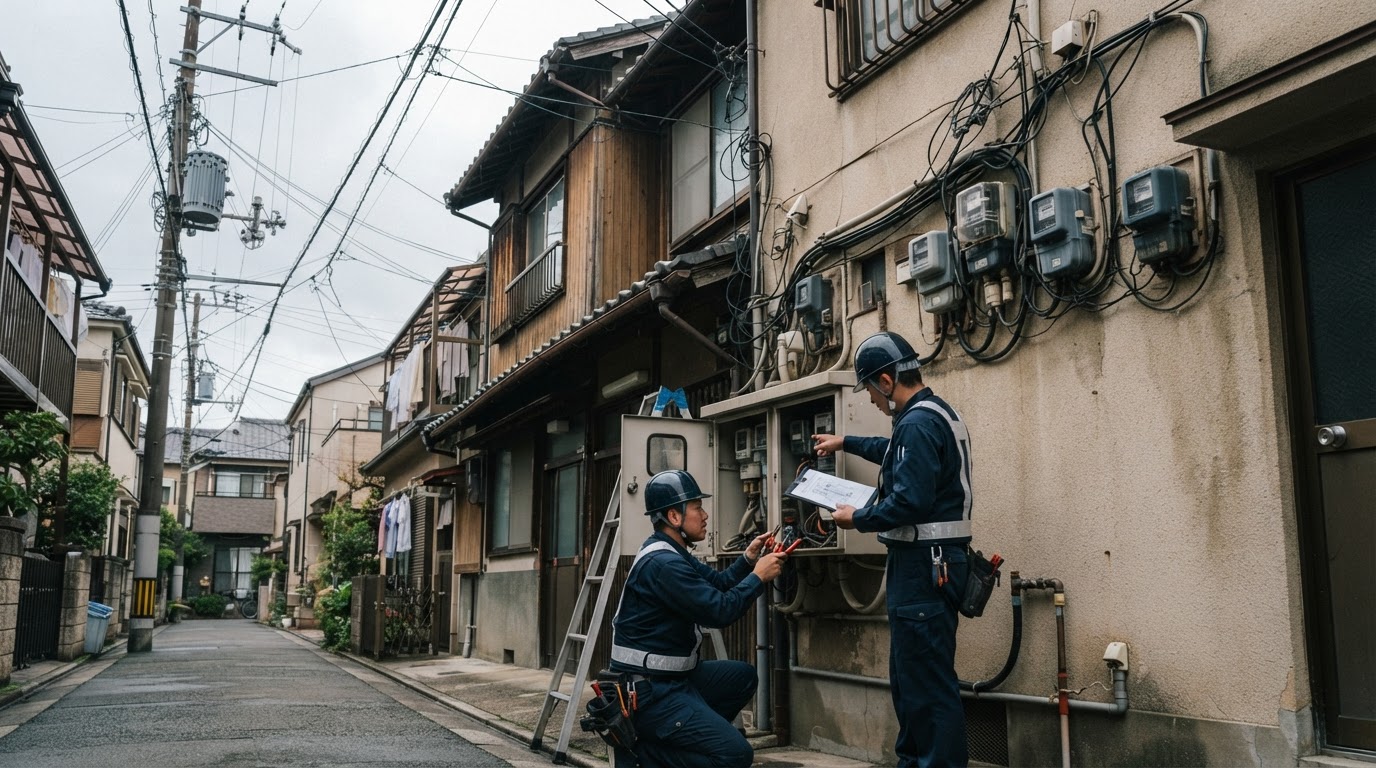
Domestic architecture once depended on a strict physical division between private domestic interiors and civic utilities. Copper conduits entered through foundation sleeves, while exterior masonry kept municipal forces outside the domestic threshold. Buildings were conceived as fortified containers whose utility meters marked the end of civic jurisdiction. That structural division no longer holds.
According to reporting by Nikkei Asia, Japan confronts acute systemic risk across its power grid through 100m connected home devices. The assessment marks an unacknowledged architectural turning point. Residential spaces have ceased to function simply as passive endpoints at the terminus of a transmission corridor. Instead, private household fittings—such as inverter units and climate controls—operate as active electrical switches linked directly to metropolitan grids. Dwellings have effectively been converted into distributed operational nodes without the defensive physical buffers that municipal utilities require. A utility network is now only as secure as the private properties attached to it.
Infrastructure planners conceived distributed household networks as clean models of operational efficiency. Individual nodes promised automated load management alongside real-time responsiveness. Yet aggregating 100m residential fixtures into external networks simultaneously erected a continuous digital bridge from private rooms into national supply lines. Private spaces are no longer defensive enclosures. They are unguarded conduits.
The Unbuilt Defense
Reuters has warned that China-linked networks use everyday consumer hardware to mask their intrusions. Traditional engineering historically insulated electrical supply behind dedicated perimeters and restricted control rooms. Those physical boundaries isolated municipal substations from civic disruption. Connecting utility management directly to domestic living spaces strips away those structural boundaries.
The living room is no longer an architectural terminus but a public conduit.
When an individual domestic installation can be compromised remotely, residential zones cease to offer spatial sanctuary. Each connected appliance represents an unresolved collision between private convenience and municipal vulnerability. The timber framing stands firm, yet its circuits belong to the street.
Advocates suggest that routine firmware updates and local firewalls can insulate distributed domestic hardware. That defense presumes software functions as an impenetrable structural partition. Experience demonstrates otherwise. Consumer fixtures are designed for convenience and rapid deployment rather than long-term security. Cheap electronic components rarely receive continuous protection. Once tens of millions of consumer nodes sit permanently plugged into common infrastructure, defensive cohesion collapses. Digital protocols cannot substitute for absent architectural boundaries.
Fragile Boundaries
This structural exposure across Japan carries implications for fast-urbanising regions across the Asia-Pacific. From municipal planning in Southeast Asia to dense East Asian developments, authorities encourage automated domestic systems without assessing how aggregate residential hardware exposes power networks. Contemporary architecture obsesses over floor plates while ignoring the conduits linking domestic space to broader public grids. The vulnerability is fundamentally spatial. The defect lies in the design logic itself.
Building codes govern fire separation and structural stability with rigorous precision. Municipal statutes mandate secondary egress and load-bearing margins. Yet regulatory standards remain entirely silent on the aggregate threat posed when private domestic equipment communicates unrestricted with municipal energy networks. The domestic interior has been exposed to external forces while developers continue to market the home as an autonomous refuge.
Architecture has always been an exercise in defining borders between the resident and the street. In contemporary domestic design, that threshold has been dismantled from within. Japan now confronts an energy system whose vulnerabilities sit inside private utility cupboards and above kitchen counters. The physical house remains upright, but its defensive perimeter has dissolved. The dwelling refuses its oldest civic duty: it can no longer keep the outside out.
Sources
Newsletter
Pacific Daily
A curated briefing from Thailand, Asia-Pacific and the world.