The Dinner Table Redrawn: Where Nature Reclaims the Culinary Scene
A trend of dining in unexpected natural settings reflects a subtle shift in how cultures engage with both food and environment.
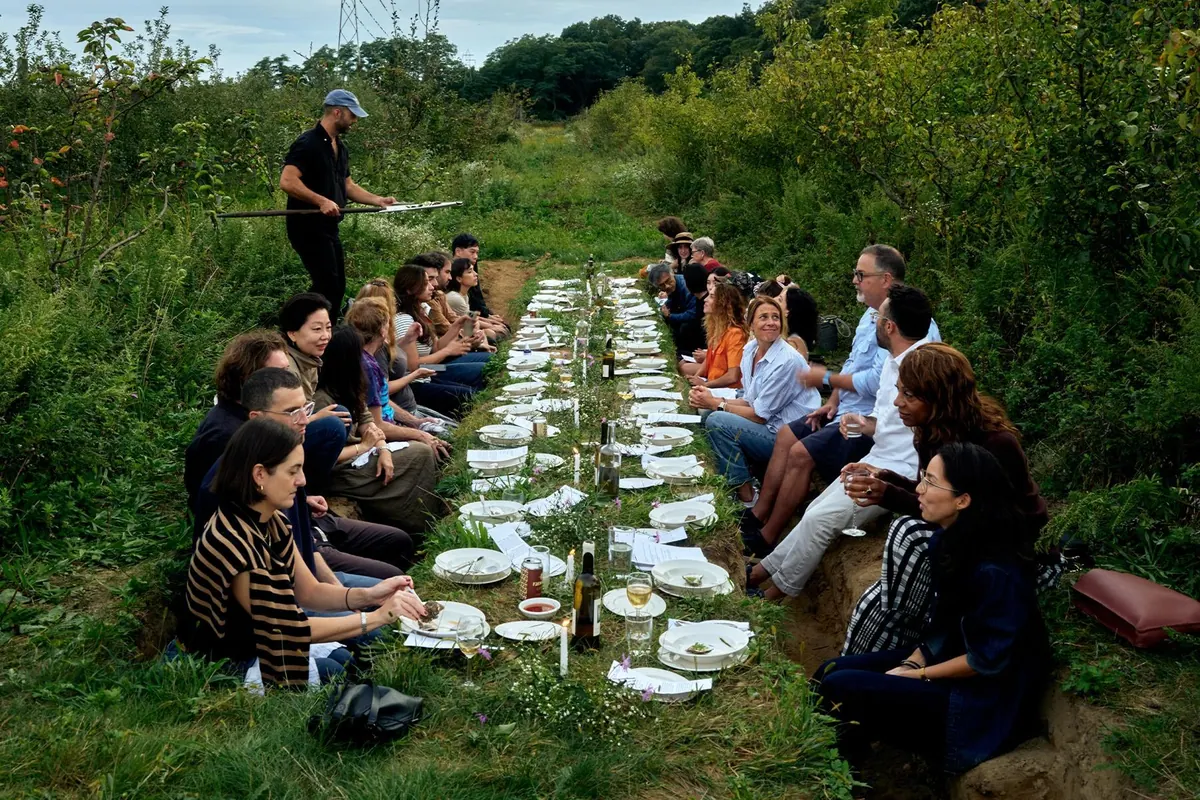
In upstate New York, a small group recently gathered for a picnic during a retreat, but their setting departed from the expected. Instead of a checkered blanket on a grassy knoll, diners huddled on a flat rock beside a waterfall. Here, Charles Michel, a co-organizer of the retreat, prepared the stone's surface, priming it with vinegar before painting it with vegetable purées and adorning it with flowers and foraged elements, creating an abstract composition. This act, reported by Eater in August 2026, marks a precise observation about a particular way of eating, one that quietly replaces established customs.
Historically, the act of dining has been shaped by societal structures and available resources. From communal floor-level meals in many Asian societies to the formal dinner parties of the Western world — often documented as significant social events, as seen in accounts of political gatherings and cultural affairs in Washington D.C. (The Washington Post, April 2026; The New York Times, April 2025) — the venue and its accoutrements have long signaled status, occasion, and relationship. The traditional dining table, whether a modest family circle or an expansive banquet, provides a defined space, separating the meal from its broader environment. Samin Nosrat's practice of gathering friends for dinner weekly, as reported by The New York Times in September 2025, underscores the enduring social function of a structured, familiar dining setting.
What is preserved in these new, untamed dining experiences is the fundamental human need for communal eating and aesthetic appreciation. What is being quietly replaced, however, is the assumption of a controlled, domestic, or even restaurant-bound environment for these acts. The landscape itself becomes the table, the canvas. This is not merely a change of scenery; it is a re-engagement with food preparation and consumption that blurs the lines between art, nature, and sustenance. The act of priming a rock with vinegar before painting it with vegetable purées suggests an elevation of the environment to an active participant, rather than a mere backdrop. This approach echoes historical practices where food was intimately linked to its source, before the rise of industrialization and urban living distanced many from the origin of their meals. It represents a return to a more elemental, perhaps even performative, engagement with eating.
The Wider Habit Reflected
This trend, while presently observed in specific, curated retreats, holds implications for the Asia-Pacific region, including Thailand. The region's culinary traditions are deeply embedded in respect for ingredients, seasonality, and connection to the land. From the use of fresh, locally foraged herbs in Thai cuisine to the careful plating that often mimics natural forms, there is an inherent artistic and environmental sensibility. However, modernization has often pushed dining experiences towards more conventional, often indoor, settings.
"The re-wilding of the dining table can be seen as a cultural signal, suggesting a desire for authenticity and connection amidst increasing abstraction."
One might argue that such experiences are exclusive, limited to those with access to specific landscapes or the means to attend such retreats. The counterargument suggests that for the majority, dining remains a pragmatic affair, bounded by convenience and cost. Furthermore, the formality of some Asian dining customs might resist such a radical shift towards un-domestication. However, even within these constraints, the underlying impulse towards deeper engagement with nature and the origins of food can manifest in subtle ways—from farm-to-table movements gaining traction in cities like Bangkok to the increasing popularity of outdoor markets and dining spaces that intentionally incorporate natural elements. The practice of preparing food directly on a natural surface, as seen in upstate New York, might seem far removed from daily life. Yet, it underscores a growing inquiry into the boundaries of consumption and presentation, an inquiry that resonates with cultural practices that have always valued the integrity of natural forms and processes. This episode, therefore, says something about a wider habit: a quiet but persistent search for experience that transcends the conventional, reconnecting the act of eating with the environment that sustains it.
Sources
Newsletter
Pacific Daily
A curated briefing from Thailand, Asia-Pacific and the world.