Thailand's Scam Crackdown Reveals Enduring Transnational Threat
Raids across 11 provinces expose the persistent structural challenge of financial crime networks operating across national borders.
SINGAPORE
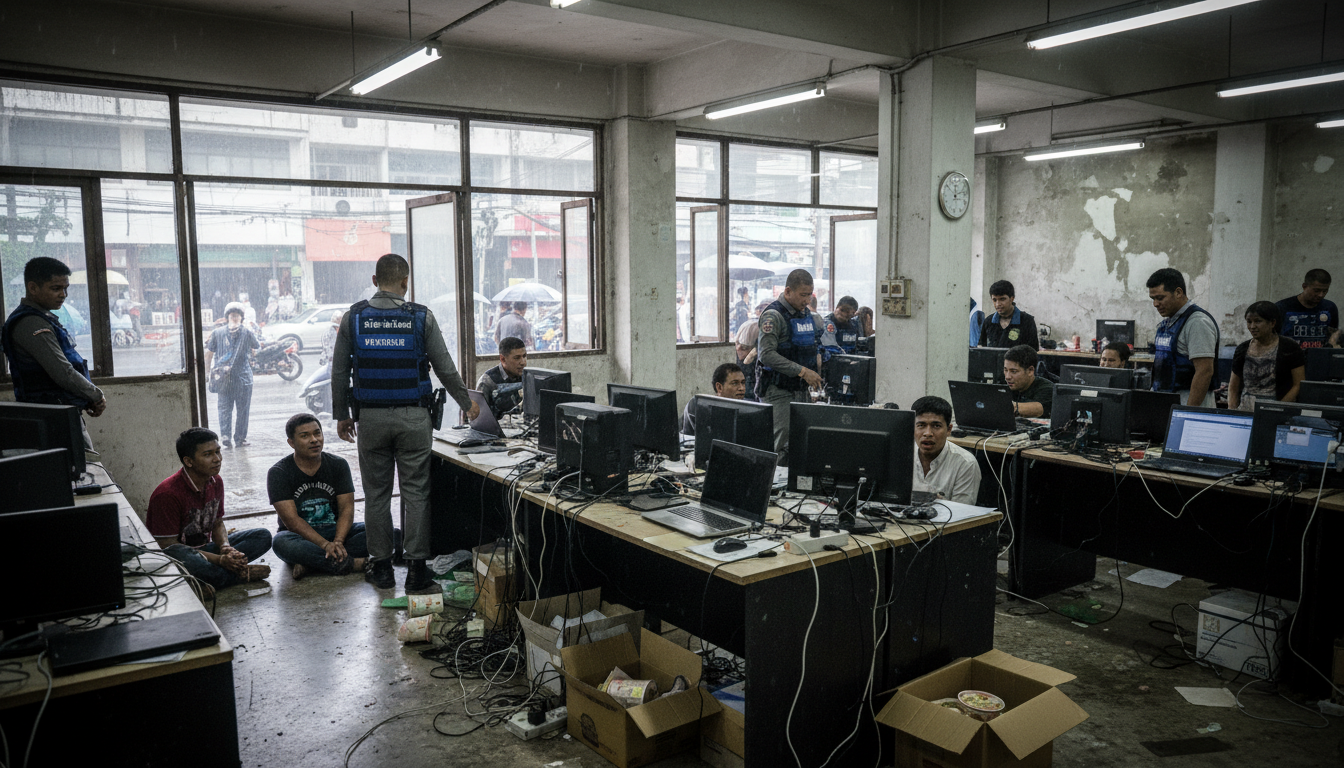
Thai police arrested 39 suspects and seized assets worth more than 500 million baht following raids across 11 provinces. These actions targeted a transnational scam and money-laundering network. Pol Lt Gen Jirabhop Bhuridej, deputy director of the Anti Cyber Scam Centre (ACSC), and Pol Lt Gen Natthasak Chaowanasai, commissioner of the Central Investigation Bureau (CIB), examined seized items during a press conference on a raid of 27 locations, the Bangkok Post reported.
While the seizure of 500 million baht represents a tangible disruption to a criminal operation, it simultaneously highlights the scale of financial flows that sustain these transnational networks. The fact that raids spanned 11 provinces indicates that the infrastructure for these scams is distributed and adaptable, rather than centralized. Such decentralization renders complete eradication challenging, as law enforcement must coordinate across multiple jurisdictions. This latest operation follows a pattern of recent enforcement efforts; the Bangkok Post earlier reported the arrest of 11 foreign suspects in a nominee crackdown.
The structural implication of this enforcement is that the demand for such illicit services, or the susceptibility of the population to them, remains sufficiently high to sustain intricate criminal enterprises. These groups routinely exploit technological advancements and porous borders to conduct their activities. What happens to the operational model of these transnational groups once key nodes are removed? Evidence suggests these networks often reconfigure, rather than collapsing entirely. This generates a continuous cycle of detection and disruption, rather than definitive resolution.
Police across the Asia-Pacific region confront similar issues. The Star reported in September 2026 that nearly 5,000 scam suspects were detained in a crackdown; 77 police officers were disciplined in connection. This indicates both the broad scope of the problem and potential internal vulnerabilities within enforcement agencies. Earlier in 2026, the South China Morning Post detailed how China arrested 16 individuals in drone hacking cases in May. In July, Hong Kong police arrested 13 people in a drink and drug driving crackdown.
While the recent Thai operation removed 39 suspects and considerable assets from circulation, the underlying conditions that enable transnational scams and money laundering persist. The availability of digital tools, coupled with regional connectivity, means that as one network is dismantled, others may emerge or existing ones adapt. The challenge for authorities, therefore, shifts from individual arrests to altering the structural incentives and capabilities that allow these operations to thrive. The outcome of such efforts now depends on sustained, coordinated policy interventions that extend beyond immediate enforcement actions.
Sources
Newsletter
Pacific Daily
A curated briefing from Thailand, Asia-Pacific and the world.