Taiwan's Missile Testing Expansion Reflects Broader Regional Adaptation
The planned commissioning of dedicated missile testing facilities by Taiwan's army signals a deepening commitment to self-reliant defense capabilities, a pattern emerging across the Indo-Pacific.
SINGAPORE
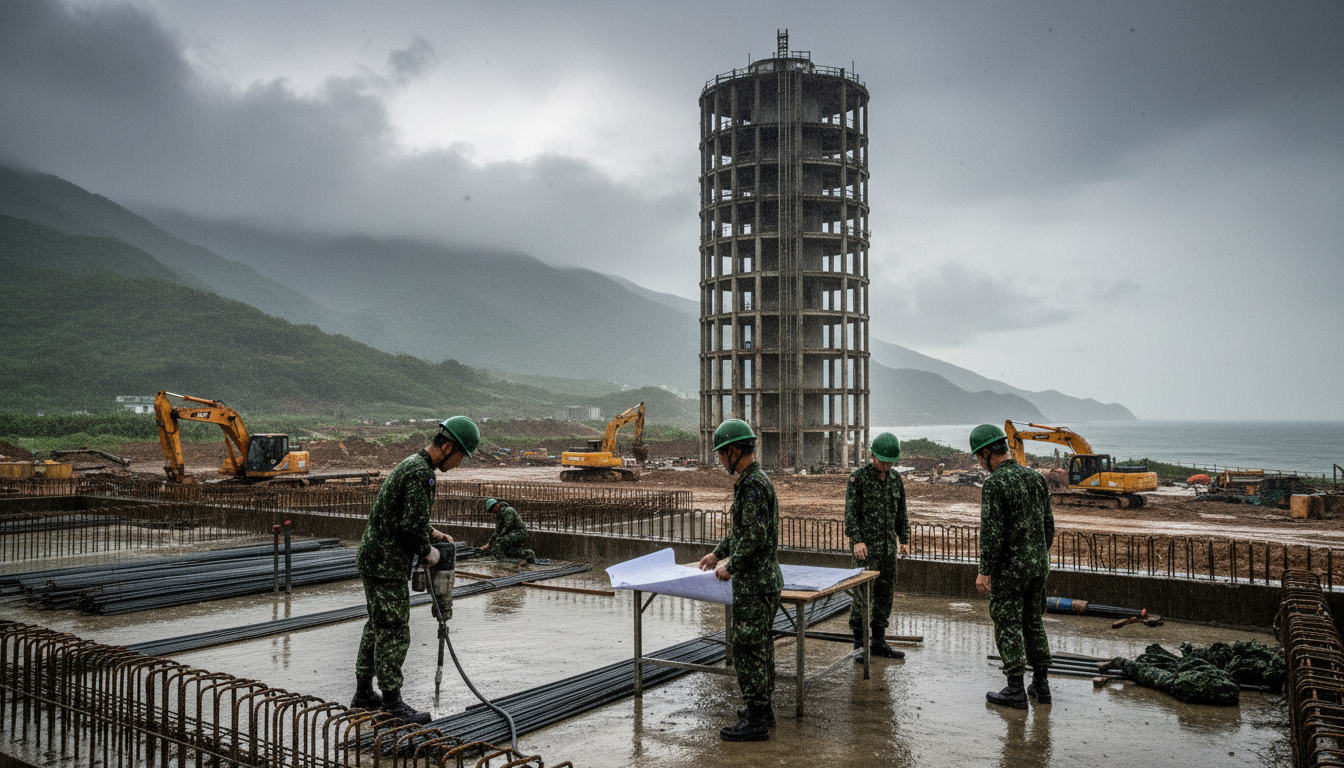
Taiwan’s army plans to commission the National Chungshan Institute of Science and Technology (NCSIST) to construct dedicated testing facilities for its indigenously developed Lu Chien II ("Land Sword II") missile systems. This initiative, budgeted at more than NT$295 million (US$9.27 million), points to a strategic imperative. The need for these new facilities has become apparent as the navy’s existing missile inspection and testing capacity experiences increasing strain. This strain is attributed to the growing demand linked to next-generation light frigates and Kang Ding-class frigates, alongside the production and testing requirements for Hai Chien II ("Sea Sword II") missiles.
The development of independent missile testing infrastructure in Taiwan occurs against a backdrop of evolving defense postures across the Asia-Pacific. While Taiwan’s immediate concern is its own self-sufficiency, the decision to invest significantly in domestic testing capabilities mirrors broader trends. Regional actors are increasingly prioritising internal defense production and verification as external security dynamics shift. This focus on indigenous capabilities, moving beyond reliance on foreign suppliers for critical validation processes, implies a longer-term strategic calculation for national defense planning.
Historically, many nations in the region have sought off-the-shelf military hardware or relied on foreign assistance for advanced testing. Taiwan’s move to expand its testing infrastructure, especially for indigenously developed systems like the "Land Sword II" and "Sea Sword II" missiles, represents a departure from this past reliance. It highlights a determination to control the entire lifecycle of key defense assets, from development to production and validation. This is not merely about increasing capacity but about ensuring the precision and reliability of systems deemed crucial for national security without external dependencies. Controlling the full lifecycle of these assets enables a robust defense posture.
The implications for regional stability are complex. On one hand, a more self-reliant Taiwan could be seen as enhancing its deterrent capabilities, potentially contributing to a more stable balance of power. Such moves could be interpreted by some as escalatory, however, potentially prompting reciprocal actions from other regional players. The emphasis on independent verification distinguishes this development from a simple arms buildup; it is a structural enhancement of a defense ecosystem rather than an immediate increase in deployed weaponry.
While this investment's direct impact is on Taiwan’s defense logistics, it reflects a wider regional shift towards more independent defense industrial bases. This pattern suggests that nations are re-evaluating their security architectures in light of geopolitical changes and a desire to reduce vulnerabilities inherent in global supply chains for defense technology. The constraint that remains unresolved is how this drive for national self-reliance in defense will ultimately shape regional security cooperation and interoperability, given differing strategic priorities across the diverse Asia-Pacific landscape.
Sources
Newsletter
Pacific Daily
A curated briefing from Thailand, Asia-Pacific and the world.