Tactical Gambles and Weather Friction at St George's Park
Australia altered selection doctrine for seam conditions, yet external delays left strategic intent untested against South Africa.
SINGAPORE
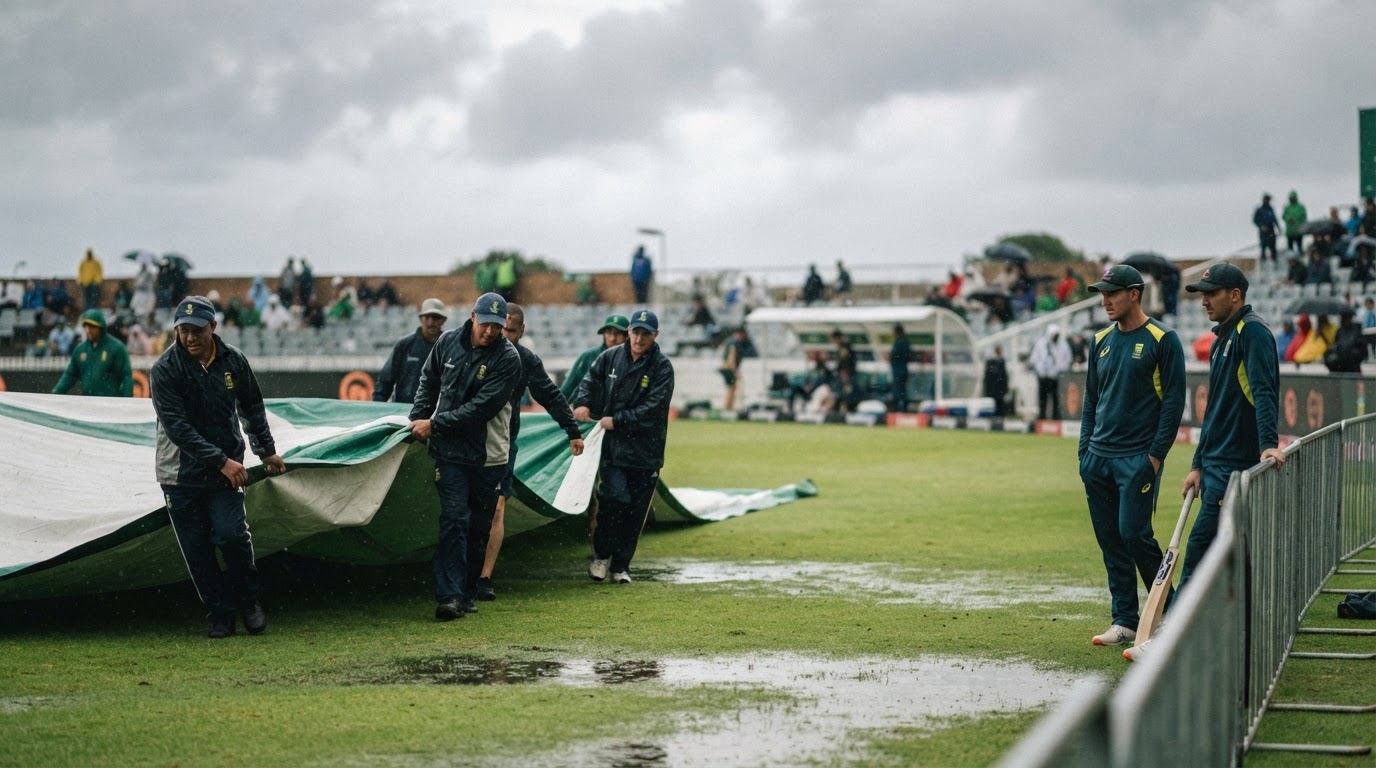
Physical capability commitments in five-day international cricket lock tactical systems into structural pathways before match friction can validate underlying assumptions. At St George’s Park in Gqeberha, rain curtailed play on the first day of the second test against Australia on Sunday, Oct 18, after an initial two-hour delay. The weather disruption left strategic plans untested on both sides. Australia won the toss and elected to bowl, seeking to exploit surface moisture under persistent cloud cover. Instead of testing South Africa over an extended period, the weather reduced the morning exchange to twenty-seven minutes of live action before players left the field for an early lunch. Environmental friction thus interrupted the contest before either team could establish operational dominance.
The critical tactical development occurred prior to the toss, when Australia altered their bowling attack by inserting Scott Boland to replace Nathan Lyon. Omitting an established frontline spin bowler represented an aggressive institutional calculation. Touring management wagered that atmospheric moisture and seam-friendly turf would generate rapid top-order dismissals, outweighing the eventual requirement for spin on deteriorating pitches. Scott Boland provides disciplined line-and-length seam pressure, a capability tailored for heavy overhead conditions. By deploying an additional fast bowler, Australia accepted significant structural exposure. If weather clears and sunshine bakes the pitch over subsequent days, the absence of Nathan Lyon will force fast bowlers to absorb extended workloads without rotational respite.
Structural Caution Under Overcast Conditions
Physical selection commitments remain fixed even when environmental disruption suspends tactical execution.
South Africa met that pace adjustment with disciplined defensive restraint. Opening batsman Aiden Markram reached 10 not out, while debutant Marques Ackerman moved to one not out across 5.3 overs, taking South Africa to 11 for no wicket. The opening pair declined to chase deliveries outside off-stump, neutralizing seam movement through patient leave-alone judgment. That measured approach protected top-order wickets during volatile morning conditions, denying Australia the immediate breakthrough required to justify their altered attack. Surviving the opening spell intact preserved structural stability for the home side under testing circumstances.
Restricting the opening session to just 5.3 overs converted Australia's tactical gamble into an administrative pause. Committing to four fast bowlers requires prompt wickets to offset the absence of a frontline spinner. Because covers returned after twenty-seven minutes, Australia expended physical preparation without testing South Africa under heavy skies. The selection decision remains locked on the team sheet, yet ambient friction prevented the bowling unit from exerting structural pressure. Host batters absorbed the abbreviated spell without alarm, shifting early operational pressure back onto Australia's bowling management.
Selection Trade-offs and Workload Pressures
Squad composition highlights divergent strategic approaches between the two sides. South Africa maintained balance across their roster, naming spinner Keshav Maharaj alongside pace spearhead Kagiso Rabada and specialist batsmen Ryan Rickelton and Kyle Verreynne. That selection preserves bowling variety across changing conditions over five scheduled days of play. Australia, conversely, staked their tactical blueprint entirely on immediate surface assistance. Omitting Nathan Lyon creates an acute operational imbalance if the pitch hardens and offers little seam movement. Replacing frontline spin with seam capability reduces tactical flexibility when overs accumulate and physical fatigue sets in.
Touring sides regularly balance short-term environmental indicators against long-term operational wear. Australia chose immediate tactical leverage, yet rain delays curtailed the very session meant to validate that choice. South Africa navigated the abbreviated morning burst without loss, leaving Australia committed to a four-seam strategy whose structural viability remains constrained by the weather. Managing bowler workloads over upcoming sessions presents an unresolved operational problem if conditions stabilize. Until play resumes under clear skies, the strategic wisdom of benching Nathan Lyon remains an open question at St George’s Park.
Sources
Newsletter
Pacific Daily
A curated briefing from Thailand, Asia-Pacific and the world.