Singapore's orchestral ambition: a subtle shift in cultural consumption
The Singapore Symphony Orchestra's recent performance of Shostakovich’s Fourth Symphony suggests a changing appetite for demanding art, but its broader implications for regional cultural development remain nuanced.
SINGAPORE
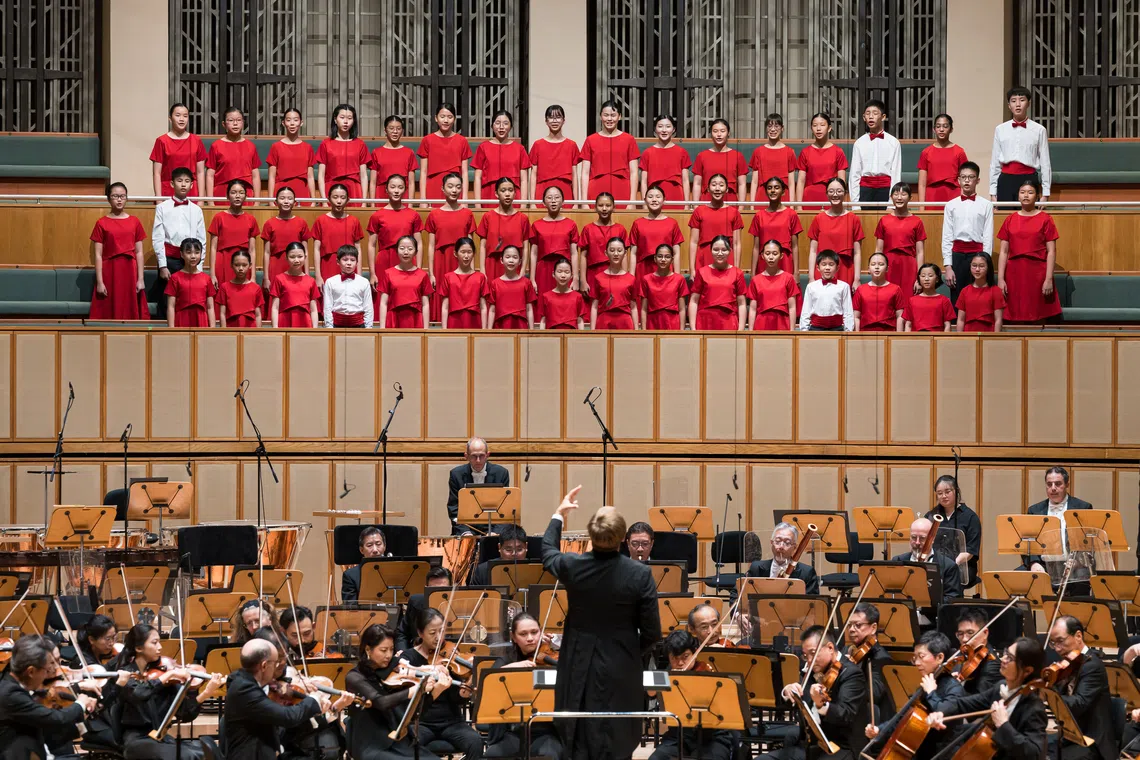
The Singapore Symphony Orchestra’s presentation of Shostakovich’s Fourth Symphony required over 120 musicians, including multiple woodwinds, brass, two harpists, and nine percussionists. This complex work, performed under Vasily Petrenko, was part of a concert that also featured Arvo Pärt's children's cantata and Saint-Saëns’ cello concerto.
The scale of this performance, described as a Singapore premiere, points to a subtle, yet significant, shift in cultural consumption patterns within the city-state. Shostakovich's Fourth, a composition contrasting Socialist Realist optimism with the composer’s critique of oppressive society, is not a piece for casual listening. Its inclusion in the SSO’s repertoire, concluding their journey through the composer’s orchestral symphonies, signals an orchestra aiming to engage with more challenging, perhaps less immediately accessible, works.
Historically, cultural programming in growing urban centers often prioritizes broad appeal and educational outreach. The presence of a children’s chorus performing Pärt's 'Our Garden' alongside a major symphonic premiere suggests a strategy to cultivate a new generation of audience members while simultaneously offering advanced repertoire to seasoned patrons. This approach balances accessibility with artistic challenge, a dynamic that can shape long-term cultural habits.
However, attributing this singular orchestral event as definitive proof of a widespread shift across the entire Asia-Pacific region, or even within Singapore itself, would be premature. The 'growth' highlighted in the source's headline might refer as much to the orchestra's institutional capacity to stage such a large-scale work as to a guaranteed surge in audience demand for complex symphonic music. While an orchestra’s readiness to perform such demanding pieces speaks to its artistic ambition and technical capability, it does not automatically translate into a corresponding readiness from the general public.
Moreover, the economic realities of arts organizations in the region often necessitate a careful balance between artistic integrity and commercial viability. While performances of this magnitude showcase the SSO's prowess, the broader trend in entertainment consumption often leans towards more immediate and less demanding forms. The success of a single, albeit ambitious, concert does not inherently overturn this wider cultural tendency.
The question of who actively sought out this specific performance, beyond established classical music enthusiasts, provides a crucial layer of context. Did the event draw new audiences, or primarily serve to deepen the engagement of an existing, albeit growing, niche? The image of an orchestra filling a stage with over a hundred musicians, tackling a formidable symphony, presents a distinct form of public engagement, one that requires a different kind of attention than other forms of cultural experience. This observation suggests that the habit of actively seeking out challenging artistic expressions might be expanding, perhaps quietly, among certain segments of Singapore’s urban population.
Sources
Newsletter
Pacific Daily
A curated briefing from Thailand, Asia-Pacific and the world.