SIA's Dining Refresh Signals Premium Competition, Not Revenue Certainty
Singapore Airlines is investing in passenger experience across all cabin classes, a move that focuses on market share and perception amidst rising industry pressures.
SINGAPORE
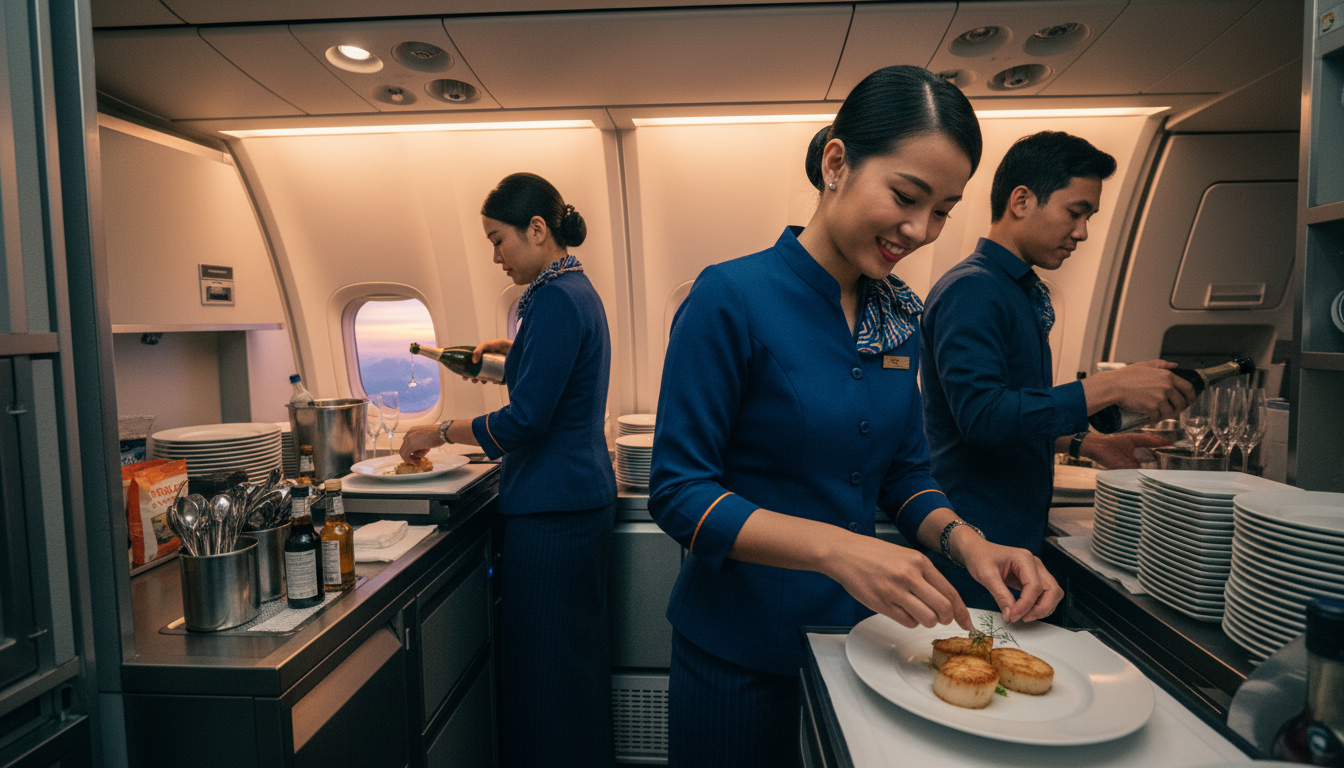
Singapore Airlines (SIA) has announced an overhaul of its in-flight dining program, introducing more than 100 new and refreshed dishes across every cabin. This initiative, which began progressively rolling out dishes under its SIA Chefs’ Selection this October and will see further changes from November 2026, also includes updates to beverages, service ware, and meal presentation. On the surface, this appears to be a straightforward enhancement of the passenger experience.
However, the extensive investment across all cabin classes, including economy, suggests a strategic response to a highly competitive premium long-haul market, where maintaining an edge on passenger perception is paramount. Offering dishes such as poached lobster and beef short rib sambal percik, as reported by CNA Lifestyle, indicates a push to differentiate in an environment where competitors are also improving their offerings. The previous revamp of premium economy class in March 2024 with more choices and bigger portions points to a consistent strategy of incremental upgrades.
Such investments are not minor. The cost of developing new menus, training cabin crew, procuring specialized service ware, and managing catering partners for over 100 dishes across a global network is substantial. While these changes may solidify SIA's reputation for quality, the direct financial return on such expenditures is often difficult to isolate. Improved dining contributes to overall passenger satisfaction, which can foster loyalty and command a price premium. Yet, the price sensitivity of even premium travellers means that these enhancements must translate into tangible booking decisions to justify their cost.
This aggressive push for service differentiation comes even as SIA reported a quarterly net loss in July 2026, as noted by The Straits Times. This creates a tension between the immediate financial performance and long-term brand building. For an airline operating with fine margins, every investment, particularly one extending to all cabin classes, needs a clear pathway to profitability or market share gain. This suggests that SIA views its premium offering as a critical bulwark against competition, potentially from Middle Eastern carriers or other Asian airlines expanding their long-haul premium products.
For airlines, passenger experience initiatives like these are often a cost of doing business in the premium segment, rather than a direct profit driver. The question then becomes: at what occupancy rates and fare levels do these enhanced dining experiences become sustainable? The benefits accrue largely to passengers in terms of improved meal quality, but the airline carries the operational burden and capital expenditure. The upgrades are designed to attract and retain high-yield passengers, whose choices are influenced by perceived value and exclusivity.
The real test of this strategy will be its impact on forward bookings and average revenue per passenger, especially in the premium segments. If these dining enhancements can secure a higher load factor or allow for slightly higher fares compared to competitors, the investment may pay off. Otherwise, it risks becoming an expensive upgrade that primarily serves to maintain, rather than grow, market position. The outcome now depends on how effectively SIA can communicate the value of these improvements to its target demographic and whether that value translates into consistent revenue growth amidst fluctuating fuel prices and economic headwinds.
Sources
Newsletter
Pacific Daily
A curated briefing from Thailand, Asia-Pacific and the world.