New York Sexual Violence Protests Signal Shifting Accountability Demands
A rally in New York City against sexual violence, marked by the 'I Am Jane Doe' banner, reflects an ongoing push for institutional accountability that could influence regional activism.
SINGAPORE
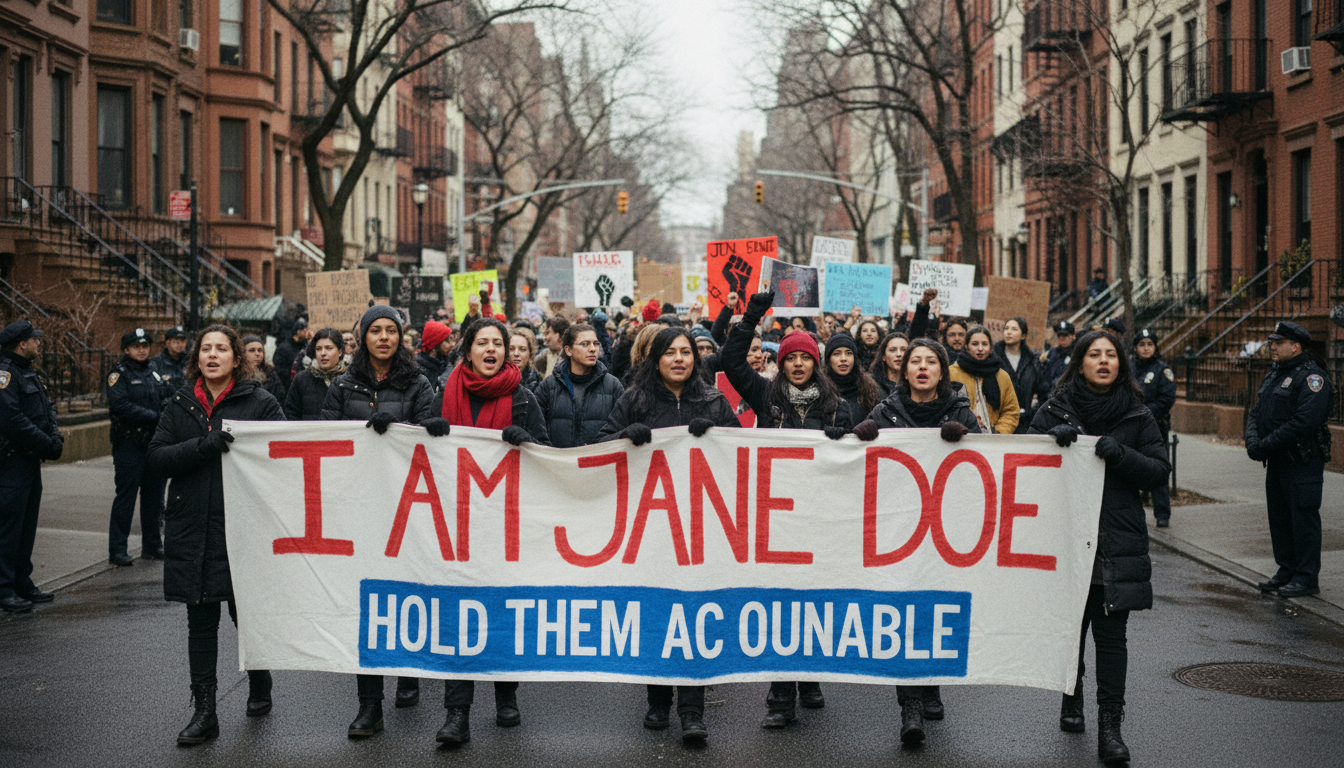
Protesters gathered in New York City on October 8, 2026, demanding tougher action against sexual violence. This demonstration, drawing a crowd to the New York State Supreme Court building in Manhattan, centered on a Cornell University student's lawsuit alleging gang rape by fraternity members. The social media banner, "#StopSexualViolence: From the Frat House to the White House," articulated a broad call for systemic change.
Such public mobilizations are not isolated to the United States. Similar protests have occurred in the Asia-Pacific region, for instance, against sexual assault on the Anna University campus in Chennai in December 2024. While the immediate trigger for the New York protest involves a specific legal case, the broader demand for accountability, highlighted by phrases like "Death to rape culture," points to a persistent structural challenge within educational institutions and society at large. The repeated need for these demonstrations, as expressed by a protester stating, "It's entirely frustrating that we are here in 2026 and still dealing with this," indicates that existing mechanisms are perceived as insufficient.
The incentive for these rallies appears to be a desire to force institutional responses where legal or internal processes are seen as failing. The Cornell case, a student suing fraternity members, demonstrates a shift towards direct legal confrontation combined with public pressure. This dual approach aims to elevate specific grievances into broader systemic issues, pressuring entities beyond the immediate alleged perpetrators. The use of a collective identity, "I am Jane Doe. Be afraid of me," aims to amplify individual experiences through solidarity, a common tactic in social movements.
From a structural perspective, these protests highlight the gap between stated institutional policies and their effective implementation. The focus on “tougher action” implies a perception that current responses are weak or slow. For Thailand and other Asia-Pacific nations, where discussions around gender-based violence and institutional responsibility are evolving, these events offer a blueprint for citizen-led pressure. The rapid dissemination of narratives via social media, such as the #StopSexualViolence banner, transcends national borders, influencing local advocacy groups and shaping public expectations of justice.
However, the ultimate impact of such protests often depends on sustained engagement and the willingness of institutions to respond with concrete policy changes rather than symbolic gestures. While rallies generate visibility and express collective outrage, their capacity to fundamentally alter power dynamics or ensure accountability for past actions is not guaranteed. The challenge remains in translating public demand into enforceable reforms and ensuring those reforms are applied equitably. The outcomes will depend on whether this public pressure can influence legislative bodies and institutional leaders to enact and uphold more stringent measures.
Sources
Newsletter
Pacific Daily
A curated briefing from Thailand, Asia-Pacific and the world.