Fiji Turns to Wellington to Rebuild an Intelligence Apparatus Under Strain
A six-month partnership with New Zealand highlights institutional vulnerability across Pacific security architectures as external pressures mount.
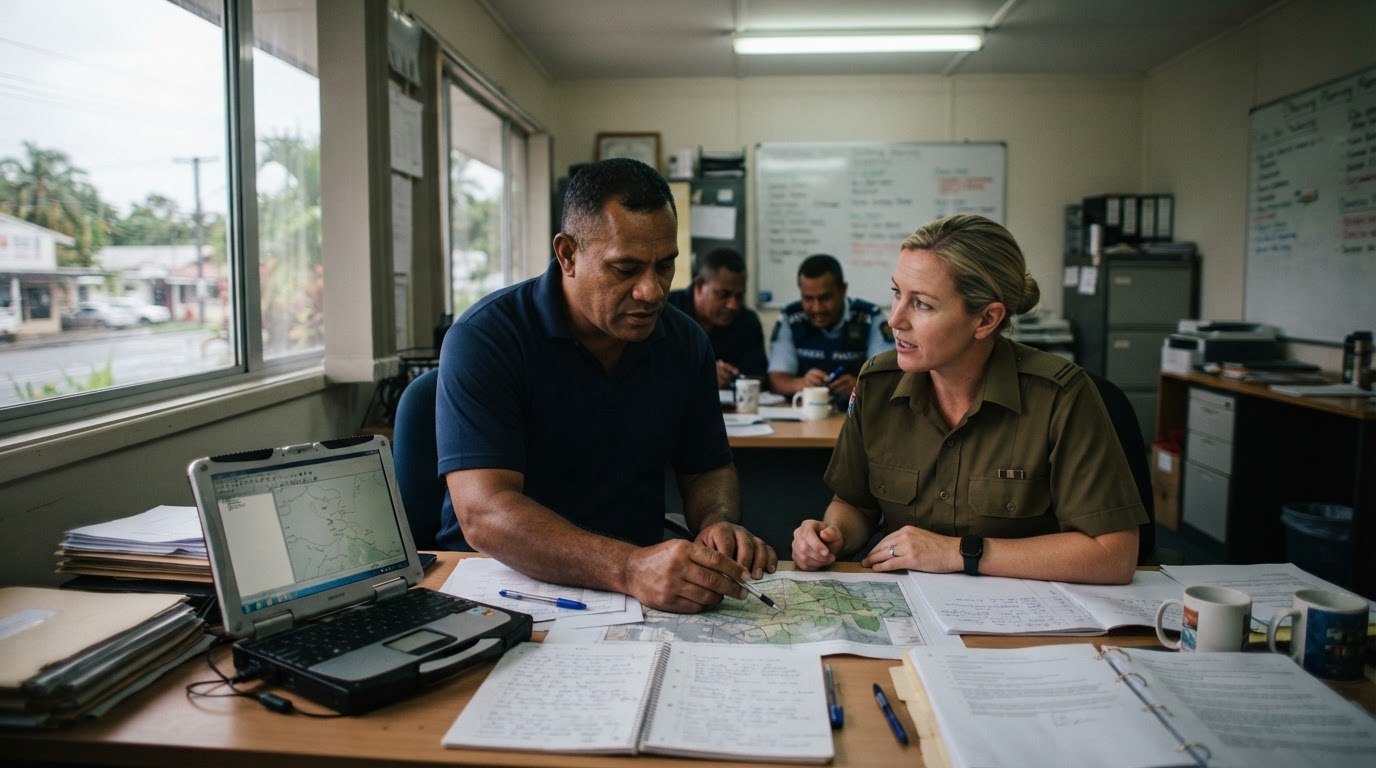
Bilateral security pacts in the Pacific have traditionally favoured high-level political communiqués over technical, interoperable intelligence machinery. That administrative routine has reached an impasse. In Suva, the Fijian government has formally commissioned the New Zealand Security Intelligence Service to conduct a six-month structural review of its national security and intelligence apparatus. The bilateral initiative follows public allegations from the United States pointing to Chinese infiltration across Fijian state systems. According to official announcements, the review is designed to assess existing intelligence structures, generate evidence-based models for reform, and dismantle institutional fragmentation across domestic agencies.
The stated goal is technical, yet the core question is operational: what capability actually alters under this mandate? Dispersed bureaucratic architectures have long left Pacific island states reliant on uncoordinated ministries to monitor borders and counter foreign interference. Fiji's internal intelligence functions remain divided among separate civilian and police bodies, creating systemic gaps in record-keeping and threat assessment. The six-month programme targets these exact deficits, evaluating governance, operational parameters, and workforce capabilities while attempting to build common standards for information-sharing with international counterparts.
Bureaucratic Realignment
Geopolitical friction provides the obvious catalyst for the timing of this engagement. In August, the New Zealand Security Intelligence Service warned publicly that foreign espionage in the Pacific was expanding, specifically alleging that China continues to conduct intelligence operations in New Zealand at scale. When the United States subsequently alleged Chinese infiltration within Fijian agencies, Suva chose not to mount an insular defence of its domestic apparatus. Instead, Fijian authorities elected to anchor their internal administrative reassessment to Wellington’s intelligence apparatus.
This decision suggests a tactical shift in how Suva manages external pressures. Engaging New Zealand allows Fiji to address external security concerns while avoiding the direct adoption of a major power's intelligence footprint. By formalising administrative ties with a traditional regional actor, the Fijian administration aims to standardise its information security without openly declaring an alignment against Beijing. Domestic resistance, however, presents an immediate operational friction. Administrative reorganisations frequently founder when career officials guard established jurisdictions, particularly where new intelligence-vetting procedures threaten entrenched discretion.
The Limits of Coordination
Beyond Suva, the partnership exposes an unresolved structural contradiction across the wider Asia-Pacific perimeter. Regional capitals consistently demand sovereign independence in foreign policy, yet their fragmented domestic bureaucracies struggle to detect sophisticated foreign espionage without external technical assistance. Small state administrations must supervise expansive maritime zones and complex financial networks, leaving them structurally vulnerable to covert state influence when internal coordination breaks down. Fiji’s turn to Wellington indicates an explicit acknowledgement that domestic administrative incoherence represents a critical security risk.
Overcoming administrative inertia within a six-month consultancy remains improbable. External technical recommendations cannot manufacture institutional cohesion where inter-agency trust does not exist. Fiji seeks to overhaul internal vetting and intelligence distribution while attempting to preserve diplomatic equilibrium with both China and the United States, leaving the apparatus dependent on foreign technical standards that its own bureaucracy has yet to absorb.
Sources
Newsletter
Pacific Daily
A curated briefing from Thailand, Asia-Pacific and the world.