Fan Chang Tien and the Displacement of the Ink Tradition
A major retrospective at National Gallery Singapore shows how migration between Shanghai, Bangkok, and Singapore loosened classical brushwork into a regional language.
SINGAPORE
Ink painting begins with submission. Before an artist attempts any departure, the hand must repeat canonical brushwork until personal impulse yields entirely to lineage. For decades, traditional ateliers measured aesthetic integrity through fidelity to ancestral models, treating geographical displacement as an incidental biographical detail rather than an engine of stylistic change. That rigid assumption falters before the historical itinerary of ink master Fan Chang Tien. Transplanted across maritime trade routes, classical brushwork could not remain immune to the physical pressure of new environments.
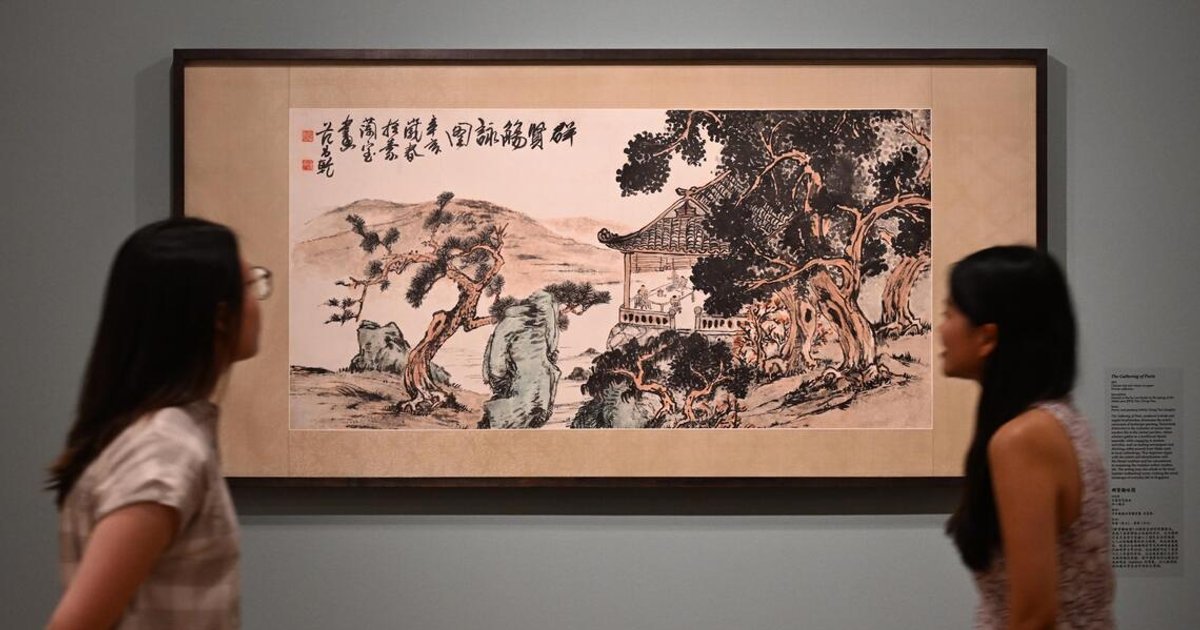
National Gallery Singapore has mounted the first major institutional survey dedicated to the Guangdong-born painter. Titled Fan Chang Tien: Rhythm Of The Southern Brush, the exhibition gathers more than 80 works alongside archival records and carved seals. The preview featured The Gathering Of Poets. By assembling these materials, curator Lim Shujuan organizes a narrative tracking an artistic trajectory from Shanghai to Bangkok and Singapore. This curation reframes what was once considered a quiet diasporic transition into an active formal evolution.
On the surface, the survey operates as an institutional enshrinement of a revered teacher whose pupils shaped Singapore's post-independence visual identity. Yet the deeper consequence lies in the physical evidence of how dislocation altered classical rules. When Fan departed mainland China, he carried classical training steeped in centuries of scholar-artist conventions. His subsequent decades in Bangkok and Singapore forced an unavoidable dialogue with equatorial humidity and unfamiliar foliage.
From Shanghai to Bangkok
Ink masters moving south during the twentieth century faced a distinct dilemma. Mainland bamboo painting relied on historical templates established in temperate river valleys, where seasonal spareness dictated brush economy. In Southeast Asia, vegetation grows dense and damp, defying the quiet reticence of classical Chinese compositions. A painter working between Bangkok and Singapore could not observe tropical groves through northern conventions without feeling friction between inherited ink and living terrain. The environment demanded a response.
The physical journey through Southeast Asia dismantled the pristine isolation of continental ink traditions.
Confronting that environmental shift, Fan gradually loosened his structural orthodoxy. The National Gallery exhibition illustrates this transition across decades of bamboo and landscape paintings, showing how strict balances yielded to looser, more abstract brushstrokes. Skeptics may counter that Fan Chang Tien remained an essentially conservative literati practitioner who never completely severed ties with classical syntax. His late hospital paintings demonstrate that ancestral ink idioms remained his anchor until the end. That conservative foundation, however, makes his gradual concessions to his adopted home far more compelling.
The Southern Brush
Preservation and rupture coexist within the same hand. Fan did not merely import Shanghai ink technique intact into equatorial studios to reproduce orthodox motifs for expatriate patrons. Instead, the physical reality of migration eroded scholastic rigidity, yielding an ink vocabulary responsive to southern latitudes.
His pedagogy transmitted this tempered balance directly to disciples such as Henri Chen Kezhan and Chua Ek Kay. Through their subsequent practices, the southern brush evolved from an imported dialect into a regional aesthetic vernacular that directly influenced modern art across the region. What was preserved was the moral discipline of the brush, but the insular certainty of continental tradition was quietly displaced. The resulting pedagogy encouraged students to absorb rigorous classical fundamentals without treating canonical rules as an unalterable border.
Major museum retrospectives often treat migrant painters as static vessels of ancestral heritage. When civic institutions classify diaspora artists purely through the lens of lineage preservation, they overlook how survival in unfamiliar cities dismantles orthodox craft. Fan Chang Tien navigated displacement by letting equatorial reality seep into his calligraphic ink. Traditions do not endure through defensive mimicry. They survive by surrendering their certainties to the places they inhabit.
Sources
Newsletter
Pacific Daily
A curated briefing from Thailand, Asia-Pacific and the world.