Emergency Rooms Refuse to Linger
Marcus Ong’s election to the United States National Academy of Medicine brings clinical logistics into institutional focus
SINGAPORE
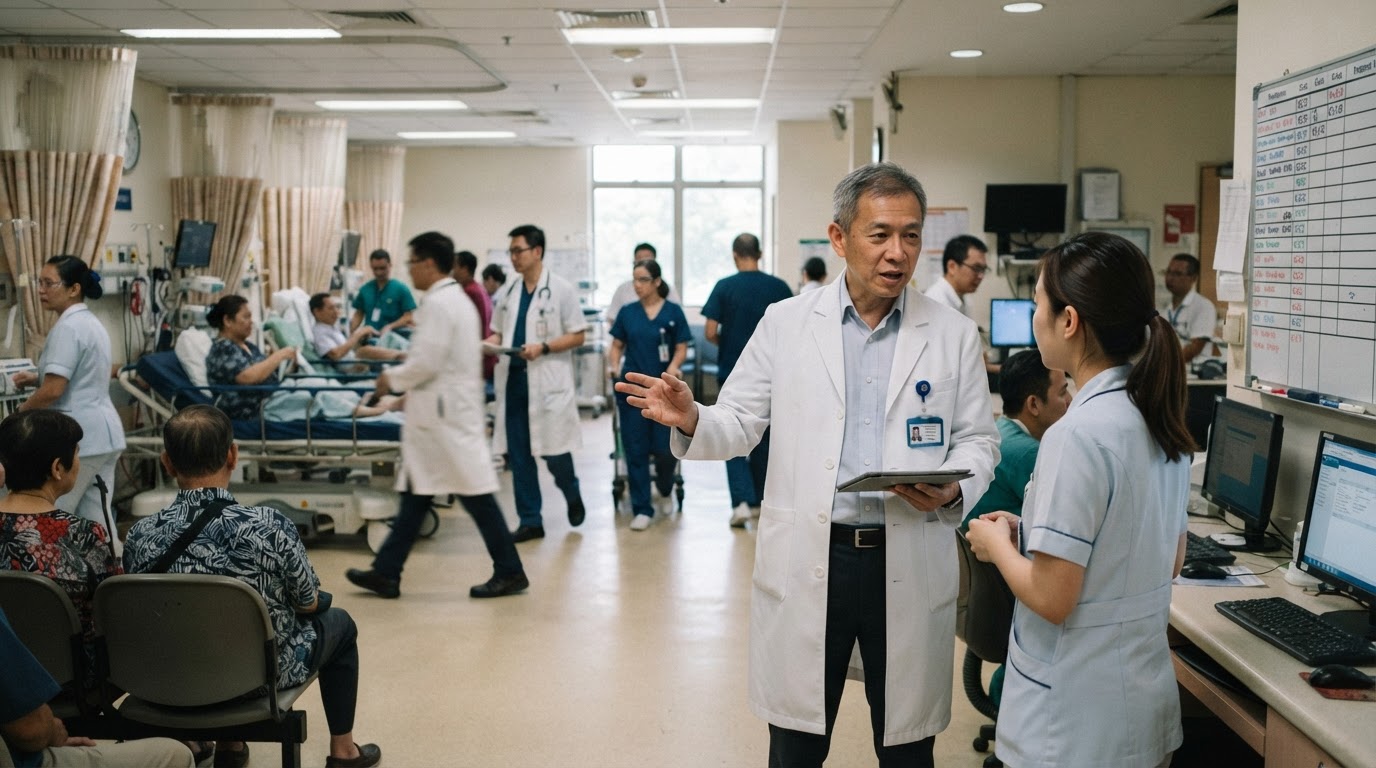
Ambulance bays operate on a simple spatial geometry: rapid vehicular arrival, linear deceleration, immediate transfer under wide cantilevered roofs, and an absolute rejection of pedestrian delay. The emergency entrance at Singapore General Hospital offers no space for contemplative repose. Steel sliding barriers, concrete approach ramps, and linoleum triage corridors channel human bodies through rigorous physiological prioritization. Nothing in this floor plan invites permanence. It is an architecture calculated entirely around transit.
That functional austerity forms the physical backdrop to institutional recognition. On October 20, Professor Marcus Ong Eng Hock, Senior Consultant in the Department of Emergency Medicine at SGH, became the first Singaporean emergency medicine specialist elected to the United States National Academy of Medicine. He is the fourth Singaporean to join the Academy. Elite medical honors in the United States typically congregate around laboratory science, molecular discovery, and the expansive capital architectures of university campuses. Acute clinical work, practiced in high-velocity municipal bays, rarely occupies that seat.
The Architecture of Acute Flow
Emergency medicine is fundamentally a discipline of threshold management. The clinical footprint designed for cardiac arrest and critical trauma cannot afford decorative perimeter walls or confusing circulation loops. Pre-hospital networks, linking emergency squads such as the Singapore Civil Defence Force directly to resuscitation suites, demand absolute logistical clarity. Every meter between the ambulance bay and the stabilization bay represents time extracted from physiological decay.
Yet medical academies have historically privileged different spaces. Institutions like the National Academy of Medicine draw their traditions from the quiet assembly hall, the lecture theater, and the long-term laboratory bench where research stretches over decades rather than seconds. Professor Marcus Ong has worked across acute resuscitation science and out-of-hospital cardiac arrest registries, translating chaotic street-level interventions into structured clinical standards. The United States National Academy of Medicine elected a clinician-scientist whose primary operational sphere is the public roadside, the ambulance interior, and the crowded hospital entrance.
Skeptics might argue that foreign academic honors alter little on the ground. A citation in the United States does not widen an emergency triage bay, nor does an international title shorten the physical queue of ambulances waiting under tropical humidity on a crowded evening. Academic prestige belongs to the realm of international diplomacy and professional validation. Clinical shifts belong to the concrete floor. That distinction is real. A clinician can hold fellowship in an overseas institution while remaining bound to the relentless spatial throughput of an overloaded urban emergency department.
Unresolved Pressures at the Perimeter
Recognition from abroad also risks obscuring the systemic pressures that acute healthcare facilities face in dense metropolitan settings. High-density urban centers rely on public healthcare compounds that are constantly expanding, retrofitting, and rebuilding to accommodate aging populations. When Singapore General Hospital rebuilds its wings or reconfigures its transit aprons, the design challenge is never purely architectural. Physical space must negotiate acute sudden illness alongside persistent structural congestion.
The election of Prof Ong confirms that emergency medicine has matured from an ad-hoc frontline service into a recognized scientific domain. That intellectual validation remains significant for frontline practitioners. Nevertheless, the spatial tension inside the hospital itself stays unaddressed. While the United States National Academy of Medicine welcomes a clinician-scientist into its formal register, the ambulance ramp at SGH continues to run on immediate triage, where architectural success is measured not by honors, but by how cleanly a human body moves through an unforgiving door.
Sources
Newsletter
Pacific Daily
A curated briefing from Thailand, Asia-Pacific and the world.