Credit Ratings Expose the Fragility of Founder Governance at Nvidia
The decision by S&P Global to place the chip designer on negative watch demonstrates that executive instability carries direct balance-sheet consequences across global supply chains.
SINGAPORE
Institutional capital markets routinely price technological capability through the narrow prism of corporate predictability. When that predictability fractures, the underlying balance sheet faces immediate scrutiny regardless of commercial momentum. On Wednesday, S&P Global Ratings placed the credit rating of Nvidia on CreditWatch Negative, explicitly signaling a high likelihood of a rating downgrade. The rating agency grounded its intervention in rising management and governance risks, puncturing the assumption that operational supremacy insulates a technology leader from basic institutional disciplines.
The formal catalyst was an abrupt leadership cycle at the Santa Clara, California headquarters. Nvidia announced on Monday, November 23, 2026, that it was reinstating Jensen Huang as chief executive officer. S&P Global determined that this rapid sequence—the departure of Huang followed almost immediately by his reinstatement—did not resolve core uncertainties. Specifically, the rating agency stated that the reversal fails to sufficiently answer outstanding questions regarding board oversight of the executive code of conduct.
Institutional Scrutiny Overrides Executive Primacy
Credit assessment is fundamentally an evaluation of structural constraint. Rating agencies measure not merely current revenue generation, but the institutional robustness that prevents arbitrary operational disruption. By targeting board governance and internal behavioural codes, S&P Global made clear that an erratic executive suite introduces material credit risk. When a governing board vacillates on executive tenure within forty-eight hours, oversight ceases to function as a counterweight and becomes a source of volatility.
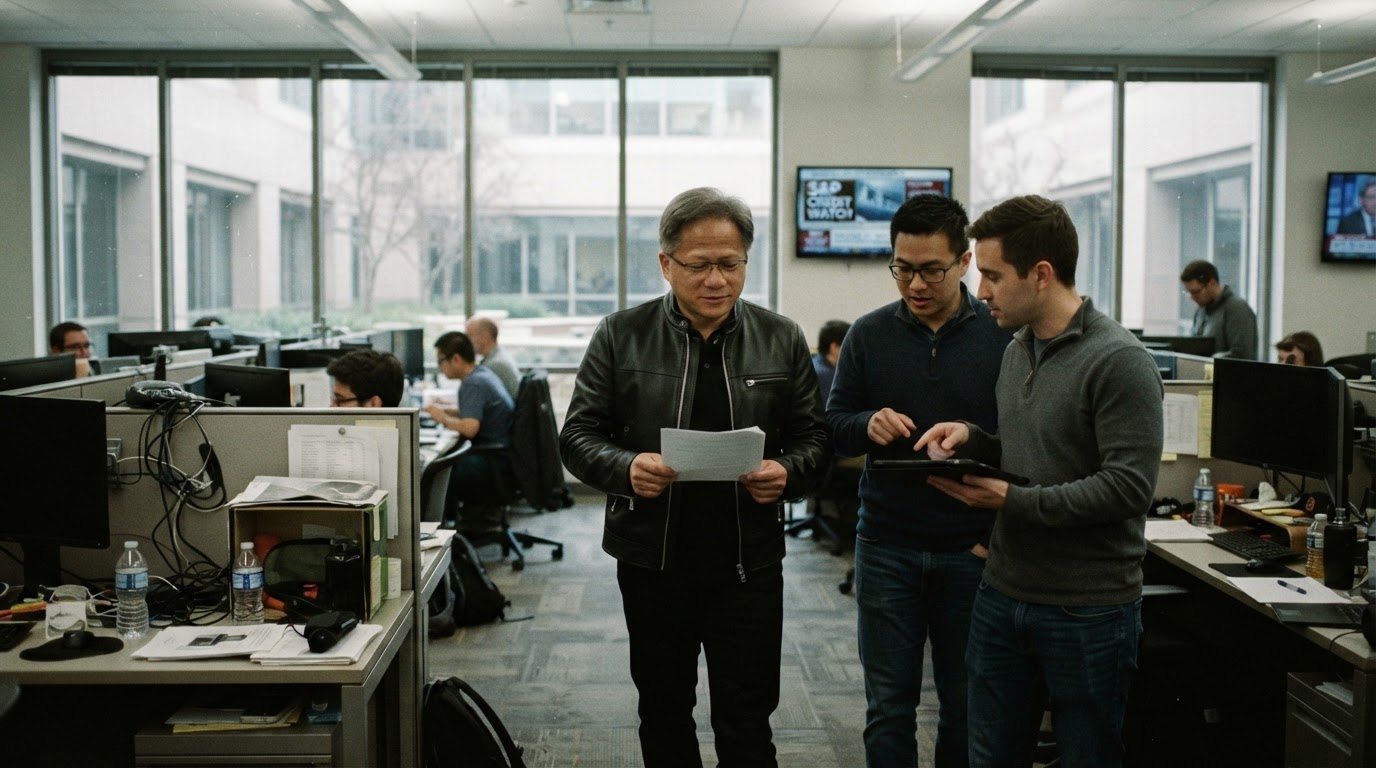
The departure, then reinstatement of Nvidia CEO Jensen Huang does not sufficiently answer its questions regarding board oversight of the executive code of conduct.
Skeptics might argue that leadership continuity under Huang neutralises operational anxiety for customers and financial counterparties. From that operational standpoint, retaining the chief architect of the company avoids the friction of an unplanned transition. Yet credit markets operate on structural duration rather than personality. A board that removes an executive and reverses its decision days later reveals institutional vulnerability, signaling to lenders that internal compliance protocols remain subservient to individual authority.
Structural Implications for the Asia-Pacific Corridor
For enterprise partners and industrial planners across the Asia-Pacific, this rating action presents a sober warning. Regional technology ecosystems rely heavily on contractual stability and predictable multi-year hardware deployment roadmaps. When a primary hardware designer incurs rating pressure, long-term financing costs adjust, capital expenditure allocations face reassessment, and corporate governance standards come under external legal pressure.
Global supply architectures require institutional steadiness from their anchor suppliers. If governance controversies begin to degrade the credit standing of foundational technology firms in the United States, commercial risk transfers directly down the supply chain to international integrators. Hardware manufacturing schedules and infrastructure commitments cannot function smoothly when the parent company's oversight mechanisms remain in flux.
Restoring commercial confidence will demand more than executive reappointments. The rating agency has established that the threshold for stability involves transparent internal control, demonstrable adherence to conduct standards, and independent board authority. Until those oversight questions receive unambiguous answers, the structural tension between founder dominance and corporate accountability remains unresolved.
Sources
Newsletter
Pacific Daily
A curated briefing from Thailand, Asia-Pacific and the world.