Bound Bodies and Sonic Heritage in Singapore
By suspending the Vedic metal band Rudra in stillness, Daniel Kok and Luke George test how living art withstands the pressure of modern displacement.
SINGAPORE
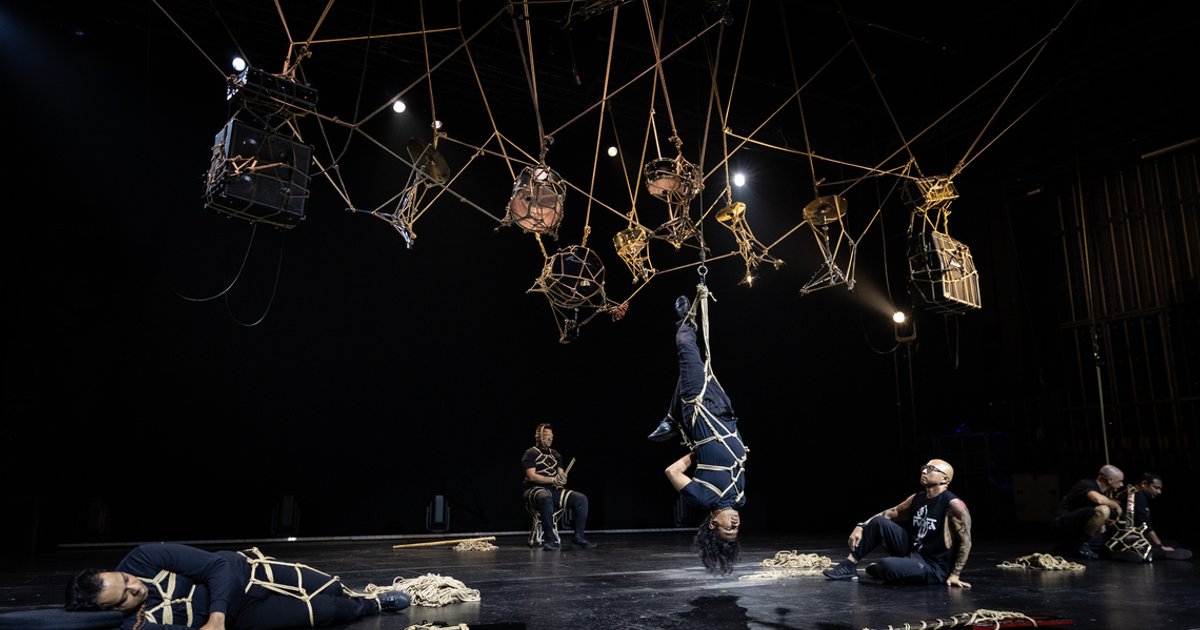
Rope holds tension only when anchor and weight accept mutual constraint. In Still Lives, the durational project staged in Singapore by co-creators Daniel Kok and Luke George, that bare mechanical law became an inquiry into collective endurance. The performance bound the members of Vedic metal band Rudra into living sculptures using shibari rope tying, lifting and lowering their bodies in disciplined suspension. What began as an intimate study in cordage and balance shifted into a broader trial of physical resilience, placing veteran performers inside an enforced stillness while the surrounding city pressed forward in constant motion.
Silence defined the room. Since 1992, Rudra had built a singular presence across the region by fusing Vedic philosophy with extreme metal, anchoring an underground music community through sheer decibel and speed. Suspending that volume introduced an immediate friction. Instead of dominating a hall with amplified percussion and distortion, the musicians submitted to being bound, hoisted, and balanced in deliberate quiet. Physical weight replaced sonic blast. By asking an established musical ensemble to yield its agency to knots and tension lines, the staging turned bodily vulnerability into a site of artistic preservation.
Suspension transfers control.
The Mechanics of Stillness
Every rope structure depends upon complete trust between the rigger and the subject, because even a minor miscalculation carries severe bodily consequence. In Still Lives: Singapore, that delicate exchange pointed to a larger civic reality. Singapore's urban landscape contends with rapid renewal, where physical sites of shared memory routinely vanish to clear ground for new commercial and residential infrastructure. When tangible spaces disappear, communities face the difficult work of deciding how their cultural lineages survive without material anchors. Slowing the pace of live art to the deliberate knotting of fibers and prolonged physical silence offered a direct counterweight to that developmental speed. Suspended above the floor, the band carried themes of multiculturalism, ageing, and memory through sheer endurance. They did not play a single note. Their history was carried by the quiet strain of holding their positions in midair.
Independent subcultures rarely enjoy permanent institutional protection. They exist because individuals commit their bodies to keeping an aesthetic alive against commercial indifference.
Endurance Against Acceleration
Skeptics might argue that rendering an extreme metal band mute inside a contemporary arts presentation neutralizes its subversive energy, reducing an aggressive sonic tradition to a passive gallery spectacle. Stripping musicians of their guitars and drum kits risks reading as an act of aesthetic domestication. Yet that critique underestimates how endurance operates within live performance. Enduring physical suspension demands an alert, rigorous patience that closely reflects the stamina required to sustain an underground musical lineage across three decades of cultural change. The tension visible in the ropes was not ornamental. It measured the real labor of remaining present when the surrounding culture demands continuous adaptation.
When the cordage slackened, the musicians returned to the stage floor and were untied before an audience moved by their collective release. That closing descent offered a telling perspective on cultural transmission across Southeast Asia. Preserving artistic heritage does not require constant volume, nor does it demand retreat into static preservation. Sometimes heritage survives simply by demonstrating how much weight a living community can bear together before letting go.
Sources
Newsletter
Pacific Daily
A curated briefing from Thailand, Asia-Pacific and the world.