Arsenal's Injury Setback Highlights Broader Volatility in Elite Sport
While ostensibly a sporting event, the London club’s double injury incident underscores how globalized high-performance fields grapple with risk management and resource allocation.
SINGAPORE
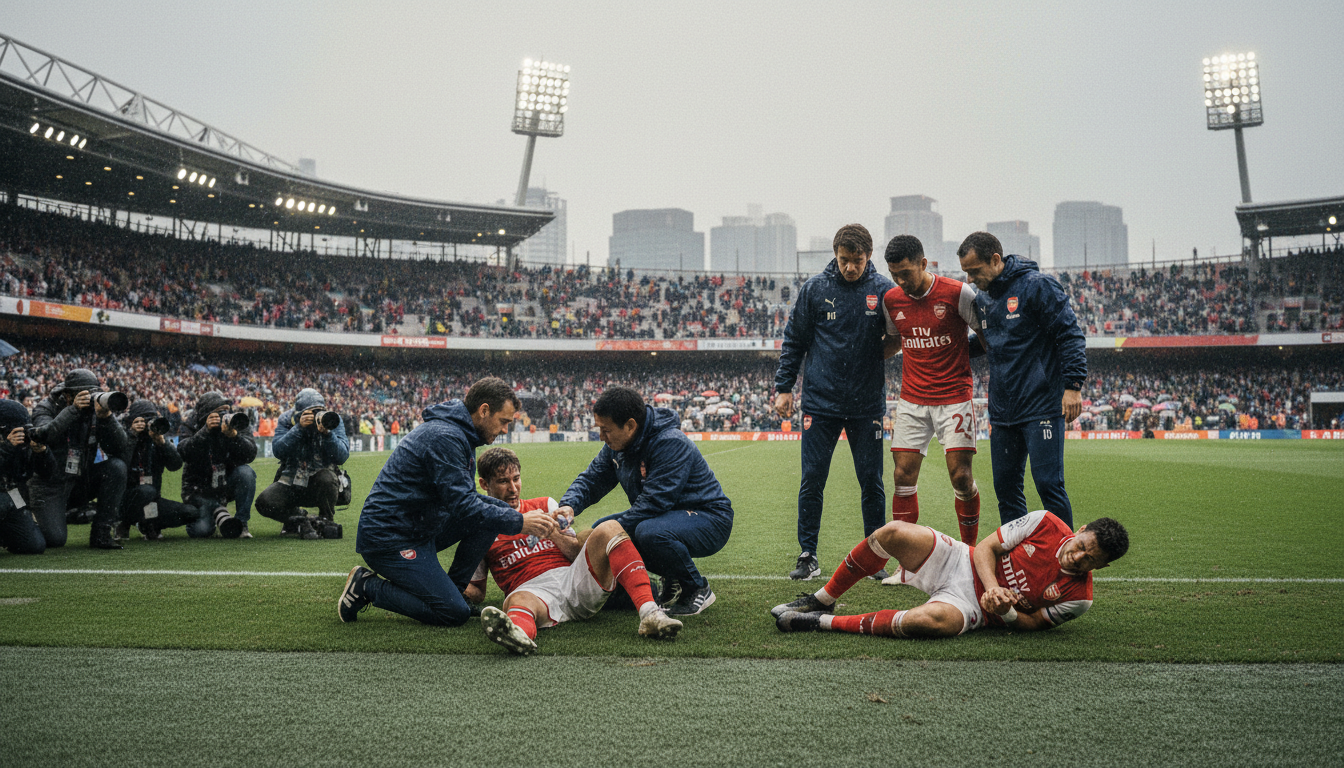
Mikel Arteta, the manager of Arsenal, described a double injury setback for the club as unprecedented in his seven years there. Piero Hincapie, 24, and Martin Zubimendi, 27, sustained injuries in a post-match training session following their Premier League win against Leeds United on Saturday. Hincapie played in the 82nd minute of that match, which Arsenal won 2-1, while Zubimendi was an unused substitute. Both players are now in doubt for the upcoming UEFA Champions League clash against Lille on Tuesday.
This incident, occurring in London, Britain, within a major European football club, may appear distant from immediate Asia-Pacific concerns. However, the nature of elite professional sport, with its intense schedules and reliance on specific, highly valued human assets, creates parallels across various sectors globally. In a system where a single injury can affect team performance and financial outcomes, the vulnerability of key individuals becomes a systemic risk. Arteta’s direct quote, "It's never happened in seven years I've been here. It could happen in the training session the next day," reveals a recognition of inherent unpredictability.
Such an event prompts consideration of how complex, globally interconnected organizations manage unforeseen personnel disruptions. Whether it is a football club, a multinational corporation, or a government agency reliant on specialized expertise, the sudden incapacitation of key individuals can challenge operational stability and strategic planning. The immediate consequence for Arsenal is a potential weakening of its squad for a UEFA Champions League fixture, impacting its competitive standing and commercial interests linked to performance.
The counterargument posits that this is merely a routine occurrence in professional sports, an accepted risk within high-contact athletic endeavors. Athletes face injuries, and clubs manage this through squad depth and medical protocols. This perspective suggests the incident is an isolated event specific to the physical demands of football, rather than indicative of broader systemic vulnerabilities. The club's continued participation in both the Premier League and the Champions League implies an existing infrastructure for managing such occurrences.
Despite this, the manager’s framing of the situation as “unprecedented” within his tenure suggests that the specific combination or timing of these injuries exceeds typical expectations for risk absorption. While football clubs operate with larger squads to mitigate individual absences, a double injury to players in their mid-twenties — Hincapie at 24 and Zubimendi at 27 — during a training session post-match, points to a concentrated moment of vulnerability. This challenges the assumption that all personnel disruptions are equally foreseen or manageable through standard procedures. The need to adapt swiftly to such unforeseen challenges remains a constant for any organization operating at an elite level, irrespective of its core domain or geographic location.
Sources
Newsletter
Pacific Daily
A curated briefing from Thailand, Asia-Pacific and the world.