Why Travel Advisories Expose the Fragile Economics of Religious Pilgrimage
Singapore's security warning on Saudi Arabia highlights how non-refundable overseas hospitality commitments compel travelers to absorb external risk.
SINGAPORE
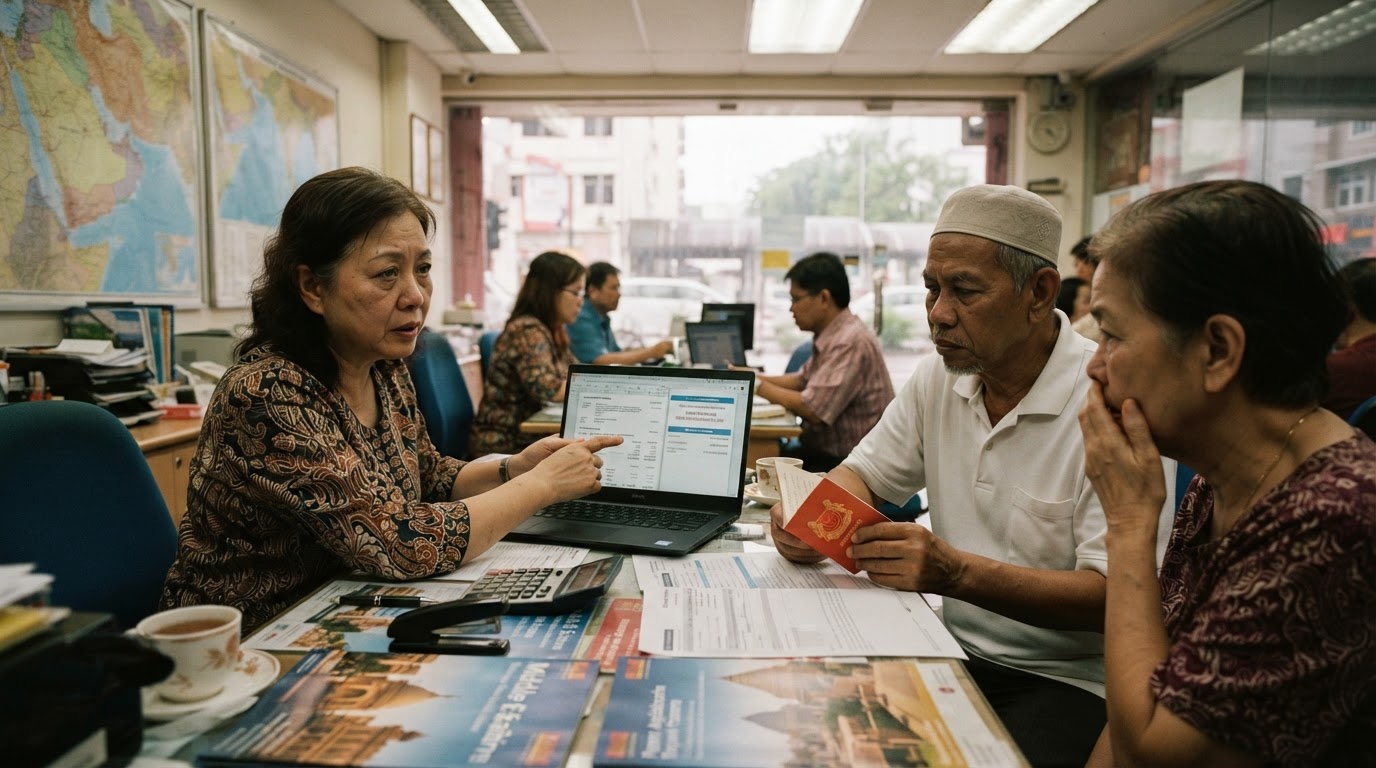
State security warnings and consumer holiday bookings rarely balance on the same financial scale, but faith-based transit operates on an economic ledger entirely its own. When the Ministry of Foreign Affairs advised Singaporeans to defer all travel to Saudi Arabia amid heightened security risks, the immediate response fractured down the middle. Some Singapore pilgrims decided to press ahead with their Umrah plans despite the advisory, while others faced outright cancellations. The resulting split illustrates an uncomfortable reality: when travel guidance stops short of a legal mandate, travelers and operators must navigate the financial cost alone.
That divergence exposes the structural friction that governs religious tourism during geopolitical disputes. Unlike standard commercial holidays that pause smoothly when governments raise security warnings, devotional journeys carry an entrenched set of financial and operational incentives. Umrah travel represents a profound commitment that families often prepare for over several years, setting aside dedicated household capital. Behind the devotional intent sits an unforgiving commercial supply chain that imposes severe penalties on unexpected disruptions.
The Cost of Compliance
A diplomatic advisory to defer non-essential movement does not carry the formal legal power of a mandatory travel ban. Because the Ministry of Foreign Affairs warning advises rather than forbids, retail travel agencies and individual clients find themselves caught in commercial ambiguity. Airlines, Mecca hoteliers and ground transport operators do not automatically issue cash refunds simply because an overseas government posts an advisory note. Without an official declaration that prevents commercial flights from operating, private service contracts remain legally active and binding.
When an itinerary is deferred voluntarily by a traveler following official guidance, that consumer frequently forfeits deposits. Conversely, if a tour agency unilaterally calls off a departure, it risks absorbing unrecoverable disbursements already transferred to overseas service providers. Operators that proceed with scheduled departures are not merely accommodating religious dedication; they are defending basic enterprise cash flow against rigid contractual terms settled under foreign jurisdictions. The economic structure effectively punishes caution while rewarding those who maintain scheduled departures.
Those who elect to journey into Saudi Arabia take on physical security exposure partly because the penalty of staying home is an immediate financial write-off. Muslim pilgrims who travelled to Mecca in mid-October 2026 to touch the Kaaba and pray at the Grand Mosque did so against a backdrop of heightened regional tension. In religious transit, operational risk evaluation is decentralised down to the household level: individual families must balance sovereign safety advice directly against non-refundable sunk costs.
Unresolved Exposure
One common counterargument holds that community leadership and religious authorities, such as the Islamic Religious Council, known as MUIS, can build intervention mechanisms to shield travelers from commercial damage. Past health crises and airspace disruptions demonstrated that institutional mediation can encourage agency patience and customer flexibility. Coordinated appeals between civic bodies and local travel organisers have previously helped defer trip dates without full fee forfeiture. Such domestic coordination offers real support when disruptions remain localised and short-lived.
Yet voluntary community coordination reaches an inescapable boundary when dealing with foreign hospitality infrastructure. Local Singapore committees cannot force contract renegotiations upon overseas hotel proprietors in Mecca or international transit carriers facing regional airspace constraints. When cross-border security alerts rise, flight availability rests with aviation authorities, while fiscal loss lands directly between the retail agency and the paying customer. The leverage of domestic regulators dissolves once capital crosses borders into overseas commercial agreements.
Pilgrimage departures remain exposed because wholesale hospitality networks operate on prepayment structures that offer no margin for discretionary deferrals. Until international booking systems and accommodation suppliers embed state advisory triggers directly into supplier agreements, that friction will recur with every diplomatic warning. What the current divergence demonstrates is that as long as deferrals remain voluntary recommendations rather than formal border closures, commercial commitments will dictate who boards the aircraft and who stays behind.
Sources
Newsletter
Pacific Daily
A curated briefing from Thailand, Asia-Pacific and the world.