The Littoral Grey Zone in Southeast Asian Waters
Singapore turns to offshore patrol vessels as regional maritime security shifts from grand fleet posturing to grey zone constabulary discipline
SINGAPORE
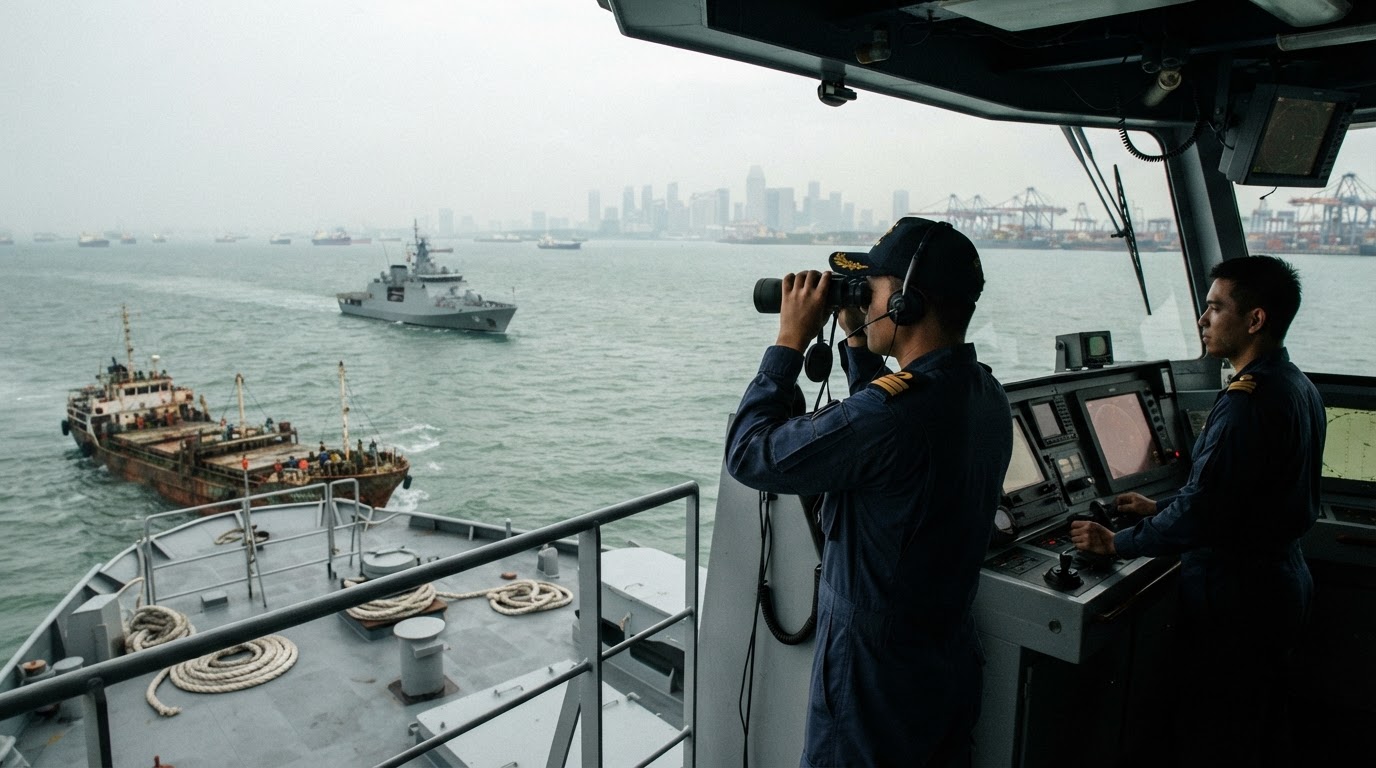
Harbour anchorages along crowded straits reveal their secrets through ship silhouettes and shifting water patterns. Container vessels sit heavy on the morning swell, pinned to their coordinates while waiting out the tide. Tugboats cut sharp lines across the grey chop. For decades, naval prestige in these waterways expressed itself through heavy capital hulls engineered for massive fleet engagements that never actually materialised. Those towering grey combatants projected raw power across distant horizons. Yet they falter against modern littoral ambiguity. Heavy guns cannot police shadows. The straits demand something else entirely.
On Oct 1, 2026, the Republic of Singapore Navy launched its new Sentinel-class offshore patrol vessel in Berne, Germany. Reported by CNA Lifestyle and Natasha Ganesan, the event underlines a deliberate operational recalibration across Southeast Asian sea lanes. Navies now confront an altered spectrum of friction that refuses to conform to clean categories of civilian law enforcement or conventional warfare. Low-end threats, from maritime terrorism to hostile drone swarms, operate in the grey space between routine policing and open conflict. Dispatching a frontline warship to trail an unflagged skiff squanders operational readiness. It burns through hull hours. Crucially, it risks rapid political escalation over minor maritime incidents.
Calibrating presence on crowded waters
Narrow chokepoints ask something counterintuitive from the coastal states charged with guarding them. Security here cannot be bought with overwhelming lethal force. A strait is not an empty battleground; it is a shared thoroughfare. Daily defense requires sustained presence alongside dense commercial traffic. Offshore patrol vessels answer that exact requirement. They provide persistent surveillance without the aggressive posture of guided-missile combatants. These patrol hulls enforce order against non-traditional disruptions. At the same time, they retain sufficient defensive systems to protect their own decks against sudden hostile strikes.
Navies face a wider range of threats that do not always fit neatly into either law enforcement or conventional warfare.
Traditional naval strategists might argue that turning toward patrol craft compromises deterrence against rival states expanding their blue-water reach. A lighter patrol hull cannot match the missile magazines of a frontline frigate during unrestricted naval combat. It lacks the deep armour required for fleet actions. That skepticism is understandable. Yet it assumes fleet actions represent the immediate hazard facing regional corridors. In practice, stability in maritime Asia erodes through quiet, incremental incursions rather than coordinated missile salvos. Committing heavy surface combatants to every ambiguous probe strains propulsion plants. It exhausts personnel. Worst of all, it risks miscalculating a localized provocation into a shooting war that neither side can afford.
The shifting demands of maritime transit
Littoral geography creates narrow passages where sovereign boundaries and international shipping lanes intersect. When a coastal navy relies exclusively on capital combatants, its strategic options shrink. It faces a stark choice between passive inaction and disproportionate confrontation. Patrol platforms like the Sentinel-class bridge that operational divide. They grant commanders measured tools to inspect suspicious vessels or escort vulnerable merchant traffic without provoking diplomatic crises. Measured presence becomes its own strategic shield.
Berne sits thousands of kilometres away from equatorial channels, yet the steel assembled in German shipyards directly reflects the daily pressures of Southeast Asian straits. The geography of these waterways insists on patience. It values proportional capability over posturing. Regional sea lanes do not ask for overwhelming naval spectacles. They require vigilant hulls built to absorb the quiet friction of the everyday.
Sources
Newsletter
Pacific Daily
A curated briefing from Thailand, Asia-Pacific and the world.