The Pavement Over Tenochtitlán and the Erasure of Isabel
Historic plazas demand selective memory from travellers, burying the female lineages that navigated colonial survival
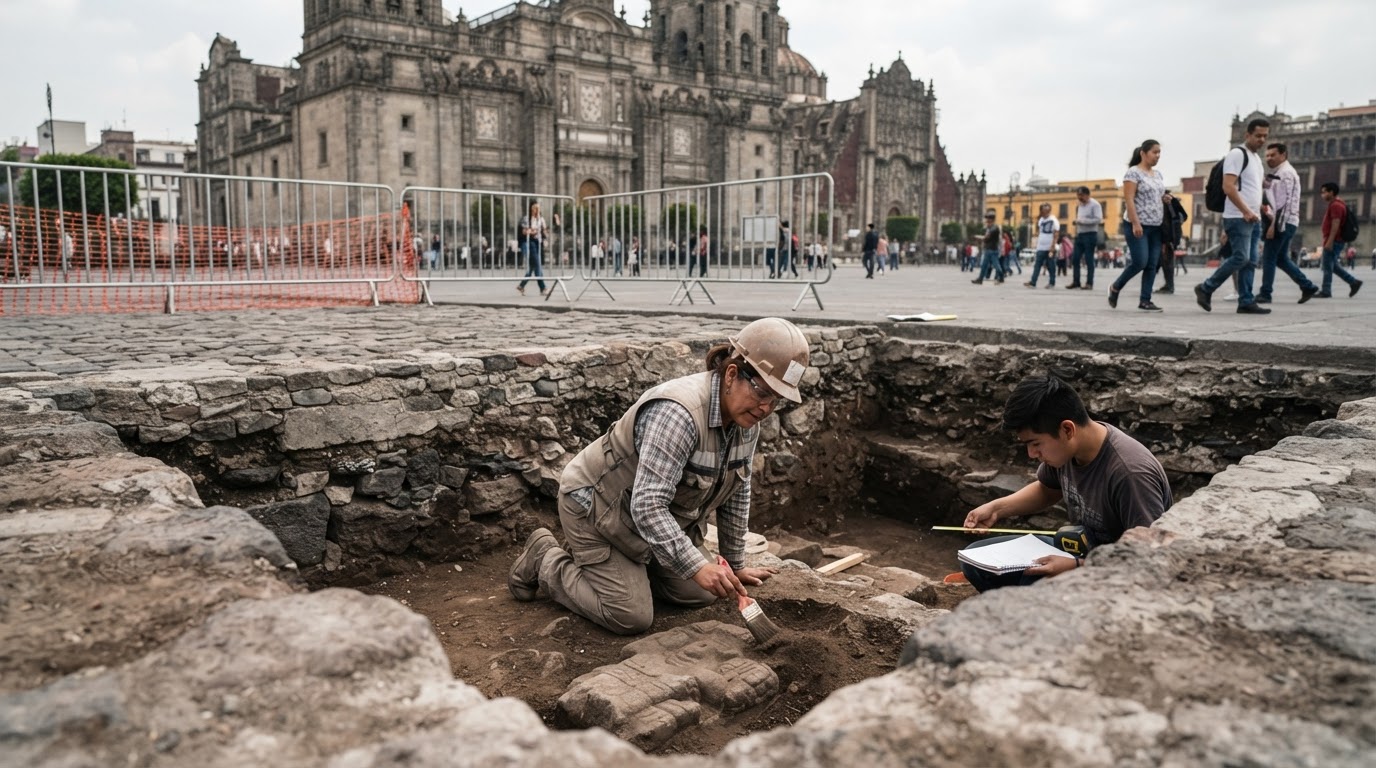
Paved stone across Mexico City holds an architectural silence that public memory rarely interrogates, inviting visitors to mistake finished masonry for settled history. Walkers crossing the expansive flags of the Zócalo encounter the metropolitan cathedral and the steady drift of foot traffic, yet the ground rests directly upon the remnants of Tenochtitlán. The open plaza offers an illusion of a clean historical transition, presenting colonial arches resting squarely over imperial Mexica foundations. That visual order obscures the fractured human bargains struck during its construction.
Five centuries have passed since the events of 1519 shook the Valley of Mexico.
Commemoration in the capital still gravitates toward a predictable set of protagonists. Displays and tourist guides highlight Moctezuma alongside Cuauhtémoc, set against Cortés and the contested legacy of Malinche. The narrative functions conveniently because it reduces catastrophe to masculine confrontation. Travellers receive an intelligible sequence of imperial collision and surrender, complete with tragic monarchs. The city asks those who arrive to witness an empire falling in open combat.
The Daughter Behind the Façade
A reading of surviving colonial records suggests a deliberate gap within this civic staging. Writing for Mexico News Daily in the column Mexico Well-Read, book reviewer Ann Marie Jackson examines Sofía Robleda and her novel, The Other Moctezuma Girls. Robleda focuses on Tecuichpoch, the favored daughter of Moctezuma who received the baptismal name Isabel. Her life intersected with nearly every dominant figure of the Conquest, yet her name rarely surfaces along the commemorative walking routes of the modern plaza.
The biographical record shows that Tecuichpoch served as consort to two Mexica rulers, Cuitláhuac and Cuauhtémoc. She survived the siege that destroyed the indigenous capital, later bore a daughter to Cortés, and entered marriages with three separate Spaniards before dying in 1551. These marriages suggest neither romantic surrender nor heroic martyrdom. Instead, historical analysis indicates the brutal, pragmatic calculations forced upon indigenous noblewomen who sought to protect lineage and ancestral property while their society dissolved.
Conventional travel writing rarely accommodates such tension. Heritage itineraries favor sharp binaries, as stark military conflicts fit neatly onto bronze plaques. A sovereign dying in battle provides civic theatre; a noblewoman negotiating multiple colonial marriages complicates the nationalist script. By keeping Isabel outside the commemorative frame, civic planners encourage visitors to experience conquest as a completed duel rather than an ongoing domestic accommodation.
Memory Across the Pacific Rim
This pattern of selective recall extends beyond Latin America. Across Pacific trading ports and post-colonial administrative centres, municipal monuments consistently honour military governors while overlooking the local intermediaries and female lineages that negotiated administrative continuity under foreign dominance. When contemporary observers walk through an old imperial square, the surrounding façades ask them to accept the public record of conquest without weighing who sustained daily survival.
Skeptics may counter that historical fiction like Robleda's merely fills documentary silences with inventive sentiment. That critique carries weight whenever dramatisation untethers itself from historical discipline. Yet Jackson observes that Robleda grounds her narrative in real moral force, demonstrating how creative re-examination can restore nuance when official stones refuse to speak.
The Zócalo remains an intimidating urban expanse, bordered by commuters and shadowed by towering colonial walls. The physical plaza still invites observers to admire the visible scale of European triumph erected over Mexica foundations. Yet the stones conceal a quieter reality: the post-conquest settlement relied on women whose lives resisted simple heroism, whose baptisms renamed them, and whose surviving households enabled the capital to endure.
Sources
Newsletter
Pacific Daily
A curated briefing from Thailand, Asia-Pacific and the world.