The Labour Export Dilemma in Honiara
Matthew Wale pitches expanded mobility quotas to Australian employers, exposing the tension between domestic employment deficits and offshore wage dependence.
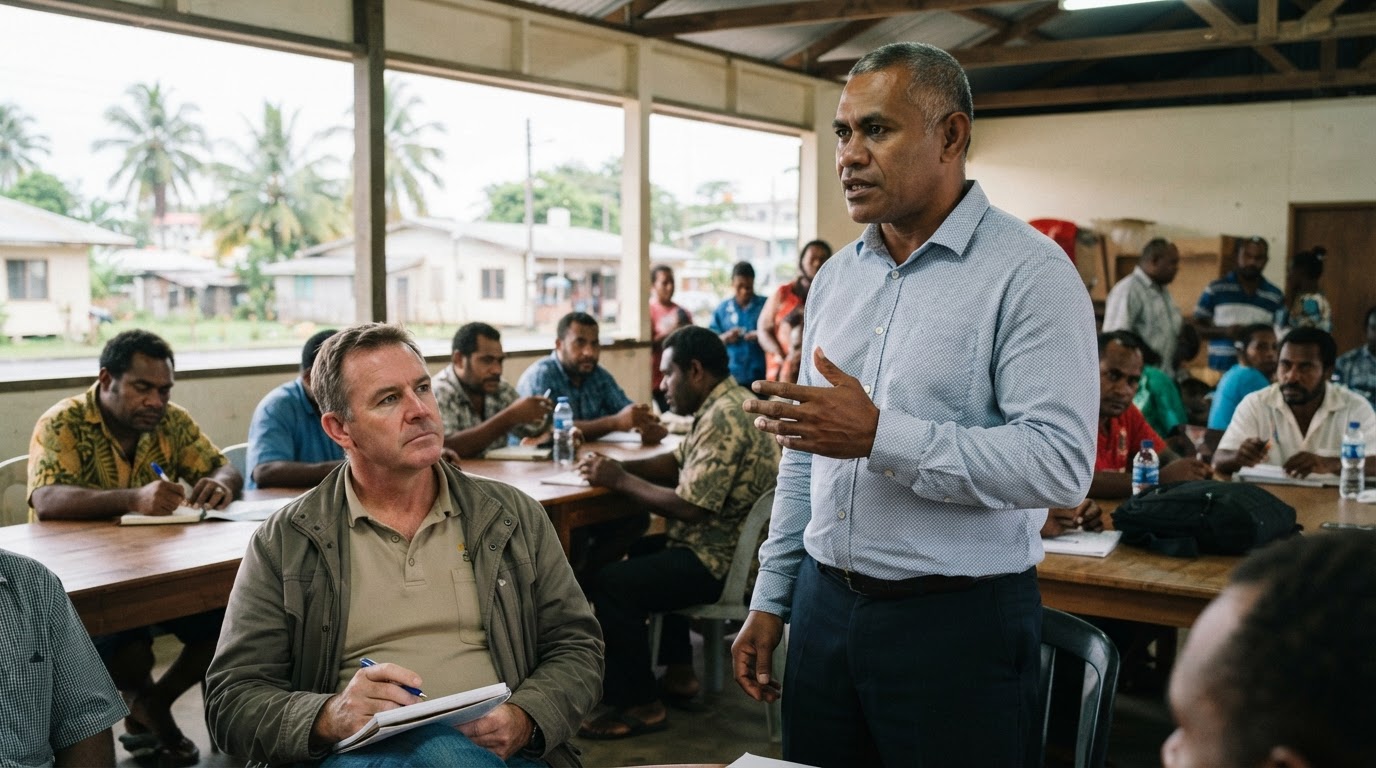
When Solomon Islands Prime Minister Matthew Wale addressed the inaugural PALM Approved Employer Expo in Honiara on Tuesday, his central appeal was clear. Speaking before visiting Australian employers, Wale called for an expansion of job opportunities for Solomon Islanders under Australia's Pacific Australia Labour Mobility scheme. More than 13,000 Solomon Islanders have participated under the PALM scheme since 2018 across seasonal and longer-term placements, a record the prime minister characterised as a massive achievement and a huge investment for our people.
The regional architecture supporting this mechanism has expanded steadily over the past decade. Pacific Australia Labour Mobility permits eligible Australian employers to recruit workers from nine Pacific Island countries, filling deep agricultural and service-sector vacancies that Australian domestic labour markets consistently fail to supply. For sending governments, the arrangement appears mutually beneficial on paper: overseas employment generates steady liquidity for rural households without demanding immediate domestic industrial expenditure or complex administrative restructuring from the state.
Yet that outward reliance creates structural friction across domestic systems. When thousands of productive workers depart island communities for multi-month fruit picking or regional processing shifts, they leave behind fragile subsistence agriculture networks, domestic small businesses, and community leadership roles. National income metrics celebrate incoming wages, but those foreign earnings often disguise a prolonged absence of local capital development. The immediate inflow of offshore funds conceals how little internal commercial capacity is actually being constructed at home.
Exporting Human Capital
Proponents of expanding mobility quotas point out that these bilateral arrangements deliver essential stability. Foreign employment directly finances village education costs, urgent medical care, and small-scale domestic commerce across provinces where commercial banks and formal private employers barely operate. From Australia's perspective, the PALM scheme similarly serves as a dependable institutional instrument, addressing pressing domestic employer demands while anchoring bilateral relations with island states. Curtailing the program or capping participation would abruptly starve remote households of their primary path to disposable income.
Yet treating temporary offshore work as a sovereign economic model conflates immediate emergency income with genuine structural transformation. Agricultural labour overseas rarely transfers sophisticated technical or commercial expertise back into the domestic economy. Workers who finish long placements in Australia frequently return to precisely the same constrained employment environments they initially left, creating recurrent incentives to re-enlist for subsequent overseas contracts rather than invest locally.
The long-term hazard for Pacific Island countries is the institutionalisation of a labour reserve structure that sustains regional industries while domestic sectors languish.
This asymmetry governs the broader governance of the scheme. Australia establishes the regulatory ground rules, employer accreditation standards, and border access criteria. Meanwhile, Pacific Island administrations bear the lingering domestic costs, from prolonged family absence to the administrative burden of running candidate registries through bodies like the Labour Mobility Unit. National institutions find themselves functioning as recruitment managers for another country's industries rather than architects of domestic employment growth.
The Bilateral Bargain
Wale's address at the Honiara expo demonstrated the political momentum behind this dynamic. Framing the 13,000 participants since 2018 as proof of operational reliability, the prime minister actively urged Australian employers to expand hiring across further sectors. The strategic calculation is obvious: placing surplus labour abroad absorbs demographic pressure and secures valuable foreign earnings. But it also postpones difficult sovereign choices regarding infrastructure, domestic economic diversification, and private sector expansion.
Ultimately, the tension underpinning the PALM scheme will not be resolved by increasing quotas alone. Expanding offshore recruitment delivers undeniable household sustenance today, yet it leaves Pacific Island economies structurally dependent on Australian labor demand. For Honiara, the deeper policy dilemma is whether an economic model predicated on exporting its most capable workers can ever build the domestic foundations necessary to keep them at home.
Sources
Newsletter
Pacific Daily
A curated briefing from Thailand, Asia-Pacific and the world.