The Compute Frontier Colonises Public Acreage
Federal land allocations across six Western states expose the severe physical footprint behind digital infrastructure expansion
SINGAPORE
Public conservation policies have long functioned on the assumption that arid federal territories exist outside the intensive demands of industrial capital. That premise is eroding rapidly as computing infrastructure encroaches directly onto the national domain.
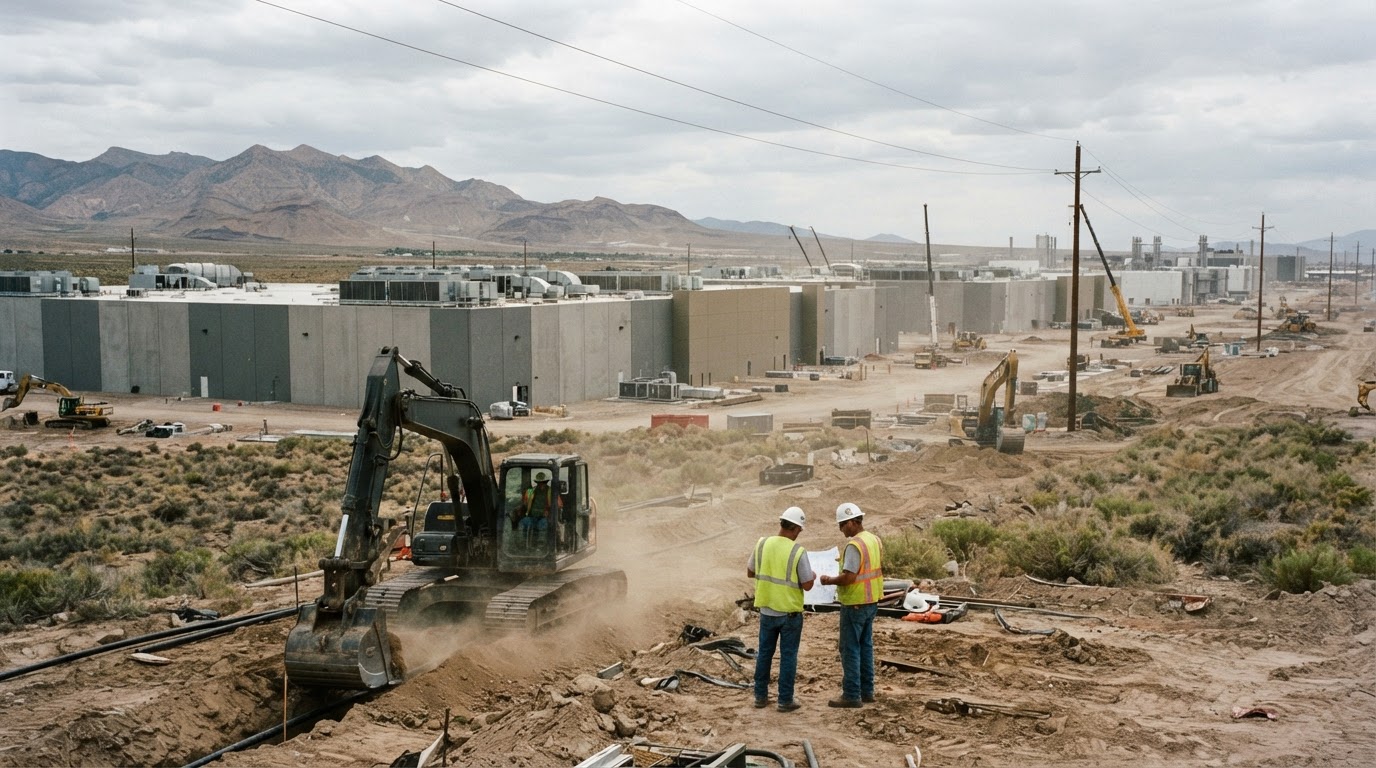
Records from the US Bureau of Land Management reveal that developers are seeking to convert vast tracts of public terrain into computational real estate. An analysis by the conservation group Center for Western Priorities identifies at least 35 data center-related applications pending or active across six Western states. These proposals cover more than 24,000 acres across Arizona, Idaho, Nevada, Oregon, Utah and Wyoming. The filings encompass at least 17 proposed data center campuses alongside 13 related infrastructure projects, including high-voltage transmission corridors, pipelines, telecommunications conduits and access roads.
This expansion represents a structural reallocation of shared territory. The Trump administration has moved to repurpose federal land holdings to accelerate artificial intelligence infrastructure, shifting the burden of digital scale onto interior habitats.
The Geography of Siting
For decades, national land policy treated public acreage as a buffer, balancing resource extraction against long-term ecological preservation. The rapid pivot toward digital processing facilities breaks that historical equilibrium. Siting hyperscale facilities on public ground bypasses the fragmented private parcel acquisitions that slow commercial development near major metropolitan centers. According to research from the Pew Research Center, most new facilities across the country are already moving into rural localities. Pushing beyond rural private parcels into public acreage marks a distinct escalation.
Public land policy has shifted from managing natural resources to hosting the industrial foundations of compute.
Corporate developers are already moving forward with specific project footprints. Verified filings include extensive infrastructure applications linked to a planned Prometheus Hyperscale facility in Wyoming, as well as an array of utility proposals submitted by developer Copia Power. Building high-capacity data campuses in fragile basins requires extensive water volumes for cooling, dedicated electrical substations and sprawling logistics arteries cut through native scrub.
Proponents argue that utilizing federal land makes strategic economic sense. Supporters contend that vast tracts in interior states offer low-density environments where industrial compute clusters can operate without displacing residential communities or overwhelming municipal zoning boards. Placing campuses closer to potential renewable corridors or remote energy generation hubs can theoretically alleviate congestion on aging municipal grids.
Shifting Ecological Burdens
Yet this argument overlooks the foundational friction between severe physical constraints and digital growth. Public acreage in states such as Nevada, Utah and Arizona faces acute environmental vulnerabilities, defined by endemic aridity and fragile ecosystems. When state policy privileges digital infrastructure by opening federal territory, it trades finite public baselines for private computational throughput.
The policy shift established under US President Donald Trump illustrates an enduring governance dilemma. Digital networks are frequently characterized as weightless utilities detached from physical geography, yet their expansion remains entirely tethered to land, water and high-capacity electrical grids. When industrial computing consumes tens of thousands of acres of public terrain, it establishes a precedent that public stewardship is subordinate to commercial tech capacity.
The administrative machinery directing public acreage toward hyperscale infrastructure shows how digital sovereignty is redefined by land control. Regulators assessing pending applications across these six states face a fundamental trade-off: whether public lands should safeguard ecological reserves, or serve as the physical foundation for private computational scale.
Sources
Newsletter
Pacific Daily
A curated briefing from Thailand, Asia-Pacific and the world.