The Grey Horizon Over Singapore
When seasonal haze suspends outdoor space, civic routine yields to atmospheric currents that municipal planning cannot design away.
SINGAPORE
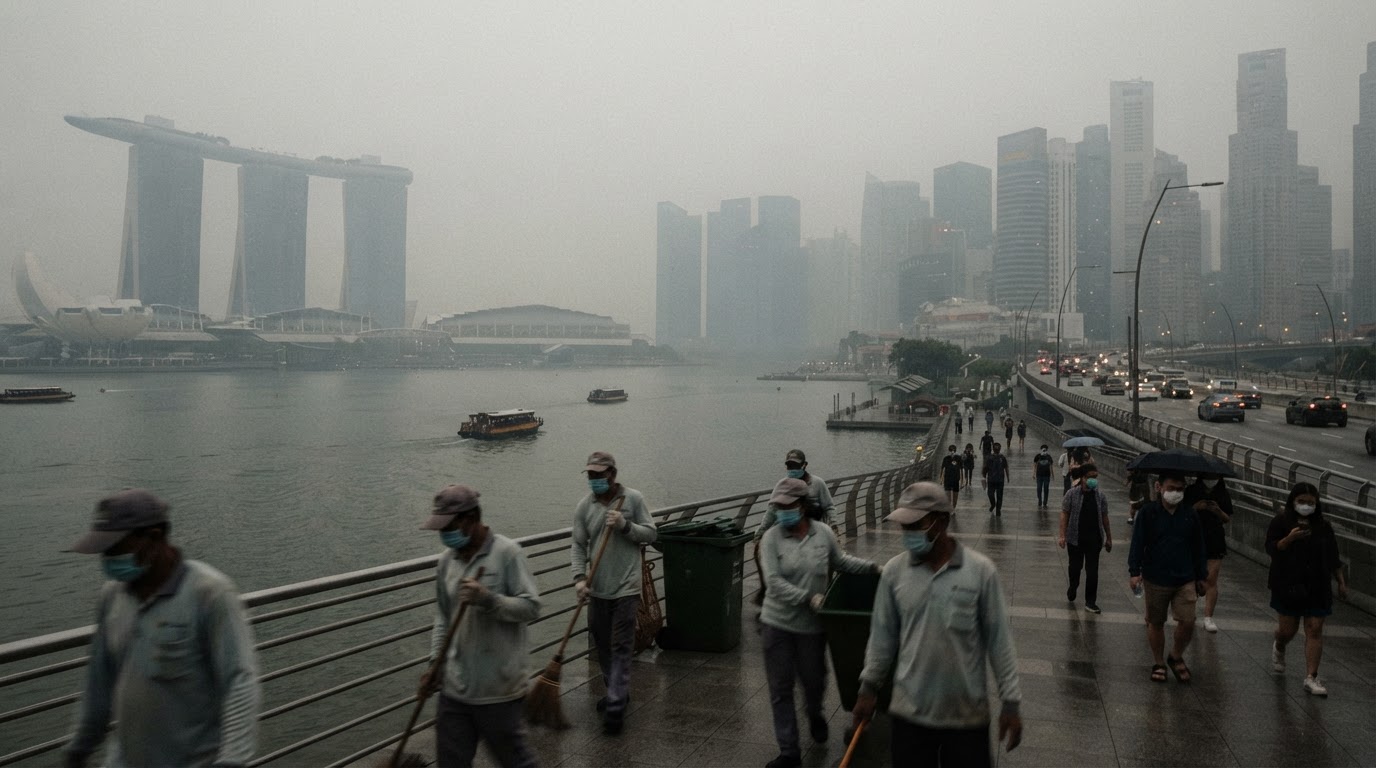
A block of flats in Potong Pasir stands out against a pale, muted skyline where distant high-rises dissolve into grey. October mornings along the island usually carry the rhythmic hum of early commuters and joggers crossing neighborhood parks. On Monday, Oct 19, 2026, that habit paused as the National Environment Agency reported the 24-hour Pollutant Standard Index holding largely in the unhealthy band, projected between 101 and 190.
Agency measurements recorded the index reaching 132 in the west by 9am, while PM2.5 concentrations registered at elevated levels across the western, central, and eastern quarters. Five days earlier, on Oct 14, public outdoor sports facilities in the west closed after PM2.5 readings reached an annual peak of 288. Such figures document more than an air quality event. They outline how physical geography regularly intrudes upon one of the most thoroughly engineered urban spaces in Southeast Asia.
The Limits of Enclosure
Public life across Singapore relies heavily on deliberate environmental mediation. Covered walkways link residential precincts to transit concourses, air-conditioned passages run unbroken beneath commercial streets, and municipal authorities monitor local conditions with systemic discipline. Yet atmospheric drift exposes the perimeter of that built buffer.
When the Pollutant Standard Index crosses 101, civic patterns alter without requiring formal curfews. Courtyards empty, running tracks sit vacant, and daily recreation shifts into private or filtered interiors. What emerges during these episodes is a clear sorting between spaces that can be sealed and spaces that must remain exposed.
The retreat indoors suggests that environmental continuity cannot be entirely guaranteed by civic design.
Commercial towers and transit hubs continue to operate without visible friction, relying on synthetic air circulation and double-glazed facades. Outside those cooled perimeters, however, the social utility of shared terrain erodes as soon as being outdoors carries an official caution. The public realm becomes something to traverse quickly rather than inhabit.
Geography Overrules Architecture
The physical dispersion of the pollution also reveals local contrasts across a compact landmass. While the northern district recorded a moderate reading of 87 on Monday morning, the western zone climbed to 132. That divergence suggests how atmospheric currents fragment municipal space, turning neighborhood exposure into an accident of wind direction.
Urban planning can mandate shaded courtyards, plant canopy covers, and construct open pavilions intended to foster communal interaction. But these spatial interventions assume an ambient atmosphere that remains consistently benign. When regional conditions deteriorate, the open architecture of public housing estates highlights the vulnerability of open-air living.
Shifting monsoonal patterns will eventually move the air mass elsewhere, and passing rains may lower the particulate concentrations back toward normal baselines. The shuttered sports enclosures in the west will reopen, and footpaths will regain their usual traffic. Even so, the recurring presence of the haze leaves the Potong Pasir flats looking less like isolated bastions of modern order and more like fragile outposts subject to seasonal winds.
Sources
Newsletter
Pacific Daily
A curated briefing from Thailand, Asia-Pacific and the world.