The Fragile Economics Behind the Fungal Plastic Alternative
Biological packaging promises an alternative to synthetic polymers, but material variability and corporate value capture constrain industrial scale.
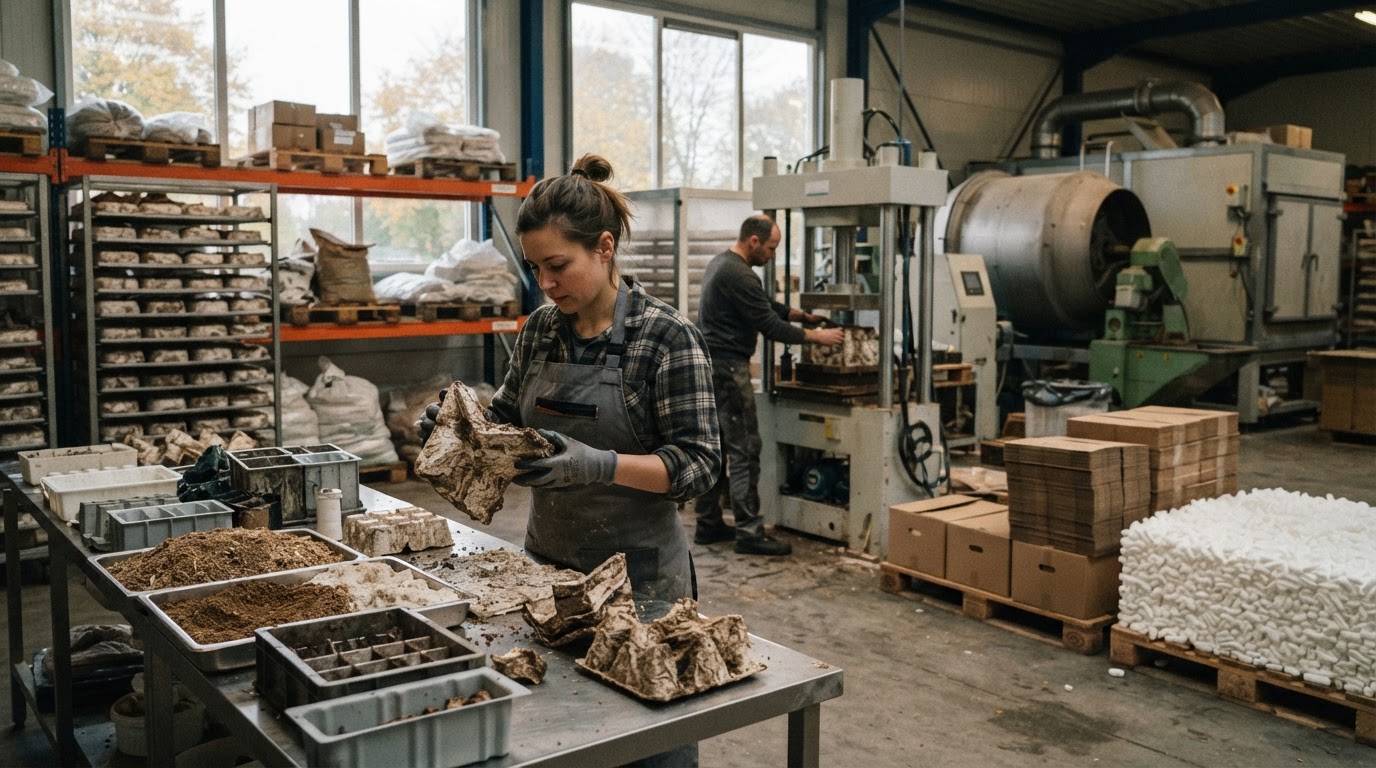
Oct. 15 marks World Mushroom Day, positioning fungal organisms at the centre of debates over industrial decarbonization and plastic substitution. Biologically, a mushroom operates as the reproductive organ of a fungus, dispersing spores across an environment much like a flower distributes reproductive material on a plant. Beyond their ecological functions and established role as food for humans and wildlife, mushrooms are increasingly presented as viable replacements for synthetic polymers and structural components in construction.
Advocates suggest that fungal cultivation can resolve deep ecological dilemmas while assisting agricultural communities. Gabriela D’Elia, director of the Fungal Diversity Survey, has argued that fungi can generate low-cost, sustainable housing materials while delivering additional income to farmers. Evaluating this structural proposition in a Mongabay video titled “Fungi are our climate allies”, D’Elia stated:
Fungi are showing us new ways to live in allyship with the planet,
Institutional interest has expanded across North America and parts of the Pacific Rim, where researchers at entities such as the University of Wisconsin-Madison study mycelial properties. The industrial vision relies on converting agricultural residues into fungal matrices, yielding biodegradable packaging or composite panels capable of displacing fossil fuel outputs. Yet transforming a biological phenomenon into an industrial supply chain introduces structural hurdles that enthusiasm alone cannot surmount.
The Industrial Consistency Deficit
Petrochemical polymers did not secure their dominant market share purely by commercial accident. Synthetic plastics provide uniform tensile strength, reliable moisture resistance, and predictable thermal tolerance across high-speed manufacturing lines. A commercial packaging converter depends on raw materials that exhibit identical chemical specifications during every fabrication cycle.
Biological substitutes operate under entirely distinct physical rules. Cultivating strains such as Ganoderma requires organic substrates that naturally vary in moisture content, biological density, and nutrient distribution. Producing mycelium at industrial scale demands sterile inoculation facilities, continuous atmospheric monitoring, and significant thermal energy to dry and deactivate the fungal culture prior to distribution. Should an organic package absorb ambient humidity or degrade unevenly in cargo handling, commercial logistics operations will reject the material. Technical feasibility demonstrated within a university laboratory does not ensure continuous stability on a mechanized factory line.
Furthermore, biological decomposition presents an operational contradiction for long-haul shipping. Commercial packaging must resist degradation during transit, warehouse storage, and unpredictable climatic exposure. When biological packaging achieves rapid biodegradability under natural conditions, it risks compromising the structural integrity required by international freight systems. Overcoming this trade-off requires chemical binders or synthetic coatings, compromises that diminish the environmental justification for transitioning away from petrochemicals.
Structural Value Capture
Economic assumptions surrounding farm-level prosperity also warrant rigorous examination. Proponents emphasize that mushroom production generates supplementary revenue for agrarian producers. Commercial agriculture, however, repeatedly demonstrates that raw biomass producers encounter intense margin pressure while downstream entities retain pricing power.
When crop residue becomes an industrial feedstock, cultivators supply raw biological mass into an intellectual property regime controlled by external developers. Downstream enterprises such as Evocative develop patented mycelium formulations, proprietary inoculation systems, and corporate supply contracts. Rural producers absorb the biological uncertainties of crop contamination, humidity failures, and storage loss, while value accrues to the firms holding processing patents and brand partnerships. Without direct equity in processing plants or local ownership of fungal strains, farming communities risk remaining suppliers of cheap raw inputs rather than primary beneficiaries of bio-industrial manufacturing.
Industrial substitution will therefore not occur solely through technological optimism. Petrochemical plastics maintain cost advantages because fossil infrastructure has matured over decades while externalizing the environmental costs of waste disposal. Fungal materials cannot attain market scale through voluntary corporate pledges or consumer preferences. Achieving widespread commercial adoption requires direct regulatory mandates, including fossil fuel disincentives, strict landfill restrictions, and public procurement standards that create guaranteed demand. Until statutory frameworks alter production costs, mycelial composites will remain confined to niche applications, leaving the underlying petrochemical apparatus intact.
Sources
Newsletter
Pacific Daily
A curated briefing from Thailand, Asia-Pacific and the world.