The Engineered Respite of Singapore's Milestone Leisure
Treating academic relief as an itinerary reveals how tightly domestic escapism mirrors the discipline it claims to soothe
SINGAPORE
Civic recreation in Singapore relies on the strict containment of relief within planned geographic boundaries. When The Straits Times Life presented an itinerary for Sentosa structured around a two-day weekend, the premise hinged on domestic ease: no departure gates, no flight schedules, and immediate proximity. The primary audience singled out for this managed downtime was not wandering tourists, but local families marking the conclusion of the PSLE.
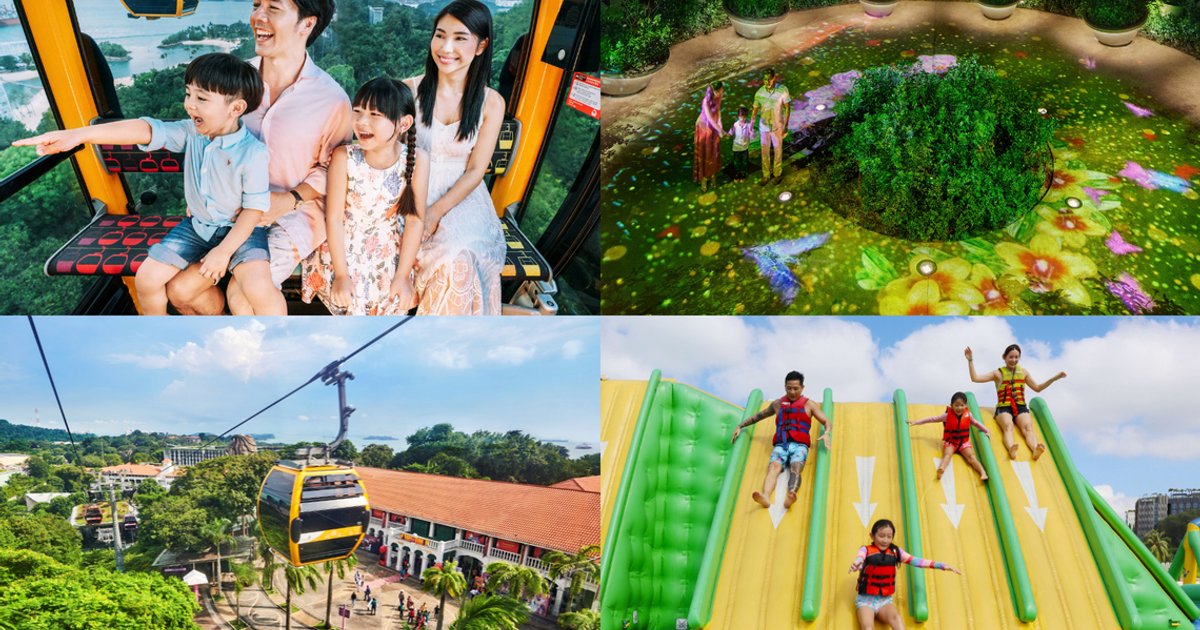
Academic milestones across the island have long functioned as an intense collective ritual. For months, households calibrate daily routines around revision cycles and institutional expectations. Once the testing season ends, the urge to decompress surfaces immediately, yet the cultural form that release takes remains telling. Rather than unstructured quiet, parents and children are directed toward scripted recreation: cable car rides coordinated by Mount Faber Leisure Group, designated leisure nodes like The Palawan, the high-velocity tracks of Skyline Luge, and the controlled waters of HydroDash.
The Geography of Managed Relief
Sentosa was conceived and curated by the Sentosa Development Corporation as a zone distinctly separated from the financial district, yet anchored firmly to the transport grid. The short passage across the water from HarbourFront to the southern shore transforms an offshore perimeter into a laboratory of synthetic escape. Attractions such as the Singapore Oceanarium, Fort Siloso, and the forest trails of Sentosa Nature Discovery offer variety, but they operate within a tightly bounded perimeter.
What makes this arrangement striking is the contradiction between the language of freedom and the structure of delivery. The promise that an offshore break requires no planning is fulfilled only because the commercial apparatus has pre-planned every waking interval. Leisure becomes another syllabus to complete. Families progress from morning sensory exhibitions to afternoon water sports and evening dinners, checking off activities with the same methodical diligence that carried pupils through their textbooks.
Domestic tourism here does not disrupt the prevailing national discipline; it absorbs it. The island offers an antidote to stress that mirrors the exact mechanics of modern Singaporean administration. Transit extensions through Keppel, Cantonment, Prince Edward Road, and Marina Bay along the Circle Line continue to knit these leisure zones directly into the urban core, shrinking the psychological barrier between workplace and playground.
The promise that an offshore break requires no planning is fulfilled only because the commercial apparatus has pre-planned every waking interval.
Containment as a Civic Habit
There is a reasonable defence for this style of domestic retreat. For working parents operating under demanding schedules, an accessible offshore enclosure removes the friction of international travel. Crossing the water provides a psychological break without passport control, while the density of managed attractions keeps adolescents entertained. It delivers predictability in an urban environment where predictability is deeply prized.
Yet this convenience exposes a deeper cultural premise. True aimlessness carries an ambient anxiety in societies calibrated around continuous productivity. To spend milestone downtime simply sitting in uncurated space feels uncomfortably close to squandered time. By branding two days and one night in Sentosa as the definitive celebration for academic endurance, civic habits reassert that leisure is legitimate primarily when it is earned, scheduled, and spent.
Respite in the city remains an exercise in logistical zoning. Children learn early that relief does not mean stepping entirely outside the boundaries of structured progress, but rather moving into a designated precinct where the rules of productivity are momentarily paused by mutual agreement. The coastal walking paths and amusement venues do not dissolve the relentless drive of urban achievement; they simply provide its official holding pen.
Sources
Newsletter
Pacific Daily
A curated briefing from Thailand, Asia-Pacific and the world.