State Flood Payouts Expose the Recurring Deficit in Thailand's Disaster Math
With 5.2 billion baht spent and 10.5 billion more requested, flat cash transfers offer quick emergency liquidity while leaving long-term reconstruction on family balance sheets.
SINGAPORE
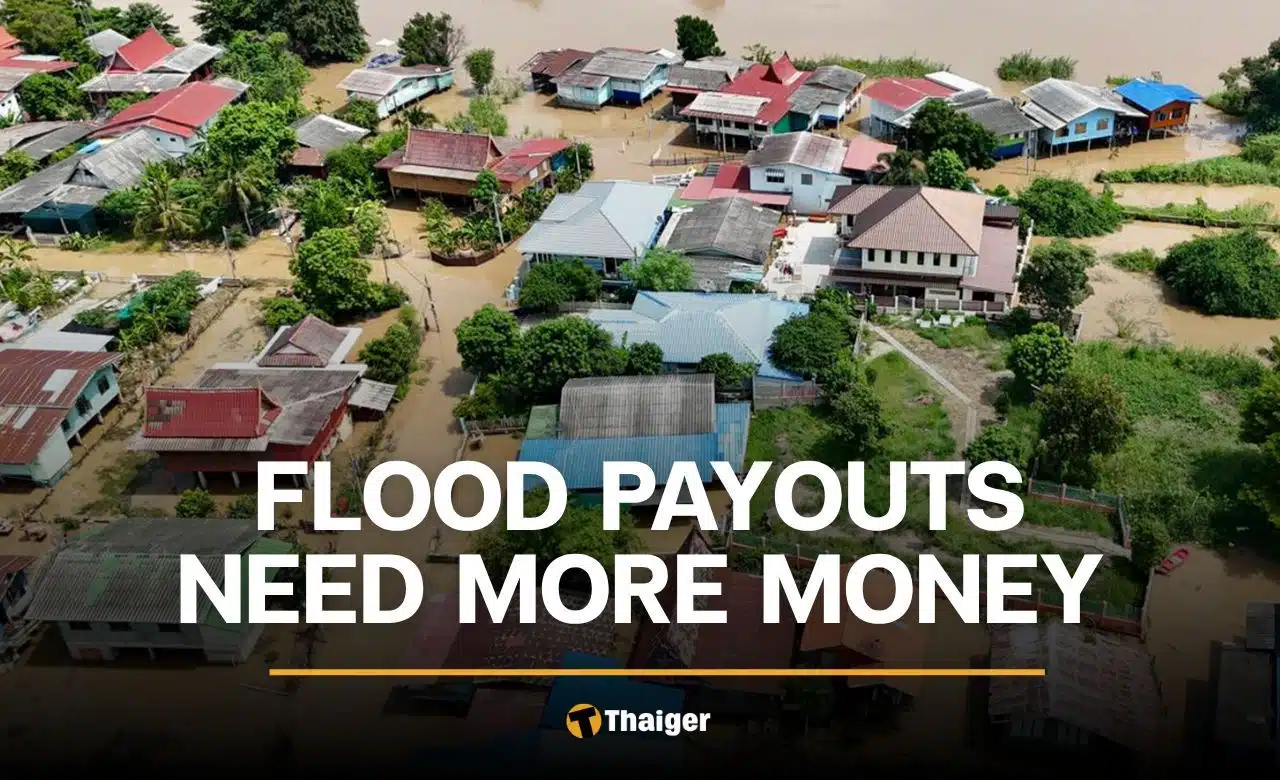
A direct transfer of 7,000 or 9,000 baht registers on a mobile screen within seconds, but the silt left behind by seasonal inundation takes months to clear. Official accounts confirm that Thailand’s Department of Disaster Prevention and Mitigation has distributed 5.2 billion baht, roughly 156 million dollars, to 683,286 households struck by heavy rains between May 15 and September 30. Nirat Pongsittaworn, the department’s director-general, verified the figures on October 17, explaining that the Government Savings Bank received the initial allocation of 5.28 billion baht to execute direct payments to affected residents. Now, on Tuesday, October 20, the agency plans to ask the Cabinet for an additional 10.5 billion baht to settle expanding liabilities.
This steep upward revision exposes the enduring gap between emergency liquidity and genuine recovery. Under the existing Cabinet resolution, financial assistance covers damage recorded across Bangkok and 66 provinces, dividing claimants into tiers based on whether water invaded their living quarters or merely isolated their neighborhoods. For families whose floors warped, whose livestock feed washed away, or whose day labour ceased during monsoon surges, those fixed grants provide immediate cash for groceries and basic clean-up supplies. They do not, however, absorb the sustained economic shock of ruined infrastructure and lost earnings. The state pays a token sum for the acute crisis, leaving households to fund the slow structural repairs themselves.
The arithmetic of emergency transfers
Disaster accounting in the lowlands inevitably collides with scale. Over one million households have filed compensation claims following the recent rains, while industrial assessments indicate that 4,500 factories suffered damage across the country. Distributing 5.2 billion baht across 683,286 families consumed nearly the entire 5.28 billion baht allocation transferred to the Government Savings Bank, with individual payments strictly confined to the mandated 7,000-baht or 9,000-baht tiers. That initial disbursement exhausted available resources before the full roster of affected communities could be compensated, forcing administrators back to the fiscal drawing board.
State planners can reasonably defend this mechanism as an operational necessity. Channeling emergency funds through the state banking network avoids the physical choke points, localized political favoritism, and bureaucratic delays that traditionally plagued distributed relief aid. Speed remains vital when families require immediate funds to buy drinking water, secure fuel, and clear standing sludge before disease sets in. Deploying fixed 7,000 and 9,000 baht payments also avoids the impossible administrative bottleneck of conducting bespoke loss appraisals on hundreds of thousands of individual rural dwellings while waters are still receding.
Absorption versus resilience
Procedural speed nonetheless risks institutionalizing a reactive pattern of governance. Treating the monsoon as an unexpected shock rather than an annual certainty encourages ministries to treat supplementary budgets as a regular tool of disaster management. When an emergency agency requires a supplementary 10.5 billion baht request right after exhausting a 5.28 billion baht fund, the fiscal apparatus is operating as an improvised buffer. Parallel initiatives to shift risk to commercial markets through a 467 million dollar insurance arrangement suggest that policymakers understand the fragility of balance sheets exposed to repeated flooding. Yet commercial insurance frameworks tend to insulate state finances and industrial assets, doing little to alter the daily economic precarity of agrarian and peri-urban families.
When the Cabinet convenes on Tuesday to review the request for 10.5 billion baht, discussion will almost certainly focus on fiscal space, inter-agency mechanics, and delivery schedules. That institutional perspective obscures the primary reality on the ground. For the 683,286 families who have already collected their compensation through the Government Savings Bank, the money was spent days ago on immediate survival. Until national policy addresses the systemic vulnerabilities that leave 66 provinces submerged year after year, the true cost of each flood will remain where it has always been: on the uncompensated balance sheets of individual families.
Sources
Newsletter
Pacific Daily
A curated briefing from Thailand, Asia-Pacific and the world.