Premier League Momentum Collides With Physical Cost on an Uneasy Saturday
Pedro Neto delivered two goals for Chelsea at Everton, yet a serious head injury to Martinez exposed the ongoing friction between elite athletic output and player safety.
SINGAPORE
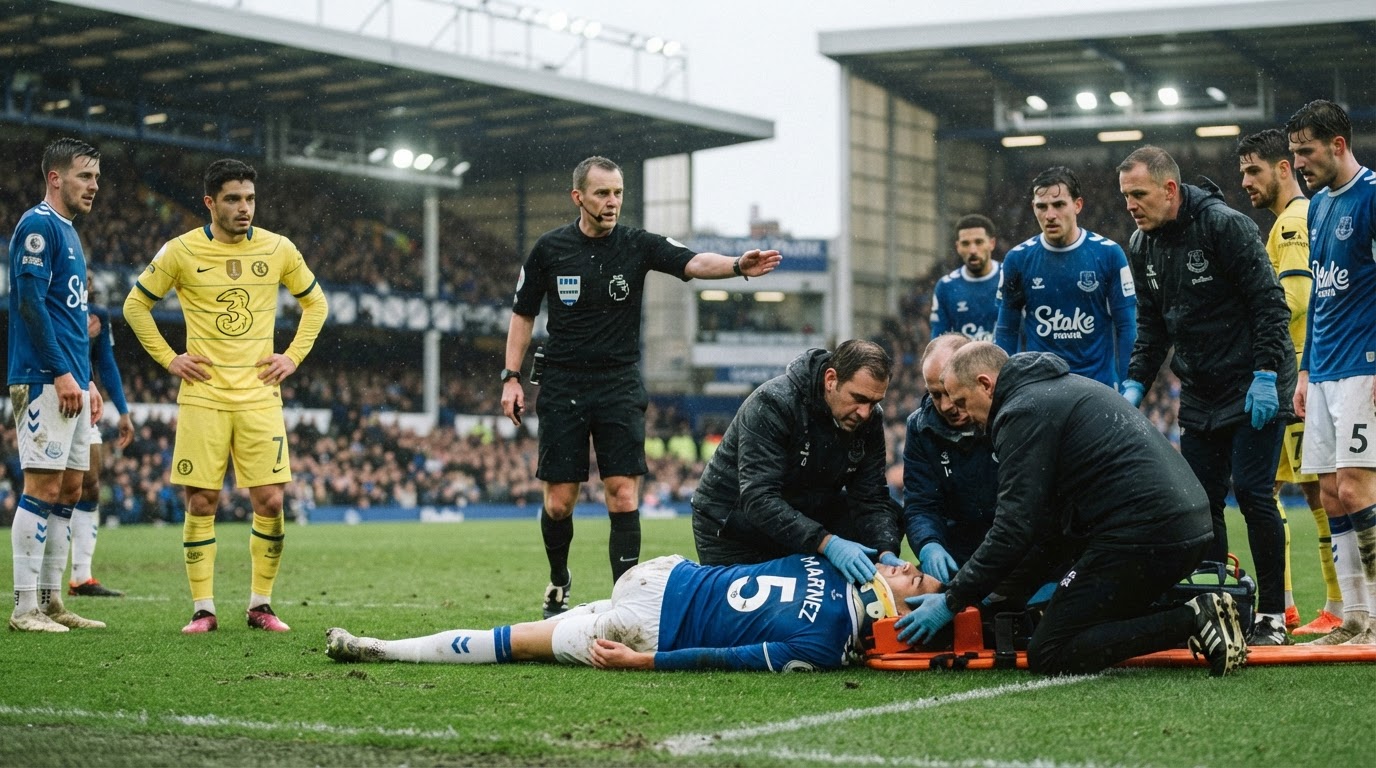
Elite professional sports leagues have long traded on an unwritten operational assumption: physical trauma is treated as a regrettable, manageable byproduct of commercial entertainment rather than an indictment of the structure itself. On October 17, 2026, match reports recorded a slate of decisive results across grounds in the United Kingdom. Chelsea secured a domestic away victory over Everton at Hill Dickinson Stadium through two goals from Pedro Neto. Yet match logs also confirm that Martinez sustained a severe head injury during the contest, an occurrence that halted competitive play and dampened the visiting side's celebrations.
Weekend results across English venues illustrated how attacking efficiency routinely drives commercial visibility. In London, Liverpool defeated Brentford at GTech Community Stadium, where Alexander Isak celebrated scoring a second goal alongside Bradley Barcola. Simultaneously in Manchester, Manchester City reinforced domestic control at Etihad Stadium against Ipswich Town as Erling Haaland registered his second goal. In isolation, these scorelines reinforce the Premier League brand across international broadcast markets that track English football from London to overseas networks. Viewed systemically, however, the afternoon revealed an uncomfortable contradiction between athletic velocity and human durability.
Competitive Output and Athletic Vulnerability
Attacking output remains the primary currency of elite football. Neto demonstrated clinical sharpness to fire Chelsea past Everton, securing three points that validate expensive tactical recalibrations. When offensive execution operates at this level, domestic football appears entirely coherent as an export product.
High-velocity collisions remain an inherent structural hazard of elite sport, converting commercial performance into clinical emergency within seconds.
Field reports from Hill Dickinson Stadium suggest that competitive intensity exacts a specific physical toll. The head injury suffered by Martinez prompted immediate medical stoppage, illustrating the sharp boundary where physical exertion becomes medical emergency. Match statistics document victories, but they obscure the compounding physiological costs borne by individual players who must contest every aerial ball at full speed.
Defenders of existing league protocol argue that contemporary officiating and pitchside clinical teams handle head impacts with sufficient caution. From their viewpoint, the rapid deployment of medical personnel to attend to Martinez confirms that current safety guidelines function as designed. That interpretation, while technically grounded in observable pitchside response times, assumes procedural compliance is equivalent to structural prevention.
The Unresolved Deficit in Player Protection
Rapid clinical intervention cannot compensate for excessive athletic exposure. High-pressing systems, expanded competitive expectations, and congested calendars inevitably accelerate physical wear on elite athletes. Well-resourced institutions including Chelsea, Manchester City, and Liverpool assemble multi-tier squads to endure a grinding season, yet individual physiology cannot be hedged through tactical depth charts alone.
Broadcast partners depend heavily on relentless physical spectacle delivered by marquee names like Haaland, Neto, and Isak. Sustaining that tempo requires athletes to operate continuously near physical exhaustion. While administrative bodies celebrate broadcast ratings and scoring totals, the structural incentives that prioritize unbroken match tempo over preventive recovery remain largely unaddressed.
Saturday produced tangible sporting advantages for Chelsea, Manchester City, and Liverpool across their respective fixtures in Liverpool, Manchester, and London. What it failed to produce was structural reassurance. Chelsea departs Everton with points in hand, but the severe injury sustained by Martinez leaves an unresolved institutional tension at the heart of modern professional football.
Sources
Newsletter
Pacific Daily
A curated briefing from Thailand, Asia-Pacific and the world.