Tech Giants Buy Proximity in Washington While Global Supply Chains Absorb the Cost
Direct corporate funding for White House construction signals a shift from broad lobbying to transactional protection among critical hardware leaders.
SINGAPORE
Disclosures in October 2026 confirming that Apple and Nvidia each committed $25 million toward US President Donald Trump's planned White House ballroom document an unmistakable recalibration of corporate survival. These contributions, revealed in reports on a $330 million private capital drive for presidential facilities, place two foundational computing firms alongside traditional political benefactors such as the Adelson family and Dish Network chairman Charles Ergen. For decades, American hardware architects preserved an arm's-length posture toward partisan initiatives, distributing political action capital across institutional committees while relying on formal trade policy channels.
That posture has ceased to function. By directing funds into an executive building project overseen by Donald Trump, corporate leadership has moved past traditional regulatory engagement into bespoke transactional diplomacy. Documentation indicating that donors to the White House ballroom collectively hold $279 billion in federal contracts underscores the scale of commercial dependency at stake. What appears on the surface as civic patronage functions as balance-sheet defense against executive disruption.
Capital and Executive Access
Nvidia and Apple manage operations acutely sensitive to executive discretion. Presidential authority over export restrictions, cross-border tariffs, and procurement authorizations can invalidate production schedules across the Pacific overnight. When Nvidia's Huang joined senior corporate figures backing the presidential compound development, the financial allocation registered less as ideological alignment than as structural hedging.
Financial contributions toward executive domestic projects reflect the commodification of regulatory stability for globalized enterprise.
Critics contend that capital commitments of this magnitude represent routine executive cultivation, indistinguishable from the historical influence campaigns run by defence conglomerates and telecommunications groups. Charles Ergen and the Adelson family have long committed resources across the Republican Party to insulate domestic operations. Yet the equivalence fails when applied to advanced technology. Unlike domestic telecommunications networks, leading hardware enterprises rely entirely on distributed fabrication networks, oceanic logistics corridors, and cross-border assembly chains that operate beyond direct American jurisdiction.
Structural Pressures on Regional Production
Across the Asia-Pacific, corporate alignment with executive power in Washington produces immediate operational friction. Manufacturing partners and component suppliers throughout the region operate on razor-thin delivery windows established by California boardrooms. When American technology giants secure political shelter in the White House, the regulatory pressures they deflect do not disappear; those liabilities are transferred directly downstream onto regional subcontractors.
Asian production ecosystems must now navigate trade environments dictated by personal presidential transactions rather than predictable multilateral rules. If access to the executive branch requires direct private financing of sovereign residential infrastructure, sovereign industrial policy across the Pacific loses its institutional footing. Subcontractors face sudden compliance demands, localized export curbs, or sudden facility shifts engineered solely to satisfy political commitments made in Washington.
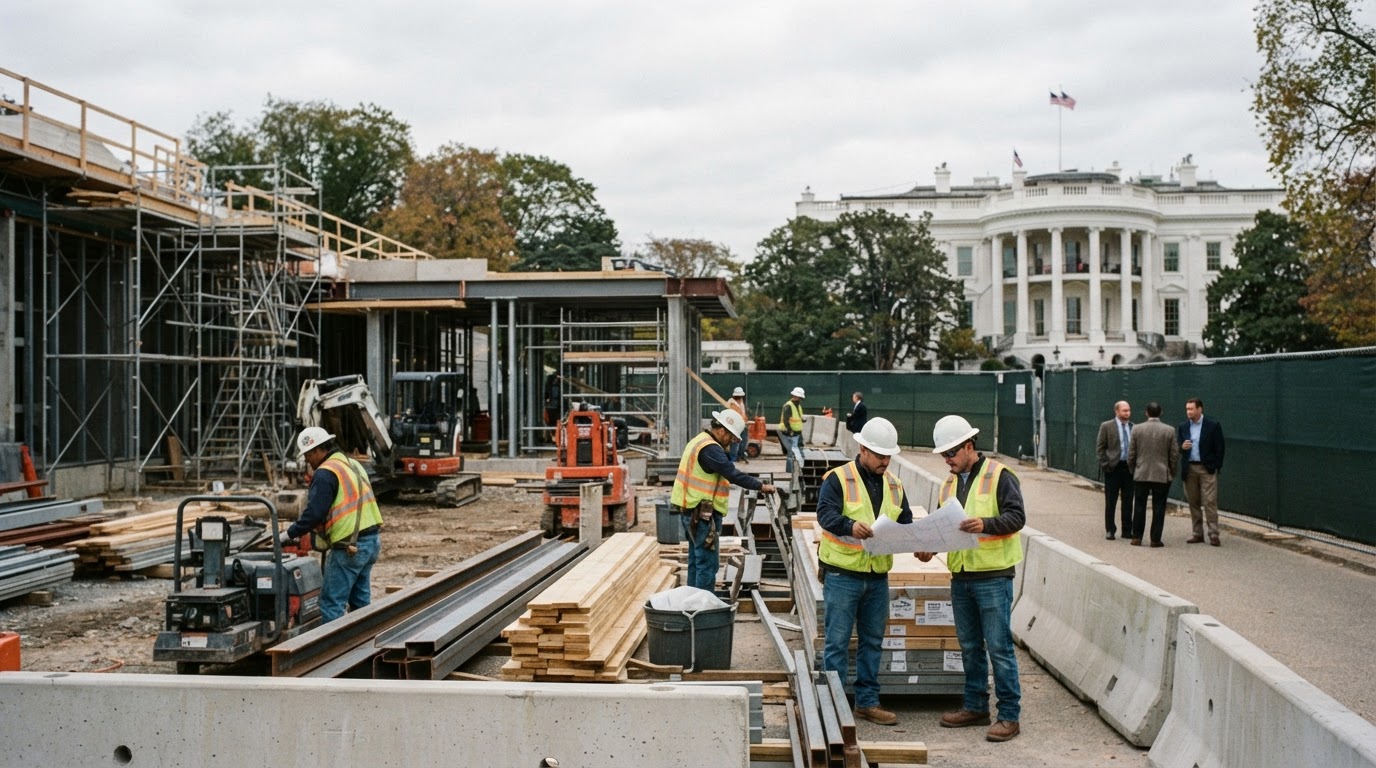
Marine One flying over the ongoing White House construction site demonstrates a government openly integrating corporate capital into state real estate. Apple and Nvidia have purchased momentary domestic reassurance at the expense of systemic market transparency. What remains unresolved is the structural vulnerability of production networks outside the United States, which must absorb the destabilizing shockwaves of American executive patronage without any seat in the room.
Sources
Newsletter
Pacific Daily
A curated briefing from Thailand, Asia-Pacific and the world.