France Deploys Force to Cover the Cracks of Fuel and Living Costs
Mobilising 70,000 security personnel on a single Saturday answers unrest with tactical containment while leaving the fiscal triggers untouched.
SINGAPORE
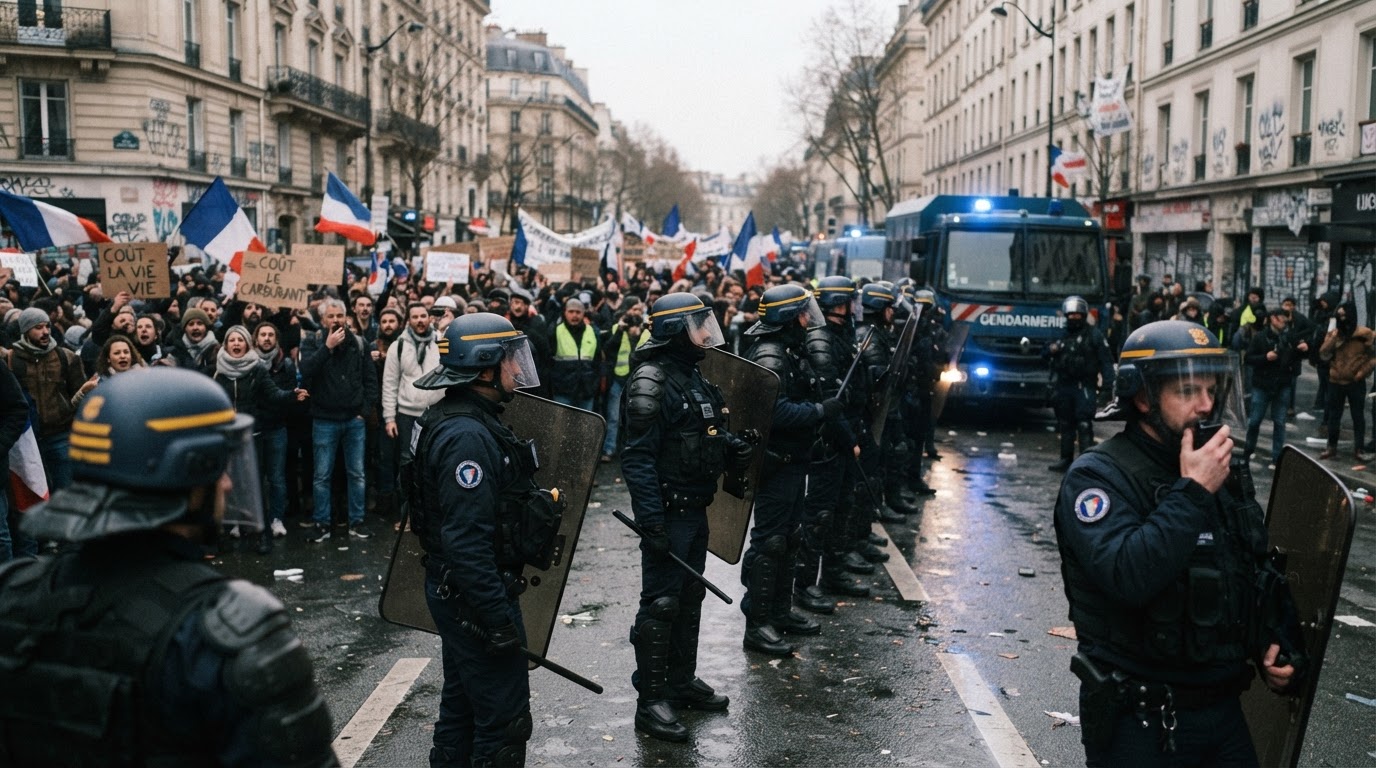
A security apparatus operates as a temporary balance-sheet expenditure when structural inflation outpaces civic tolerance. On Friday, Oct 23, 2026, Interior Minister Laurent Nunez confirmed that France will deploy 70,000 police across the country on Saturday, Oct 24. The stated intention is straightforward: authorities want to prevent a rerun of the property damage, looting, and street confrontation that broke out during recent demonstrations. Elite units and mobile formations will monitor urban centres alongside standard detachments. Yet the sheer scale of the operation signals an administrative system reacting to symptoms after core economic buffers have failed.
Public dissent does not assemble 70,000 security officers out of thin air. In recent weeks, sustained frustration surrounding living costs, strained public services, and climbing fuel prices has pulled students, unions, and workers into common ground. When municipal staff spent Friday morning clearing fresh paint from the pedestal of the Louis XIV equestrian monument at Place Bellecour in Lyon, the choreography demonstrated how rapidly symbolic urban real estate becomes collateral. Civil unrest rarely targets monuments out of historical grievance alone; it targets public space because institutional channels have stopped absorbing household economic pressure.
The Cost of Tactical Containment
Nunez framed the state position around deterrence rather than negotiation. The minister asserted that the government will remain uncompromising against rioters, looters, and anyone committing violence. Such declarations reassure retail business owners and municipal administrations who bore the immediate financial brunt of last weekend's disruptions. Property destruction imposes real economic friction on logistics, commercial foot traffic, and private balance sheets. Enforcing public order is a statutory obligation that any governing executive must deliver.
We will be uncompromising with rioters, looters and all those who commit acts of violence,
The tactical calculation, however, carries diminishing returns. Mobilising 70,000 uniformed officers nationwide absorbs municipal capacity, diverts regional law enforcement, and incurs heavy fiscal overhead for a single operational cycle. While elite squads and road checkpoints can disperse assemblies or isolate flashpoints, police cordons cannot subsidise transport logistics, adjust energy retail margins, or repair underfunded public services. Deploying thousands of officers to contain street demonstrations functions as an expensive holding pattern. It absorbs street-level volatility without adjusting the policy levers that produced the crowd.
Unresolved Economic Drivers
External statecraft already reflects this domestic friction. Demonstrations have reshaped the broader executive schedule, with state leadership delaying an official trip to Africa to manage the domestic crisis. When domestic inflation protests alter foreign diplomacy, internal economic instability ceases to be a strictly domestic policing issue. For external markets and international trading counterparties watching European stability, frequent mass disruptions serve as a bellwether of underlying macroeconomic stress.
Similar dynamics challenge trade-dependent economies across Asia, where energy volatility and essential consumer costs routinely test government subsidies and fiscal room. When basic living expenditures outstrip domestic wage growth, security crackdowns provide temporary street clearance at the expense of wider civic legitimacy. A state can clear urban thoroughfares on Saturday, but Monday morning brings the same fuel pump receipts and the same eroded household budgets.
Security mobilisations of this magnitude reveal an administration operating defensively against its own taxpayers. Deterrence can deter spontaneous property destruction in city plazas, yet it creates no fiscal resolution for energy markets or stretched social safety nets. The tactical presence on French avenues will hold the line for a weekend shift, but the economic imbalance that filled the streets remains entirely intact.
Sources
Newsletter
Pacific Daily
A curated briefing from Thailand, Asia-Pacific and the world.