Curating Statehood Through Concrete and Line
The archival display of Independence Palace's construction records exposes how architectural projects formalise administrative legitimacy amid political fragility
SINGAPORE
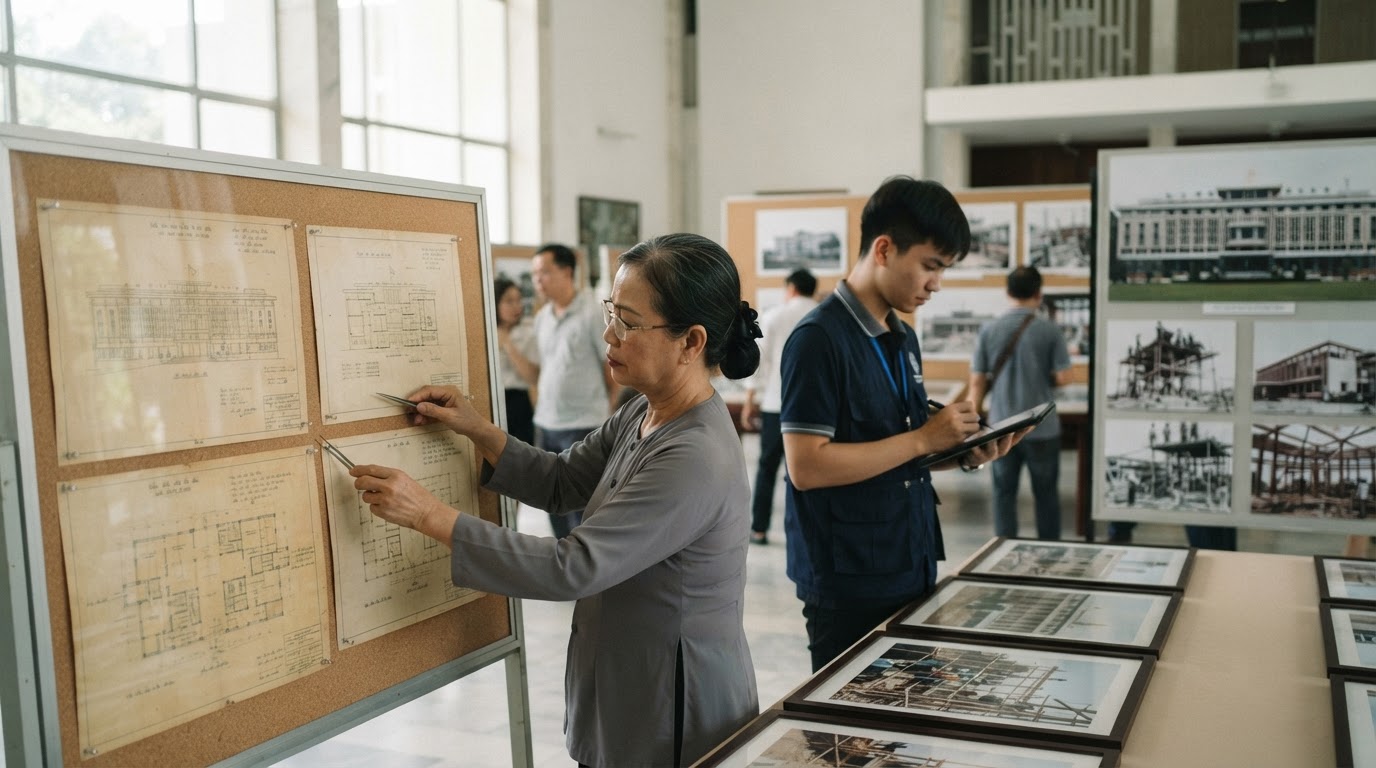
State authority in post-colonial Southeast Asia has long depended on physical structures engineered to project permanence faster than political institutions could consolidate it. In Ho Chi Minh City, an exhibition marking the sixtieth anniversary of the inauguration of Independence Palace on Oct. 31, 1966, places around 100 architectural drawings and photographs into public view. These records document more than four years of design and construction, revealing the technical calculation required to erect an administrative seat while military conflict threatened the regime commissioning it.
The site itself embodies successive efforts by governing authorities to anchor executive power in monumental masonry. Completed by the French colonial administration in 1871, the original structure, Norodom Palace, functioned as the headquarters for the Governor of Cochinchina before expanding into the official seat of the Governor-General of French Indochina. When Ngo Dinh Diem, then Prime Minister of the State of Vietnam, formally received the complex from France in 1954, renaming it Independence Palace was an explicit attempt to repurpose an apparatus of imperial control into a symbol of sovereign autonomy. That symbolic transfer, however, could not insulate the executive from domestic fractures.
On Feb. 27, 1962, two pilots from the Republic of Vietnam Air Force, Pham Phu Quoc and Nguyen Van Cu, bombed the compound in an aerial strike. The assault inflicted severe structural destruction, demonstrating that an inherited palace offered little deterrence against internal military dissent. Rather than restoring the damaged colonial shell, the administration cleared the debris to commission an entirely new complex, initiating over four years of reconstruction that culminated in the 1966 inauguration.
The Architecture of Contested Authority
Viewing these design records through a strategic lens clarifies how governance across the region has historically relied on infrastructure to assert stability during crises. The newly displayed drafting plans represent more than technical specifications for mortar and reinforced beams. They outline an effort to fabricate institutional credibility through modern design at the very moment the state faced existential military pressure.
The transition from colonial residence to reconstructed headquarters illustrates how governing regimes deploy public architecture to project continuity.
Such physical projections carry inherent operational limits. Erecting a monumental edifice creates an impression of durability, yet concrete foundations cannot substitute for civilian consensus or administrative coherence. The Republic of Vietnam sought to project modern executive command through the 1966 complex, yet the building survived the government that financed its completion. Architectural scale often masks structural political fragility, offering an illusion of permanence while underlying state mechanisms fracture.
Unresolved Legacies of Administrative Space
Regional observers evaluating modern public infrastructure projects encounter an enduring tension between symbolic intent and political survival. Across post-war Asia, successor regimes frequently inherit and repurpose administrative spaces designed by departed administrations, converting former bastions of exclusive authority into civic museums or state reception halls. Displaying the working drafts sixty years later shifts public attention toward technical labor, yet the structural record preserves the acute vulnerability that prompted the 1962 demolition.
The archival exhibition in Ho Chi Minh City demonstrates the operational limits of structural engineering as an instrument of political survival. The persistent constraint lies in the division between material fortification and strategic stability. While around 100 drawings document the technical precision achieved over four years of construction, reinforced concrete preserves the physical facility without resolving the administrative and security vulnerabilities of the authority directing it.
Sources
Newsletter
Pacific Daily
A curated briefing from Thailand, Asia-Pacific and the world.