Why Early Balloting in Washington Tests Asian Policy Stability
A surge past half of total 2022 turnout signals political friction that foreign ministries across the Pacific can neither predict nor hedge against
SINGAPORE
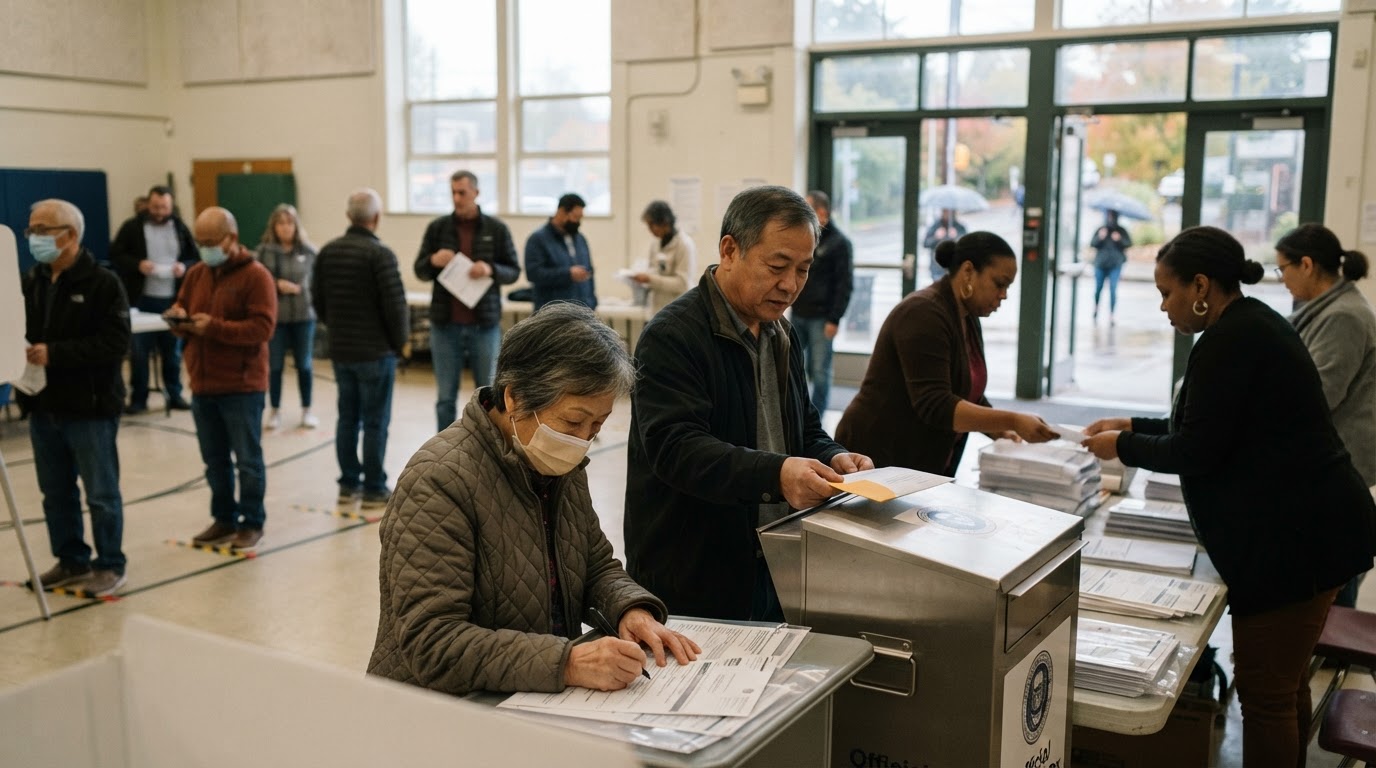
Midterm congressional contests in the United States once conformed to an established rhythm of voter apathy, allowing external trading partners to treat congressional swings as cyclical adjustments rather than structural shocks. That stability disappears when early participation surges past half of the entire turnout recorded in 2022. Early participation at this volume signals deep societal mobilization, dismantling the standard assumption that off-year American elections produce predictable, low-energy outcomes.
Early tallies demonstrate that voters are treating legislative control not as an administrative adjustment, but as a contest over the regulatory and economic architecture of the state. Reports that Democrats have mobilized early voters point toward a polarized electorate determined to lock in legislative standing before election day. For governments across East and Southeast Asia, this degree of domestic friction inside the United States alters how bilateral commitments must be evaluated. When domestic mandates are fiercely disputed at home, external economic and strategic policies rarely remain insulated.
Shifting legislative power and trade continuity
Regional planning across Asia depends on steady trade posture and regularized diplomatic communication. Over decades, sovereign capitals adapted to Washington's regular political rotations by relying on institutional inertia to preserve trade arrangements and regional security frameworks. Yet a sustained shift in early voting patterns reflects an underlying volatility that disrupts institutional habits.
Surpassing half of the total 2022 turnout before polling day demonstrates that voter mobilization has broken past historical mid-decade baselines.
Industrial policy provides a clear example of this friction. Legislative majorities determine funding allocations, supply chain directives, and tariff oversight. If a divided electorate reshapes congressional committee oversight, trading partners in Asia face sudden changes in trade enforcement and market access guidelines. Thailand, which relies on dependable access for manufacturing and agricultural exports, finds its commercial visibility narrowed when trade rules become collateral in domestic legislative battles. When legislative majorities shift abruptly, commercial agreements negotiated under one congressional configuration frequently face immediate oversight challenges from the next.
Unequal impacts across Asian trading partners
Different regional economies absorb this domestic friction through entirely different vulnerabilities. In manufacturing economies such as Thailand, uncertainty primarily threatens supply chain integration and investment planning. Industrial producers cannot readily adjust capital allocation when trade compliance standards shift alongside congressional majorities. The challenge is structural: supply chains require years of stability to mature, whereas deeply contested legislative branches operate on biennial political survival.
Advanced manufacturing economies face an alternative pressure. Where Thailand manages export stability, regional industrial peers confront targeted export restrictions and domestic manufacturing subsidies that depend on congressional appropriations. In both cases, the root instability remains identical. An American political system characterized by record early mobilization produces sharp policy revisions rather than steady administrative continuity.
Skeptics may argue that early voting volumes merely reflect procedural convenience rather than ideological intensity, suggesting that methods of voting change while the eventual legislative outcomes follow familiar historical patterns. That argument understates how early mobilization shapes the conduct of governance. When voters mobilize early and in unprecedented proportions, candidates operate under heightened pressure to satisfy party bases, narrowing the political room for legislative compromise. A polarized congress leaves executive agencies with less flexibility to negotiate durable bilateral trade concessions.
Foreign ministries across Asia can no longer assume that post-election governance in the United States will settle into familiar administrative patterns. The unresolved tension lies in the mismatch between regional economic planning, which requires multi-year stability, and an American electoral environment whose persistent mobilization ensures that long-term policy commitments remain perpetually provisional.
Sources
Newsletter
Pacific Daily
A curated briefing from Thailand, Asia-Pacific and the world.