When the Pacific Rewrites the Travel Map
Typhoon Champi exposes the fragile logistics underpinning East Asian island tourism
SINGAPORE
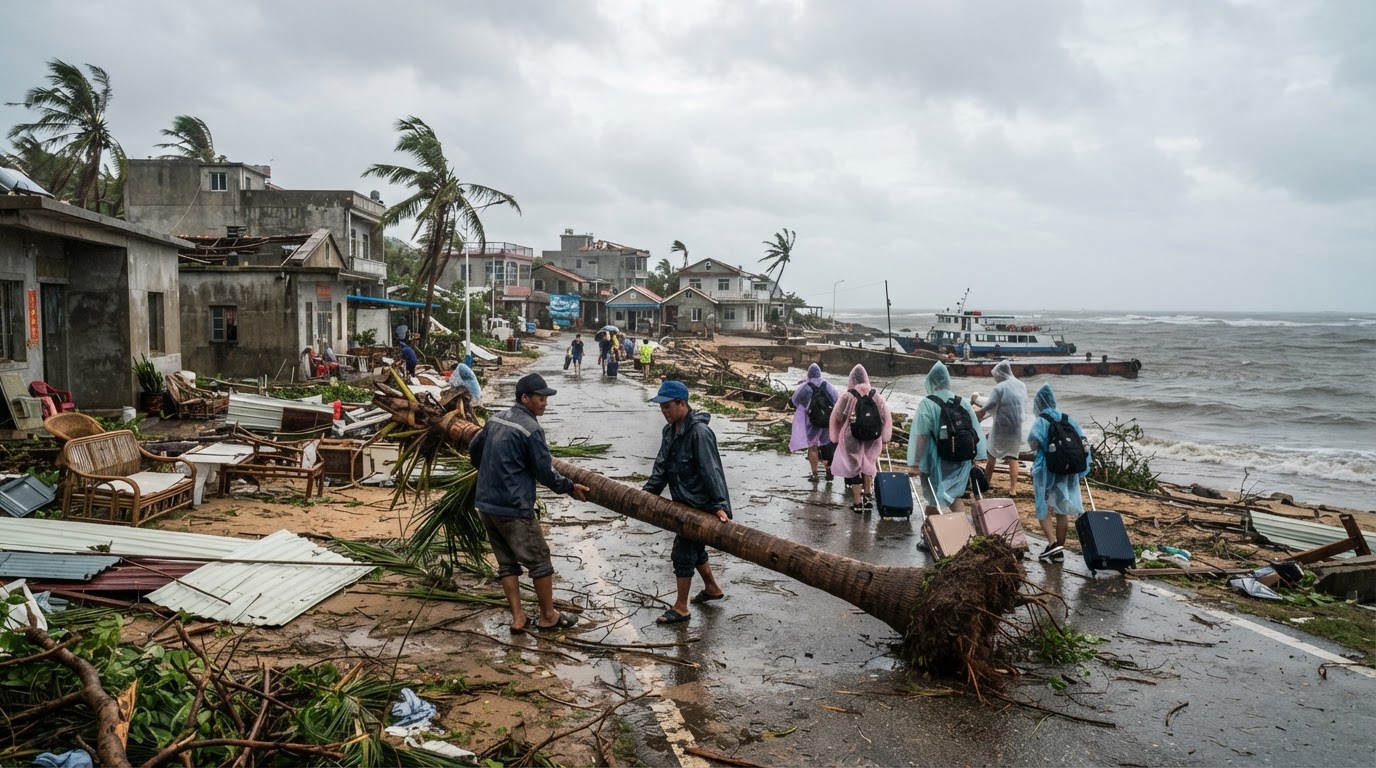
Coastal walls along Keelung took the first heavy swell on Thursday, Oct 22, 2026, hours before the core of Typhoon Champi pushed within striking distance of Taiwan. Water broke hard against northern sea barriers, sending spray over perimeter roads while fishing vessels huddled in tight rows inside inner harbours. Inland, civic activity thinned out with deliberate speed. Markets lowered metal shutters, railway corridors halted rolling stock, and terminals stood empty across the island as Friday arrived under an island-wide suspension of commerce.
Modern regional movement across East Asia relies on an assumption of constant physical circulation. Island destinations market accessibility as an absolute constant, inviting visitors to treat short-haul geography like an uninterrupted transit corridor. Yet oceanic autumns reliably reject that convenience. Champi arrived as a storm measuring roughly 320km in radius, an atmospheric expanse sufficient to blanket nearly the entire landmass of Taiwan. Its outer circulation drove heavy rainfall through Yilan and surrounding mountain passes while maximum gusts near its centre reached around 191kmh, according to Taiwan's Central Weather Administration.
The Illusion of Frictionless Island Mobility
Tourism schedules rarely account for meteorological sovereignty. Holiday packages, corporate conferences, and weekend excursions operate against tight digital timetables, presuming commercial aviation absorbs whatever weather develops overhead. When Champi approached within 170km east of the coast, that presumption evaporated instantly. Hundreds of scheduled flights disappeared from departure boards, anchoring passengers to terminals and hotel lobbies across both domestic and international routes.
Physical geography eventually claims priority over scheduled leisure, imposing stillness on systems designed for perpetual movement.
Halting an economy ahead of a tropical cyclone is not an administrative accident; it represents an institutional discipline built through decades of disaster management. The Central Weather Administration noted the cyclone had previously reached super typhoon intensity, standing among the most ferocious Pacific systems recorded this year. Even as the system showed signs of weakening upon approach, municipal authorities enforced strict closures. In places like Keelung and Yilan, the priority was survival and civil protection, leaving commercial mobility entirely sidelined.
This deliberate paralysis highlights an ongoing friction between leisure promotion and climatic reality. Travel operators promote island destinations through seasonal marketing campaigns that gloss over severe meteorological transitions. Regional travellers treat late October as a mild window for transit, underestimating how thoroughly a single storm front can suspend transportation grids across the northern Pacific.
Seasons Beyond Commercial Schedules
Neighbouring corridors across Japan and China monitor these storm tracks with equal wariness. The displacement of dozens of international flight paths ripples outward through regional transit hubs, stranding aircraft and crews thousands of miles from the storm's physical centre. A disruption in Taipei or Kaohsiung alters operations along flight paths serving Tokyo, Hong Kong, and Southeast Asian capitals. Weather systems of this magnitude reveal how tightly knit East Asian travel corridors actually are, and how rapidly their interconnectivity dissolves under atmospheric pressure.
Resilience in regional tourism cannot merely mean faster recovery protocols; it requires confronting environmental limits directly. Visitors often view disrupted itineraries as administrative failures rather than necessary surrenders to nature. The protective shutdown across Taiwan demonstrates that community survival depends precisely on knowing when to stop operating completely.
By late Friday, sea walls at Keelung remained shrouded under rising surf and gray squalls. The surrounding streets stayed silent, devoid of pedestrian traffic and tour groups. The empty concourses and grounded aircraft served not as emblems of defeat, but as evidence of a society that understands its ocean. Long after flight schedules normalize, the Pacific retains the ultimate authority over who arrives and who stays behind.
Sources
Newsletter
Pacific Daily
A curated briefing from Thailand, Asia-Pacific and the world.