Urban Transit, Commercial Footfall and the Limits of Judicial Deterrence
Repeated convictions for voyeurism in Singapore expose how routine public architecture remains vulnerable to predatory behaviour despite escalating legal warnings
SINGAPORE
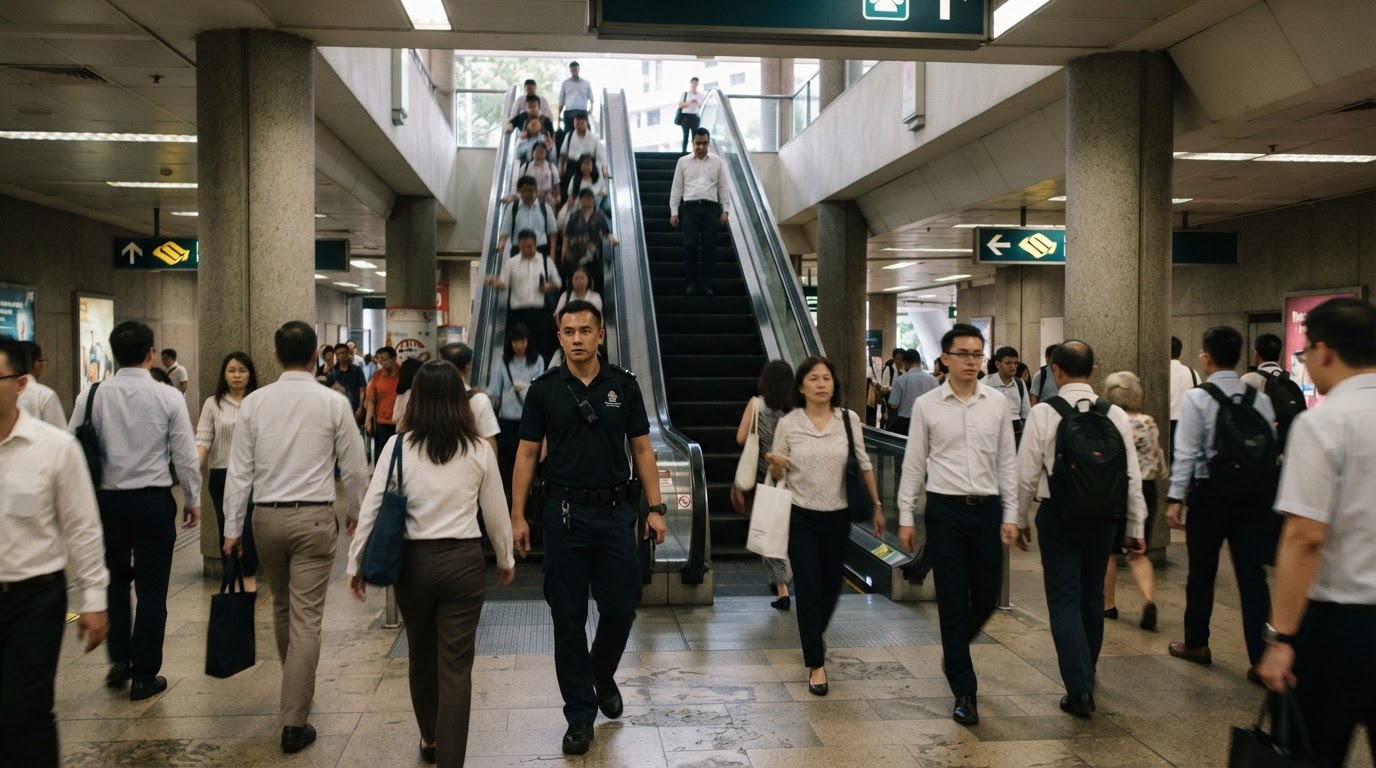
The glass-and-steel concourses of modern retail transit hubs function on predictable pedestrian momentum. Daily foot traffic moves along escalators and multi-level shopping corridors at Northpoint City in Yishun, where physical design prioritises fluid circulation and uninhibited sightlines. Inside these shared commercial volumes, communal safety rests on unspoken compliance rather than continuous policing. When an environment is constructed to channel thousands of people effortlessly between train platforms and storefronts, the architecture inherently assumes mutual respect.
Once an individual methodically subverts that physical proximity, the failure exposes an uncomfortable friction between architectural openness and personal security.
On Friday, Oct 23, 2026, Gary Huang Kunjie appeared at the State Courts for taking upskirt videos, receiving another prison term alongside an explicit judicial warning that future infractions could bring caning. Public reporting by Koh Wan Ting documented that Huang had accumulated convictions in each year between 2018 and 2022, as well as in 2025. Across nearly a decade, custodial sentences failed to break a cycle of predatory surveillance targeting women moving through everyday public transit and retail facilities. Repeated court appearances underscore an enduring challenge: regular carceral sentences remove an offender temporarily, but they do not alter the predictable public conditions that enable recurring misconduct.
The Breakdown of Routine Sanctions
Penal systems operate under the working assumption that progressive detention alters offender calculations through escalating personal cost. In retail environments, physical transit corridors like escalators offer opportunistic sightlines that offenders repeatedly exploit. When Huang walked into the State Courts again in Oct 2026, the institutional response confronted an obvious operational impasse. The persistence of identical misconduct across multiple consecutive calendar terms indicates that standard carceral periods do not automatically extinguish repetitive illicit compulsions. Authorities responded by introducing the threat of corporal punishment, signalling that standard imprisonment had exhausted its deterrent utility against repeated voyeurism. Invoking caning highlights institutional frustration when incremental custodial terms produce no behavioural change. Yet relying solely on heightened physical retribution addresses the offender only after the recording occurs, leaving the spatial setting where dozens or 100 victims are compromised entirely unchanged.
The legal system tallies the ledger of repeat convictions; the concourse continues to supply the opportunity.
Surveillance and Public Movement
Dense retail complexes depend on constant, trusting footfall. Yishun commuters step onto escalators expecting mechanical convenience, yet vertical transport creates angles of elevation that allow discreet handheld cameras to operate unnoticed in heavy crowds. The vulnerability is structural: modern shopping hubs merge public transit with multi-tier retail to maximise human exposure to storefronts, generating crowded vertical thresholds where proximity is unavoidable. Neither standard closed-circuit cameras nor intermittent floor patrols easily detect lens manipulation within a dense press of ascending shoppers.
The mechanical cadence of public escalators continues to offer predatory angles that criminal penalties alone struggle to close.
Judicial warnings can record displeasure and mandate corporal escalation, but transit operators and retail developers rarely alter the architectural conditions that facilitate clandestine filming. The legal process focuses on the individual ledger of recidivism, while ordinary commuters continue to absorb the ambient threat of covert capture. Until public environments account for the predictable misuses of elevated pathways, the burden of vigilance remains unfairly shifted onto women navigating ordinary transit hubs. Structural adjustments, such as modified balustrades, altered sightlines or shielded transit stairs, receive scant attention when crime prevention is treated exclusively as a penal responsibility.
At commercial junctions in Singapore, the escalators continue running with regular, indifferent momentum. A recalcitrant voyeur may sit inside a cell facing corporal threats, yet the physical passages through which thousands travel each morning remain identical, waiting for legal deterrents to achieve what spatial architecture has left entirely exposed.
Sources
Newsletter
Pacific Daily
A curated briefing from Thailand, Asia-Pacific and the world.