Coastal Tourism Confronts the Limits of Manufactured Stability
Successive tropical storms and contested real estate along Mexico’s western littoral show how leisure enclaves struggle against environmental strain
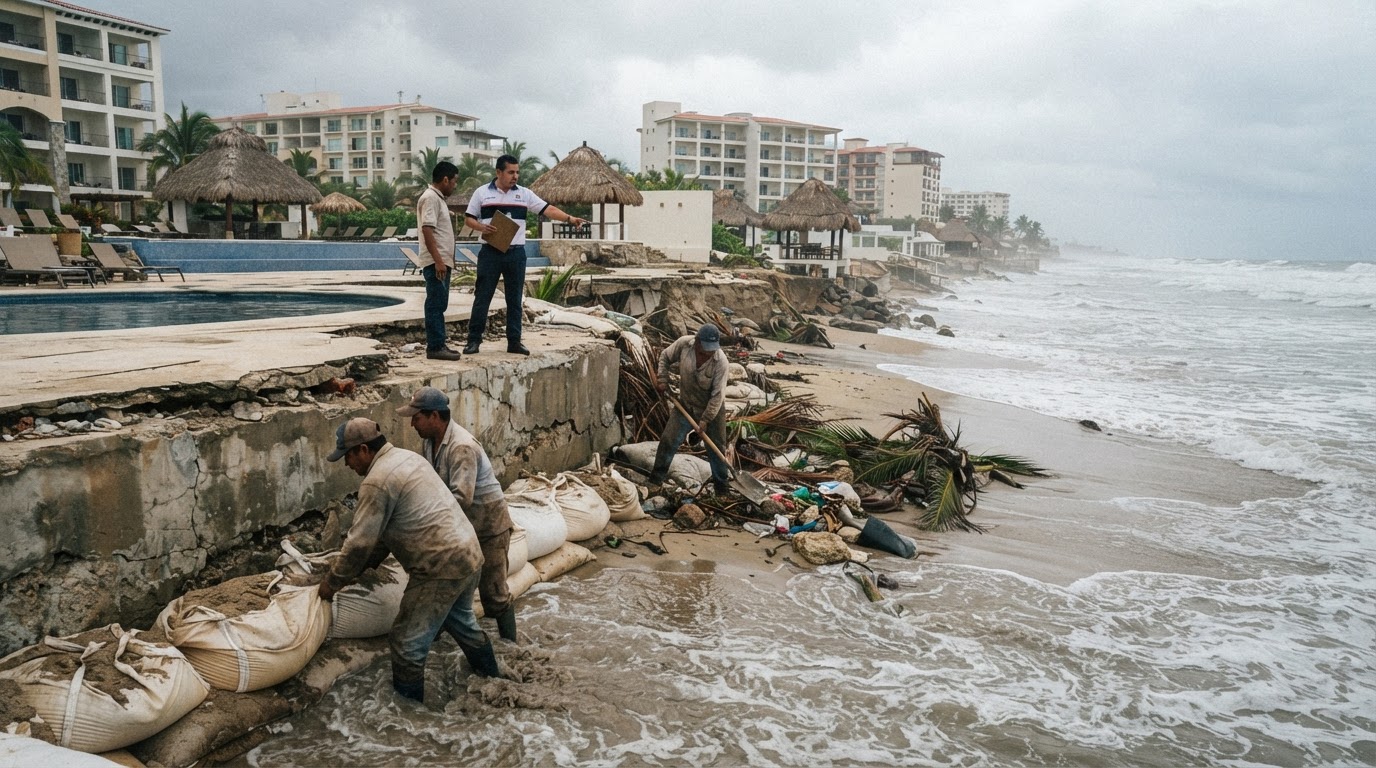
A coastline engineered primarily for leisure demands an unwritten compliance from the travellers who arrive at its water's edge, asking them to accept the illusion that manicured comfort can permanently hold a volatile ocean at bay. Visitors seek stillness, trusting that private amenities will buffer them from seasonal geography. That expectation is cracking. Four consecutive storm systems—Polo, Rachel, Simón, and Trudy—have recently brushed past Puerto Vallarta, transforming emergency weather monitoring into an exhausting civic ritual.
While direct storm damage remained relatively moderate within Vallarta itself, the broader weather system generated severe coastal flooding across the Baja California peninsula and erosion tied to ocean anomalies in Southern California. The offshore squalls accompanied an already fraught municipal landscape. Reporting for Mexico News Daily, Debbie Slobe recorded an uneasy convergence of local flashpoints: an ordered demolition targeting an unauthorized condominium complex in San Pancho, Nayarit; public anger over aggressive tree culling on local golf course properties; and the installation of basic public drinking water fountains across town. These episodes do not represent isolated civic friction. Viewed together, they signal an escalating contradiction between speculative leisure property and ecological reality.
The Architecture of Extraction
Resort enclaves require constant physical intervention to uphold the premise of effortless luxury. When commercial developers fell mature trees across fairways or erect concrete residential towers without regulatory sanction, they steadily erode the vegetative barriers that cushion shorelines against cyclonic squalls. The administrative intervention in Nayarit confirms that municipal authorities face growing friction when real estate ventures overreach statutory boundaries. Capital builds quickly. Municipalities inherit the physical aftermath.
When resort economies treat their home terrain as an inert backdrop, each recurring weather front reveals how vulnerable that bargain has become.
Advocates of intensive resort construction often contend that luxury residential towers and recreational courses anchor local employment, generating revenue that funds municipal public works like free drinking water infrastructure. That defense assumes maritime conditions will stay benign enough to allow perpetual commercial operations. This assumption appears increasingly fragile. Even when cyclones skirt the littoral without making direct landfall, massive offshore swells wear down shorelines, snarl regional transport, and leave resort staff managing municipal emergencies. The margin between an ordinary tropical front and prolonged civic paralysis remains perilously narrow.
Civic Reality Along the Coast
Across the Pacific rim, coastal enclaves that rely on tourist traffic share identical structural vulnerabilities. Rapid urban expansion shaped entirely around visiting holidaymakers distorts local priorities. When real estate developers denude golf course greenery or circumvent zoning permits along vulnerable beachfronts, the immediate risks fall disproportionately on local residents. Municipal drinking fountains supply welcome local utility, yet surface-level public works cannot correct systemic development imbalances.
A leisure corridor cannot remain perpetually sealed off from the regional climate that defines its borders. The successive arrivals of systems like Simón and Trudy demonstrate that stability along the Pacific cannot be manufactured through decorative turf and unenforced building codes. What the coastline now asks of everyone—both visitors and municipal planners—is an acknowledgment that leisure property remains subordinate to natural terrain. Coastlines eventually reclaim their space.
Sources
Newsletter
Pacific Daily
A curated briefing from Thailand, Asia-Pacific and the world.