When the Air Keeps Children Home: How Southeast Asia's Haze Is Reshaping Everyday Life
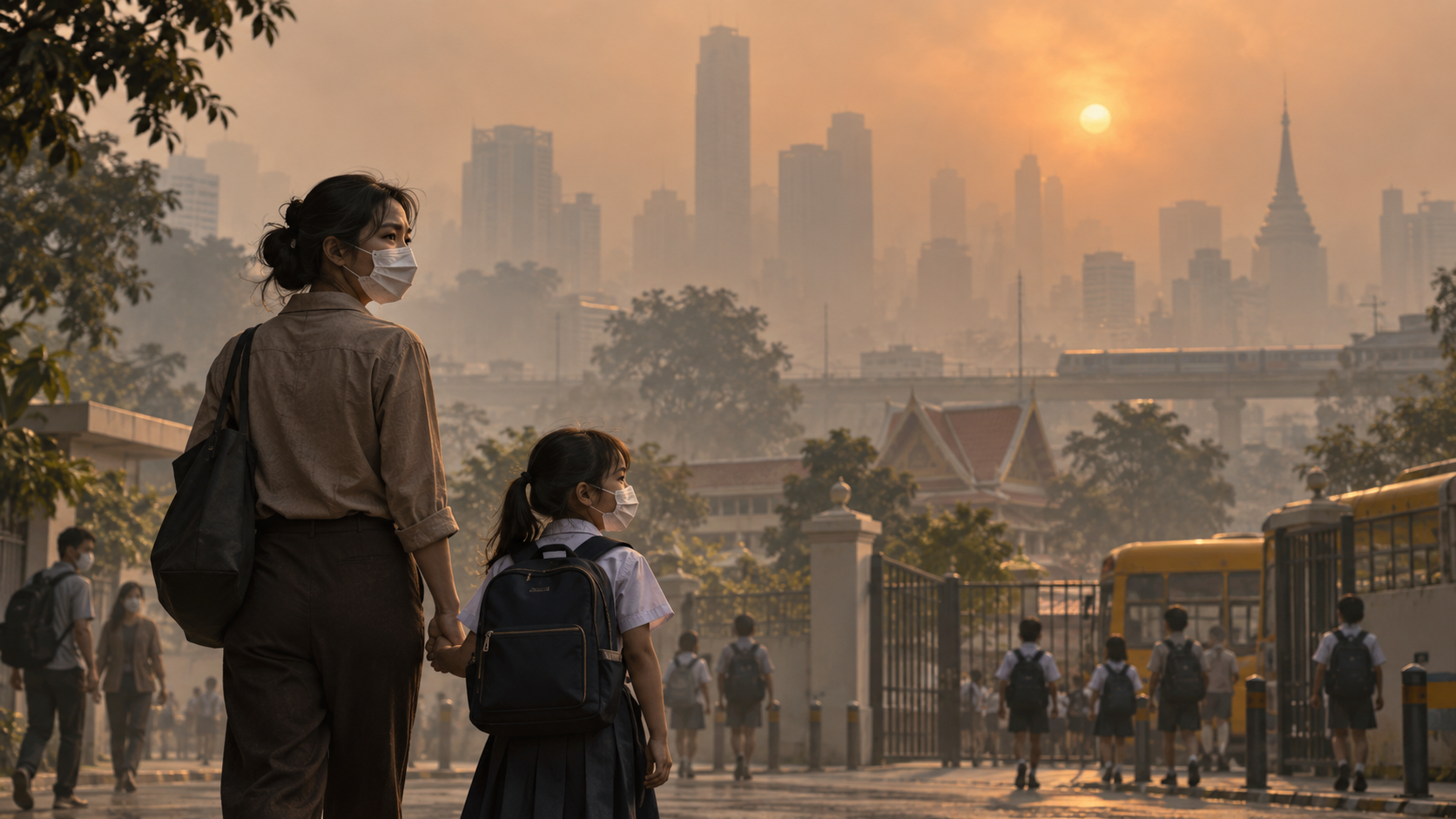
As unhealthy air pollution forces school closures in Malaysia and disrupts daily routines across parts of Southeast Asia, the region's recurring haze problem is becoming more than an environmental emergency. It is changing how families plan their days, how schools operate and how cities confront the growing cost of living with polluted air.
KUALA LUMPUR, MALAYSIA — October 9, 2026
For millions of families across Southeast Asia, an ordinary morning begins with a familiar series of decisions.
What time should the children leave for school? Will the commute be difficult? Is the weather suitable for outdoor activities?
In parts of Malaysia this week, another question has become increasingly important: is the air safe enough to go outside?
On October 9, educational institutions in several Malaysian states and federal territories faced closures as deteriorating air quality prompted authorities to take protective measures.
Schools in Selangor and Putrajaya were among those instructed to close, while additional restrictions affected other areas, including Rompin in Pahang.
The decisions followed rising Air Pollutant Index readings and renewed concern over smoke haze spreading across the region.
At 3 p.m. on October 8, Malaysia's national news agency Bernama reported unhealthy air quality in 38 areas across Peninsular Malaysia. Segamat in Johor recorded an index reading of 190, followed by Seremban at 186 and Nilai at 185.
Across the border, Singapore was confronting similar concerns.
According to the National Environment Agency, Singapore's 24-hour Pollutant Standards Index ranged from 98 to 139 at 6 p.m. on October 8, spanning the Moderate and Unhealthy categories.
The agency also reported smoke plumes drifting towards the island from parts of Sumatra and Kalimantan.
Together, the developments highlight a recurring vulnerability in Southeast Asian life.
Air pollution does not remain within national borders. Its consequences extend into homes, schools, workplaces and the decisions that shape everyday routines.
When Staying Indoors Becomes a Public Policy
A school closure is often reported as an administrative decision.
For families, however, it can represent an immediate reorganisation of daily life.
Parents may have to arrange childcare at short notice. Teachers must adjust their schedules. Students may be required to continue lessons from home, depending on the instructions issued by education authorities.
In Malaysia, affected institutions have been directed to provide home-based learning while taking account of students' access to resources, individual needs and teachers' readiness.
Such arrangements demonstrate how environmental conditions can influence the practical functioning of an education system.
A classroom is not an isolated space. It depends on safe transport, outdoor movement, reliable infrastructure and the ability of families to organise their time around a predictable school day.
When pollution makes those conditions difficult to maintain, learning becomes a question of public health as well as educational continuity.
The burden is not necessarily distributed equally.
Households with flexible working arrangements may find it easier to accommodate unexpected changes. Families whose income depends on physical attendance at work may face more difficult choices.
Access to reliable internet connections, suitable indoor study spaces and adult supervision can also shape the experience of learning from home.
These are not consequences unique to haze. They reveal broader inequalities that become more visible when ordinary public services are disrupted.
The Hidden Cost of Polluted Air
The economic consequences of air pollution are often discussed in terms of healthcare expenditure and productivity.
Yet its influence on daily spending can be more immediate.
When outdoor conditions deteriorate, households may reconsider recreational plans, postpone exercise or spend more time in enclosed environments.
Families may pay greater attention to ventilation, air filtration and indoor air quality.
Businesses whose activities depend on outdoor visitors may face uncertainty when customers become reluctant to spend time outside.
Meanwhile, employers must determine how to protect staff whose responsibilities cannot be performed remotely.
These responses do not necessarily translate into a uniform increase in consumer spending. Their effects depend on income, location, the severity of pollution and the options available to each household.
What they reveal is a change in how people evaluate their living environments.
Clean air is usually treated as an ordinary condition of urban life.
During a haze episode, it becomes a resource whose absence influences decisions about mobility, comfort and personal wellbeing.
For cities seeking to improve their quality of life, that distinction matters.
An attractive urban environment cannot be measured only by the number of restaurants, shopping centres, parks or cultural attractions it offers.
Residents must also be able to use those spaces without routinely worrying about the air they breathe.
Why the Haze Travels Across Borders
Southeast Asia's recurring haze episodes are closely connected to fires and land-management conditions in parts of the region.
During dry periods, fires affecting forests and peatlands can release substantial quantities of smoke.
Weather patterns then influence how those emissions travel.
Prevailing winds may carry smoke over considerable distances, exposing communities far from the original fires.
On October 8, Singapore's National Environment Agency reported moderate to dense smoke plumes from southern and central Sumatra and West Kalimantan moving towards Singapore.
Dry conditions in parts of Indonesia increased concern that smoke haze could persist.
The geographical scale of these episodes makes them particularly difficult to manage.
National authorities can introduce measures to protect residents within their territories, but the origins and movement of pollution may involve conditions beyond their direct control.
The resulting challenge is regional as much as domestic.
Fire prevention, land management, atmospheric monitoring and environmental enforcement require cooperation that extends across borders.
The repeated appearance of haze also raises an uncomfortable question.
If governments and communities have experienced similar disruptions before, why does the problem continue to interfere with schools, workplaces and daily life?
There is no single answer.
The causes involve environmental conditions, economic incentives, land-use practices and the difficulty of managing fires across extensive landscapes.
A meaningful response therefore requires more than temporary measures introduced after air quality has already deteriorated.
Living With Air Quality Numbers
For many residents, air-quality monitoring has become an increasingly practical part of daily decision-making.
In Malaysia, the Air Pollutant Index is used to assess pollution conditions and guide protective measures.
Singapore uses the Pollutant Standards Index, alongside more immediate readings of fine particulate matter known as PM2.5.
Although both systems communicate air-quality conditions, their figures should not be compared as though they were interchangeable measurements.
Their calculation methods and reporting frameworks differ.
What matters to individuals is understanding which indicator is appropriate for a particular decision.
Singapore's National Environment Agency advises residents to consider the one-hour PM2.5 reading when assessing immediate outdoor activities, while the 24-hour PSI forecast is useful for planning ahead.
The distinction is important because air conditions can change throughout the day.
An index reading observed in the morning may not accurately describe conditions later in the afternoon.
Likewise, a regional average may not fully capture local differences in pollution exposure.
For households, the most useful approach is to follow current information from official monitoring services rather than relying solely on the appearance of the sky.
How Families Can Reduce Exposure
Health authorities generally advise reducing exposure when haze conditions become unhealthy, with additional precautions for people who are more susceptible to air pollution.
Children, older adults, pregnant women and individuals with chronic heart or lung conditions may need to limit prolonged or strenuous outdoor activity more carefully.
The World Health Organization recommends staying indoors with doors and windows closed when wildfire smoke pollution is high, provided that doing so does not create an unsafe indoor environment.
Using appropriately maintained indoor filtration and avoiding unnecessary outdoor exposure can also help reduce contact with smoke particles.
For people who must remain outdoors for extended periods under severe conditions, a properly fitted particulate respirator may be appropriate.
However, mask recommendations depend on the pollution level, individual health and duration of exposure.
Singapore's Ministry of Health notes that N95 respirators are generally unnecessary for short routine journeys during haze and that reducing prolonged outdoor exertion is often a more relevant precaution.
The lesson is not that every period of haze requires the same response.
It is that precautions should be proportionate to the conditions and the vulnerability of the people involved.
Reliable information and sensible adjustments to daily routines are more useful than panic-driven decisions.
The Unequal Geography of Protection
One of the least visible consequences of haze is the difference between people who can avoid exposure and those who cannot.
An office employee may be able to work in an enclosed building.
A delivery rider, construction worker or street vendor may have little choice but to remain outdoors.
Similarly, some households can reduce exposure by spending more time in well-sealed, air-conditioned spaces, while others must contend with buildings that offer limited protection from outdoor pollution.
This creates an environmental inequality that is easy to overlook when air quality is discussed only through citywide averages.
In Singapore, the Ministry of Manpower has issued guidance requiring employers to assess haze-related risks for outdoor workers.
When the 24-hour PSI enters the Unhealthy range of 101 to 200, employers are advised to reduce prolonged or strenuous outdoor work.
More stringent precautions apply as pollution levels rise.
These measures acknowledge that exposure is partly determined by the nature of a person's work, not simply by personal choice.
The broader policy question is whether protection from polluted air should depend on an individual's occupation, housing conditions or ability to purchase additional equipment.
In a region where outdoor work remains essential to transport, food services, logistics and construction, that question has consequences extending well beyond individual comfort.
A Regional Lifestyle Issue, Not Just an Environmental Headline
The current haze episode illustrates why environmental reporting increasingly belongs within the wider conversation about lifestyle and public wellbeing.
Lifestyle is often associated with consumption: what people eat, where they travel, how they exercise and which products they choose.
But everyday life also depends on conditions that individuals cannot fully control.
Air quality determines whether children can play outdoors.
It affects the practicality of exercising in public spaces.
It influences the daily experiences of commuters and people whose work depends on mobility.
And when pollution becomes severe enough to close schools, it changes the relationship between families, employment and education.
These are fundamental aspects of how people live.
Understanding them requires reporting that connects environmental developments with their social and economic consequences.
It also requires recognising that the impacts extend beyond the immediate period in which a pollution episode dominates public attention.
Long-term resilience depends on both effective environmental protection and the ability of communities to adapt without placing excessive burdens on vulnerable groups.
The Question After the Sky Clears
Eventually, changing winds or rainfall may improve air quality across the affected areas.
Schools will reopen. Outdoor activities will resume. Commuters will return to familiar routines.
The visible signs of the emergency may disappear.
But the underlying questions will remain.
How effectively can governments prevent recurring fires and pollution?
How prepared are education systems to manage sudden environmental disruption?
Can employers protect people whose livelihoods depend on working outdoors?
And how can cities ensure that access to cleaner air does not become another measure of economic privilege?
These questions cannot be answered by an air-quality index alone.
They require policies that connect environmental responsibility with education, employment, housing and public health.
For Southeast Asia, the current haze is another reminder that the quality of everyday life depends on more than the services and opportunities a city provides.
It also depends on whether people can step outside their homes, send their children to school and go about their daily lives without treating the air around them as a potential hazard.
Clean air should not be a luxury of location, income or circumstance.
It is part of the foundation on which a liveable city is built.
---
Useful Official Resources
Malaysia Air Pollutant Index: https://apims.doe.gov.my/
Singapore Haze Monitoring: https://www.haze.gov.sg/
Singapore Ministry of Health — Haze: https://www.moh.gov.sg/others/haze/
World Health Organization — Wildfire Smoke Health Advice: https://www.who.int/europe/news-room/questions-and-answers/item/public-health-advice-during-the-wildfires--how-to-protect-your-health-and-keep-safe
Newsletter
Pacific Daily
A curated briefing from Thailand, Asia-Pacific and the world.