US Engagement with Myanmar's Generals Shifts Regional Stability
Direct talks between Washington and Naypyidaw, reversing years of isolation, signal a recalibration of strategic interests with immediate implications for ASEAN and Thailand.
SINGAPORE
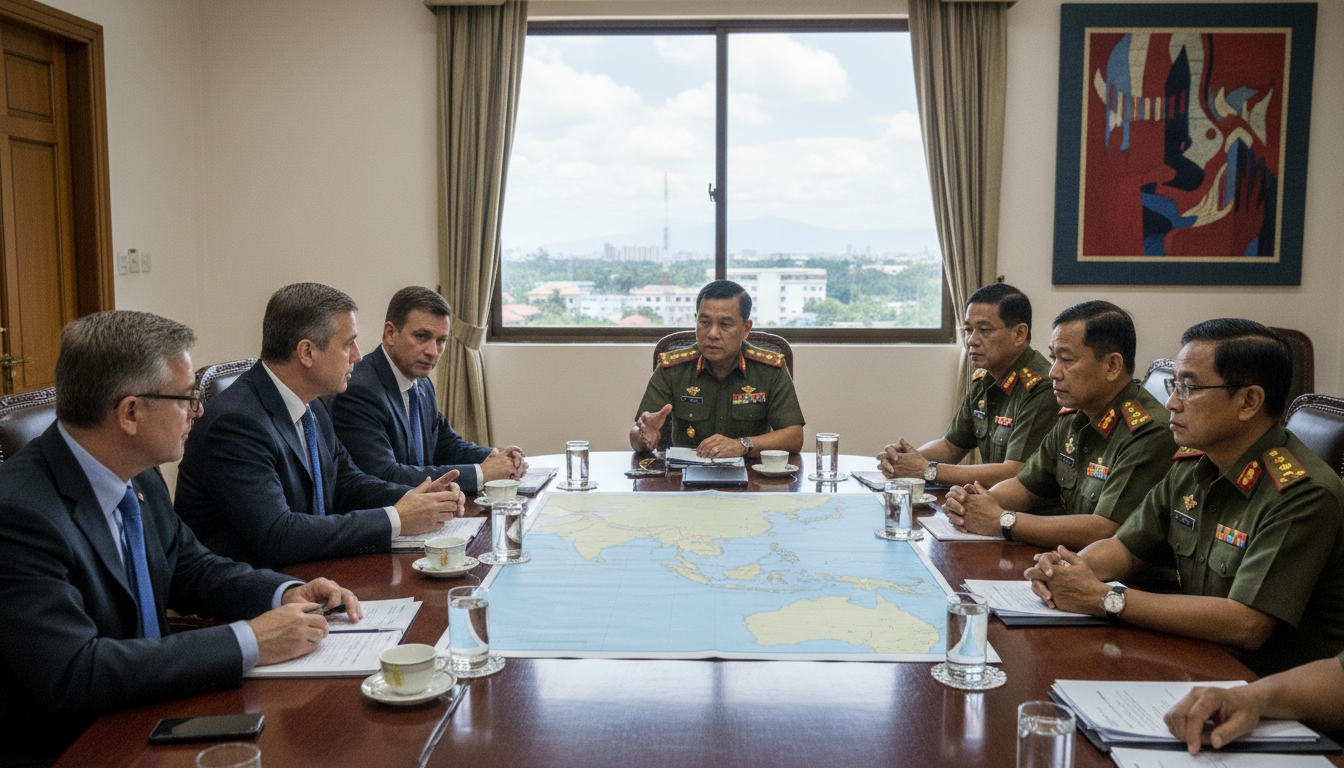
The United States has initiated direct discussions with Myanmar's military-installed government, a move that reconfigures Washington's approach after years of isolating the generals since the 2021 coup. This engagement, confirmed by US officials and other sources familiar with the outreach, involved Michael Vance, nominee for Assistant Secretary of State for Intelligence and Research. The publicly stated objective for these talks focuses on dismantling scam centers that target American citizens.
This development marks a distinct shift in how international powers address the Myanmar crisis. Punitive measures and diplomatic isolation have historically been the predominant tools. However, a parallel trend emerged recently: Myanmar's military-backed leader received a formal welcome in Malaysia on October 7, 2026. This indicates a broader re-engagement by some regional actors and now, notably, by Washington.
For Thailand and the wider ASEAN bloc, the implications are significant. Thailand, sharing a long border with Myanmar, faces direct consequences from its neighbor's stability, or lack thereof. Prolonged conflict and economic distress in Myanmar contribute to cross-border challenges, including refugee flows and illicit trade. United Nations Development Programme reports from October 8, 2026, indicate two in three people in Myanmar are either poor or at risk of falling into poverty. This highlights a deep humanitarian crisis, which external engagement aims to manage. The US focus on scam centers, while specific, points to shared transnational security concerns that necessitate engagement, even with regimes previously ostracized.
For ASEAN, this US policy adjustment challenges the bloc's non-interference principle while potentially easing pressure on its members. Countries like Thailand and Malaysia often navigate complex relationships with Naypyidaw due to geographic proximity and economic ties. US re-engagement could be interpreted as tacit acknowledgment of isolation's limits and the need for pragmatic approaches to regional stability.
However, the move also carries inherent risks. It could be perceived as legitimizing the military regime, potentially undermining democratic aspirations within Myanmar. The announced scope of talks lacks a clear path for democratic transition or human rights protection, raising questions about the long-term effectiveness of this strategy. While US engagement is framed around specific security concerns, it inherently involves a political dimension influencing regional power dynamics.
The critical question remains whether these talks will yield tangible improvements in regional stability, economic conditions, or humanitarian outcomes. The shift from isolation to engagement represents a strategic calculation. Its success, however, depends on observable changes on the ground, rather than diplomatic breakthroughs alone. The economic precarity within Myanmar, detailed by the UNDP report “Layers of Deprivation: Multidimensional Poverty in Myanmar,” underscores the scale of the challenge this new diplomatic front attempts to address.
Sources
Newsletter
Pacific Daily
A curated briefing from Thailand, Asia-Pacific and the world.