The Smoke That Crosses Borders and the Law That Stops at Sea
Singapore’s preventive notices against Indonesian plantation firms expose the limits of administrative leverage over sovereign territory.
SINGAPORE
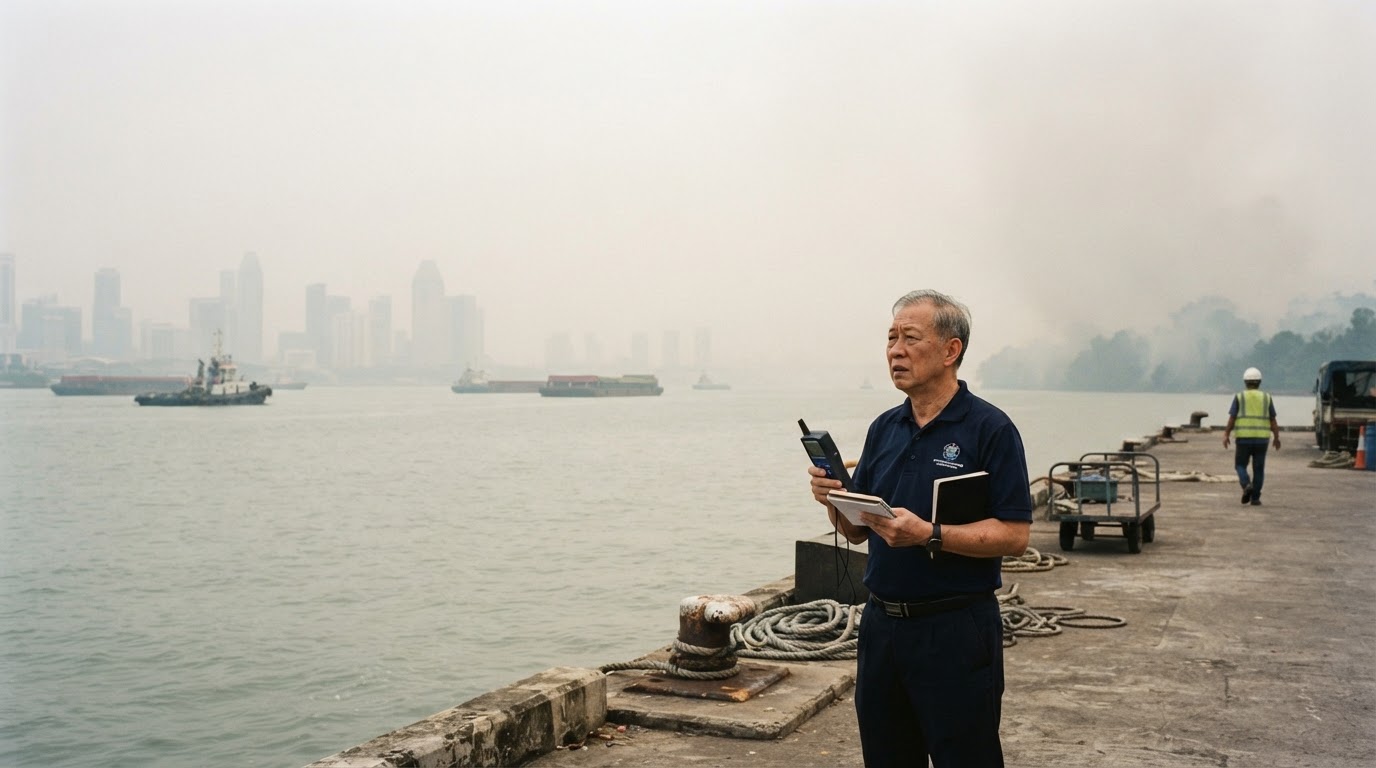
Administrative jurisdiction stops cleanly at a national boundary, but particulate matter moves wherever the wind directs it. For years, Southeast Asian capitals have wrestled with this physical reality, attempting to project legal order over an atmospheric commons that defies territorial demarcation. On Monday, the National Environment Agency said Singapore will issue preventive notices to three more Indonesian companies to tackle and prevent forest fires in Kalimantan Province that may have sent smoke across the border.
The announcement marks an extension of an administrative strategy designed to reach beyond sovereign waters into the corporate boardrooms of a neighboring state. By targeting three additional entities linked to land-clearing in Kalimantan Province, the National Environment Agency is deploying domestic statutory machinery to influence commercial behavior hundreds of miles away. It is an assertive approach to an ecological crisis that has periodically disrupted regional commerce, public health, and civil aviation across the straits.
Yet issuing a notice from an office in Singapore to a firm registered in Indonesia immediately exposes the institutional fault lines of regional governance. Southeast Asian statecraft has historically prioritized non-interference and sovereign deference above collective legal remedies. When one government attempts to serve administrative notices on private commercial entities operating deep within another nation's provinces, the friction is not merely logistical. It represents an unsettled dispute over where one nation's environmental protection ends and another's territorial authority begins.
The mechanics of administrative leverage
Officials in Singapore understand the institutional limits of these notices. A statutory warning issued across a maritime border cannot dispatch municipal inspectors to peatlands in Kalimantan Province, nor can it confiscate machinery operating on remote concessions. The operational utility of the preventive notice lies elsewhere.
To dismiss these notices as mere diplomatic theater overlooks how regional corporate finance actually operates. Agribusiness concessions in Indonesia rarely function in total commercial isolation. Many enterprises rely on regional supply chains, maritime logistics, and trade credit lines that pass through external financial hubs. By naming specific commercial entities and formally demanding preventive action against fires, the National Environment Agency introduces material regulatory and reputational friction into their broader operations. Corporate officers and regional financiers cannot easily disregard formal statutory notifications when assessing contractual risk or navigating cross-border trade transactions.
From this analytical standpoint, the preventive notice serves less as a physical enforcement tool than as an economic lever. It shifts the burden of compliance onto commercial actors, signaling that operating with impunity in remote provinces carries a measurable administrative cost once haze crosses the border.
The persistence of the territorial gap
The central counterweight to this regulatory ambition, however, remains stubbornly anchored to the ground. Corporate pressure cannot substitute for administrative and physical control across the peatlands of Kalimantan Province. The fires that generate cross-border smoke are sustained by local agricultural practices, seasonal dryness, land-tenure ambiguities, and local economic conditions that no overseas agency can directly regulate or reform.
Furthermore, Indonesian authorities retain exclusive sovereign prerogative over activities taking place on their own territory. Any perception that an external administration is unilaterally regulating domestic forestry concessions risks prompting political resistance rather than cooperative enforcement. Without formal, binding mechanisms that align ground-level provincial enforcement with regional environmental standards, statutory notices remain fundamentally dependent on the voluntary cooperation or legal exposure of the targeted firms.
Singapore has broadened its administrative campaign, expanding the roster of companies facing official scrutiny for smoke blowing across the border. What remains unresolved is the fundamental contradiction that prompted the measures in the first place. A preventive notice can travel instantly across an international border, but state power cannot follow it into the field. The regulatory ledger records the infraction, while the clearing of land continues to obey local economic imperatives on the ground.
Sources
Newsletter
Pacific Daily
A curated briefing from Thailand, Asia-Pacific and the world.