The Leash and the Landscape: Shifting Narratives of Pet Companionship in Asia
Observing how a Los Angeles phenomenon prompts questions about our own evolving relationship with domestic animals and public spaces in the Asia-Pacific.
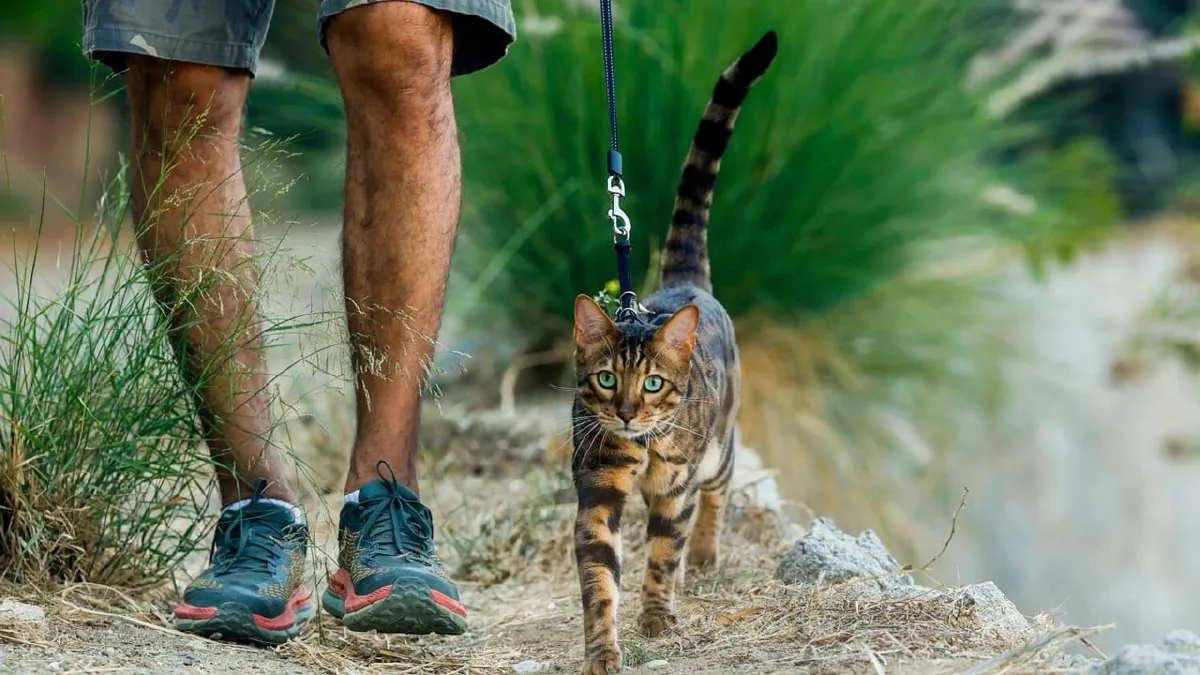
In a Beverly Grove neighborhood in Los Angeles, a cat named Gnocchi sits on a pavement, outfitted with a pink collar, an AirTag, and a red harness. His owner, Julia Luke, notes that Gnocchi often draws more attention than she does, a phenomenon not uncommon in a city where such practices may still carry a novel appeal. The sight of a cat on a leash observing neighbors and sniffing grass is an interruption to an expected pattern, prompting exclamations from strangers. This act of taking a feline into public, traditionally a canine domain, offers a lens through which to consider the broader shifts in how companion animals are integrated into human society, particularly across the diverse urban and rural tapestries of the Asia-Pacific.
Historically, the relationship between humans and animals in much of Asia has been shaped by pragmatism and utility. Cats, for instance, were often valued for pest control, their presence more functional than ornamental, and their movements largely unrestricted. Dogs, similarly, served roles from guarding to hunting, coexisting with humans in often less formalized arrangements than seen in some Western societies. The idea of deliberately restraining a cat for a 'walk' — an activity implying leisure and controlled exposure to the external world — represents a departure from these deeply ingrained patterns. It signifies a redefinition of the animal's role, from a largely self-sufficient or utilitarian creature to one whose outdoor experiences are curated and managed by its human companion.
This shift, observed in anecdotes from Los Angeles, resonates with emerging trends in cities like Bangkok, Singapore, or Tokyo. While the concept of pet ownership is far from new, the specific modes of companionship are evolving. Urbanisation has meant smaller living spaces, and for some pet owners, the desire for their animals to experience the outdoors while remaining safe leads to practices like leash-walking. The provision of harnesses for pets, or even strollers for small animals, suggests a commercial response to this changing dynamic, where the boundaries between domestic and public spheres are negotiated not just for humans, but for their animal companions too.
However, the acceptance of such practices is not uniform. The 'newness' of a leashed cat on a Los Angeles street, where it stops strangers, hints at a social norm that is still forming. In many parts of Asia, public spaces are still primarily designed for human use, and the presence of pets, especially in unconventional ways, can elicit reactions ranging from curiosity to discomfort or even disapproval. Concerns about hygiene, animal behavior, and the perceived appropriateness of animals in certain public settings remain prevalent. What is perceived as 'enrichment' for a pet in one cultural context might be seen as an imposition or an anomaly in another.
The question, then, is not merely whether one 'should' walk a cat, but what such a practice signifies about the evolving definition of family, leisure, and public space. As urban centers in the Asia-Pacific continue to expand and lifestyles change, the integration of companion animals into daily public life will likely remain a dynamic negotiation. The sight of a cat named Gnocchi on a Los Angeles pavement, while specific to its context, quietly asks us to reflect on what we preserve of our traditional relationships with animals, and what we are gradually, perhaps even unknowingly, replacing.
Sources
Newsletter
Pacific Daily
A curated briefing from Thailand, Asia-Pacific and the world.