The Hawkers Who Trade Corporate Burnout for Factory Scale
A shift into low-capital food ventures exposes how artisanal independence quickly yields to standard industrial mechanics
SINGAPORE
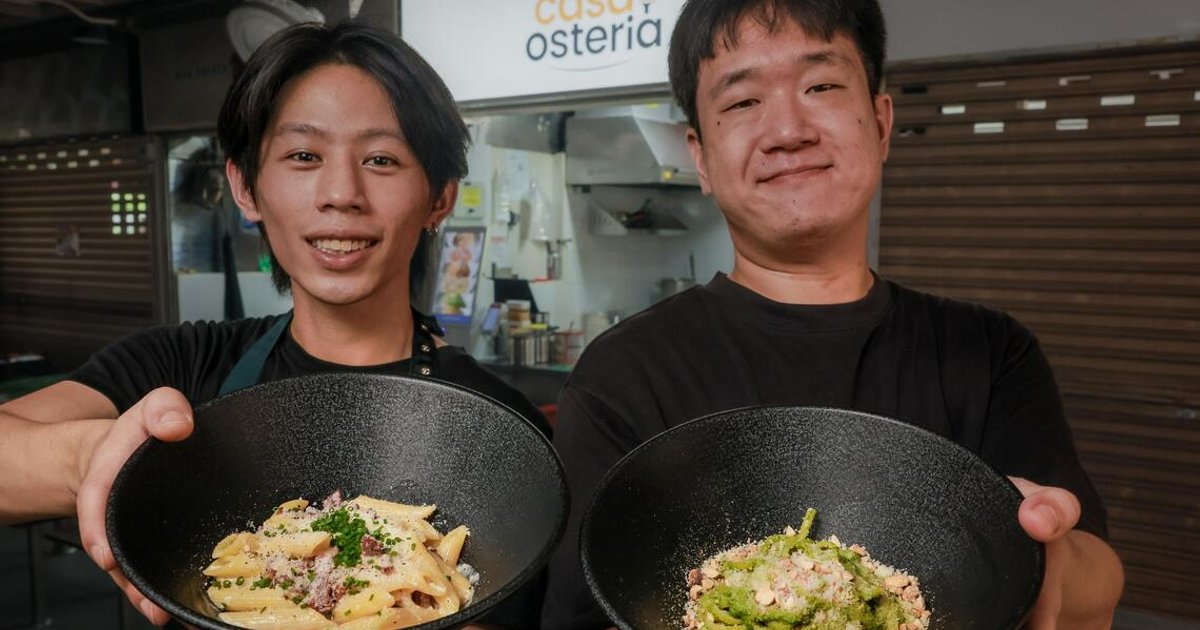
Corporate burnout often encourages an instinctive pivot toward physical craft, yet commercial kitchens impose unforgiving mechanics of their own. According to reported accounts, Michael Lam left a project-management career after hospital treatment for overwork, seeking an alternative path on the urging of his parents. Alongside Jerome Chin, the twenty-eight-year-old founded Casa Osteria, investing five thousand dollars to begin as a home-based business before committing ten thousand dollars to open a hawker stall at Chomp Chomp Food Centre in Serangoon Gardens. The public appeal of educated professionals leaving corporate roles for culinary self-employment remains strong across urban centres, yet the operational arithmetic behind such ventures indicates a far more complex financial reality.
Having opened in August with two signature dishes, Linguine Pesto and Penne Carbonara, the enterprise illustrates how rapidly manual food preparation encounters volume constraints. Reported order volumes expanded from one portion a day to more than four hundred portions by April 2026. At that scale, reliance on individual kitchen preparation inevitably strains physical capacity. The founders have stated an intention to keep quality high while avoiding premature expansion, yet they are already working with a food factory and hope to open up to five outlets within two years.
The Industrial Pivot
Such a pivot suggests that commercial replication alters the fundamental character of artisanal dining. Contract manufacturing with a food processor can stabilize batch volumes and protect operating margins against erratic ingredient overheads. Simultaneously, it indicates a structural transition: the artisanal kitchen begins to function less as a standalone culinary craft and more as a distribution node for off-site food processing.
The transition from domestic preparation to contract processing reflects the structural economic ceiling of low-cost independent dining.
Proponents of this model contend that centralized production is an unavoidable survival mechanism. Within high-cost urban markets such as Singapore, rigid operating overheads and tight labor constraints routinely burden independent stallholders who attempt to scale by hand alone. External factory processing allows young operators to protect early capital, limit physical burnout, and preserve recipe uniformity across prospective locations. Viewed through this lens, collaborating with a manufacturer represents an operational compromise designed to maintain solvency while preserving entry-level pricing.
Limits of the Replicated Stall
Yet this trajectory also introduces an analytical tension between personal craftsmanship and corporate scaling. When preparation shifts to an external factory, the direct culinary labour of the stallholder no longer serves as the primary operational differentiator. The trade risks replacing conventional office routines with the administrative burden of inventory oversight and contract manufacturing.
Furthermore, targeting up to five outlets in two years places clear demands on working capital and brand goodwill. When small hawker concepts transition toward replicated distribution, they risk eroding the neighborhood distinctiveness that initially drew customers to Serangoon Gardens. The consumer seeking an authentic hawker stall typically looks for individualized preparation rather than standardized commissary output.
Lam and Chin exemplify young professionals negotiating the boundary between corporate employment and commercial enterprise. How effectively their model reconciles industrial processing with the expectations of an independent hawker stall remains an unresolved question for low-margin food entrepreneurship.
Sources
Newsletter
Pacific Daily
A curated briefing from Thailand, Asia-Pacific and the world.