The Cantilever on Blackcomb Mountain
Suspending chairlift towers over cliff faces reveals how high-altitude leisure increasingly relies on structural contortions.
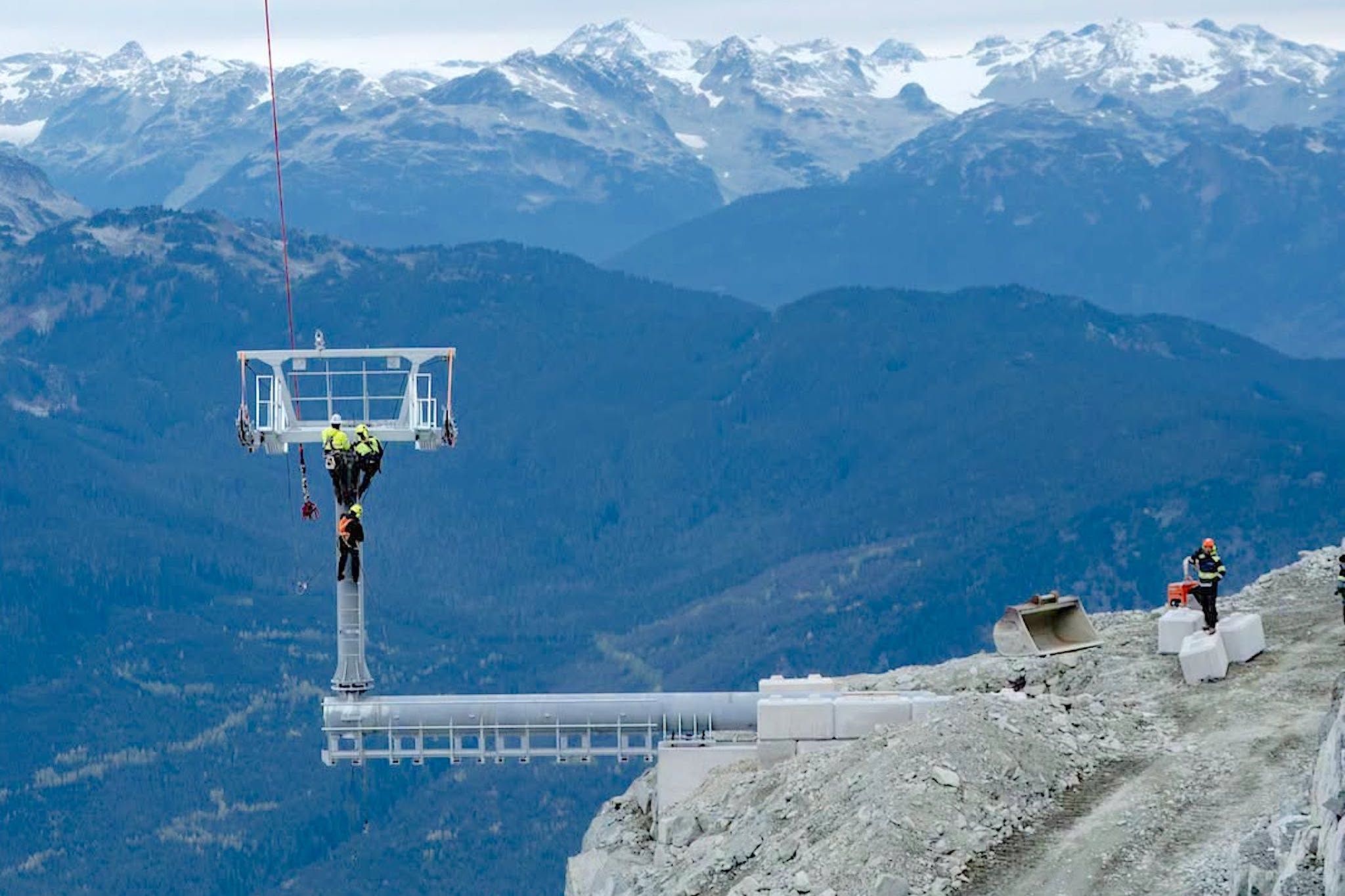
High on Blackcomb Mountain, a horizontal beam of structural steel juts into open air above a sheer rock precipice. Fastened directly into exposed bedrock, this cantilever holds the upright frame of an entire chairlift tower at its outer tip, suspended above empty space. Construction photographs released in October 2026 capture the finished framework in the subalpine zone, documenting an unusual physical perch for Tower 5 of the brand-new Showcase Chairlift. What sits beneath the original site explains why the apparatus departed from conventional ground footings.
According to Whistler Blackcomb, on-site geotechnical investigations for the project revealed buried glacial ice directly beneath the footprint planned for the tower foundation. Rather than setting concrete into an unstable mixture of ice and moraine that could settle under load, engineers anchored a heavy horizontal support into the adjacent cliff. The resulting L-shaped reach across the void bypasses sub-surface ice entirely. It functions as an ingenious structural intervention, but it also marks a distinct spatial boundary where natural slopes stop behaving as reliable foundations.
Downhill recreation relies on an implied pact between mechanical convenience and mountain terrain. Skiers step into bindings, board a lift and ascend toward alpine ridges, assuming that the ground below forms a permanent, solid base for the machinery overhead. The discovery of buried ice beneath Tower 5 highlights how brittle that assumption has become. Elevation alone no longer guarantees dependable, unmoving earth.
Shifting Footings
Resort operators routinely navigate fractured granite and steep grades, yet building above buried glacial remnants introduces an entirely different set of operational calculations. When the substrate beneath an alignment is compromised by hidden thermal pockets, lift infrastructure cannot simply rest on the ridge. Instead, it must project outward from whatever competent bedrock remains, cantilevering visitors over the very ground that engineers judged untrustworthy.
This structural adaptation points to a broader tension in alpine tourism. Resorts commit significant capital to new chairlifts and higher summit access, responding to visitor demand for consistent winter snowfields. Blackcomb Mountain attracts skiers who reserve travel months in advance, seeking high-elevation pistes that remain cold when lower terrain experiences mixed precipitation. The paradox is clear: the physical measures needed to reach those upper bowls become structurally extreme because the high alpine itself is shifting beneath the surface.
The Synthetic Edge
There is unquestioned technical logic in bolting steel armatures directly to exposed rock faces. The design rationale presented by resort planners is pragmatic: thorough site exploration identified a hidden subsurface hazard early, and cantilevered fabrication resolved it without abandoning the lift corridor. Structurally, securing an upright tower to an engineered cantilever bolted to bedrock provides far greater load stability than pouring footings into unmapped ice.
That engineering success nevertheless underscores how increasingly artificial alpine access has become. The steel arm projecting from the cliff is not merely an inventive construction milestone. In spatial terms, it serves as a physical indicator of the contortions required to keep tourist circulation running smoothly over an unpredictable alpine floor.
As mountain destinations across the Pacific Rim confront changing alpine conditions, the response is rarely a retreat from fragile zones. Mechanical networks push further out, bridging over hidden glacial layers with heavier steel and deeper rock anchors. Passengers riding the Showcase Chairlift will pass smoothly beside the cliff face, carried across a pocket of buried ice that modern engineering could no longer trust to hold their weight.
Sources
Newsletter
Pacific Daily
A curated briefing from Thailand, Asia-Pacific and the world.