The Administrative Illusion of the Line Shuffle
Vancouver reorganises its forward combinations during an eight-game slide, yet redistributing talent across an unbalanced roster rarely resolves structural stagnation.
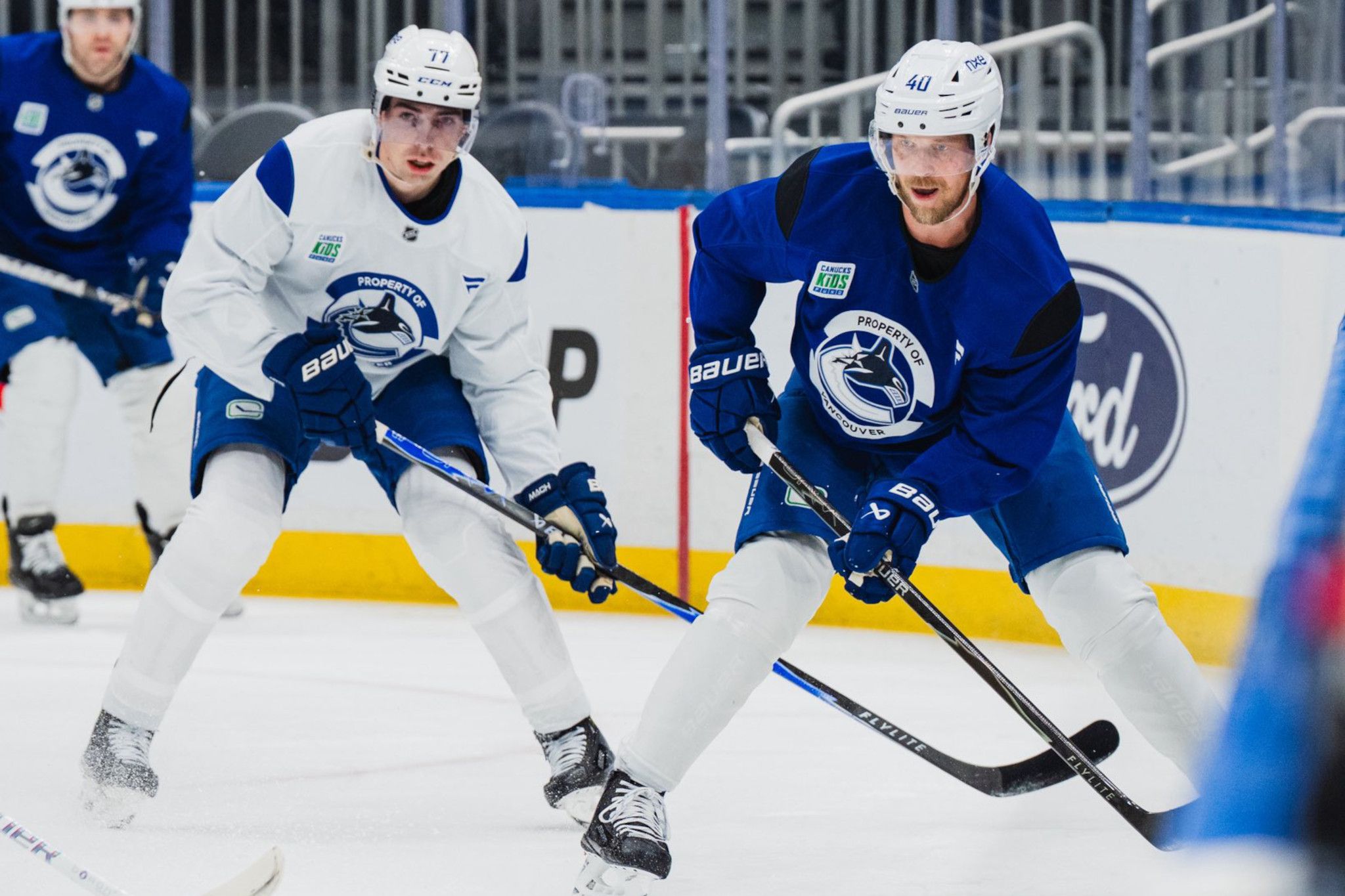
An enterprise can retain premium individual capacity while experiencing total systemic breakdown. On Wednesday, the Vancouver Canucks confronted an eight-game losing streak by dismantling their primary forward units during practice. Head coach Manny Malhotra removed Jake DeBrusk from the top trio, inserting Drew O’Connor alongside Linus Karlsson to flank Elias Pettersson. Routine reshuffling serves as the standard administrative reaction when operational yields collapse. Management redistributes human capital across existing lines, hoping reconfiguration will generate output that the core system has failed to deliver.
The mechanics of the reorganization were immediate and stark across the roster. Jonathan Lekkerimäki surrendered his deployment near the top, sliding downward into a unit centered by Filip Chytil and flanked by DeBrusk. Paul Cotter partnered with Marco Rossi on a second tier featuring Brock Boeser. Liam Öhgren joined Max Sasson alongside Brendan Gallagher on the fourth unit, while Arshdeep Bains skated outside the active rotations. Superficial readings interpret this as a disciplinary exercise designed to balance scoring across separate operational units. Real operational analysis reveals a different dynamic: Malhotra is diluting established pairings to compensate for chronic inefficiency throughout the lower roster.
Labor reallocation under operational stress
Roster adjustments inevitably test the load-bearing capacity of core personnel. Elias Pettersson has performed as the Vancouver Canucks' premier forward, yet leaning excessively on a solitary high-yield performer exposes systemic fragility whenever surrounding lines stagnate. Elevating O’Connor and Karlsson to flank Pettersson constitutes an extraction maneuver familiar to high-pressure production floors. By flanking an elite center with industrious, lower-profile assets, coaching staffs attempt to protect overall output without introducing outside resources. The strategy assumes that elite technical skill can artificially inflate the performance metrics of supplementary labor.
Rearranging line combinations during an extended slump shifts accountability from structural mechanics onto disposable rotations.
The limitations of this approach become glaring under sustained operational pressure. Replacing DeBrusk with O’Connor does not diagnose why Vancouver dropped eight consecutive contests. Substituting one winger for another merely shifts the distribution of physical labor without addressing defensive breakdowns or sluggish transition phases. When secondary units anchored by Chytil or Rossi fail to contain opposing momentum, Pettersson's minutes carry disproportionate responsibility. Defenders of Malhotra's shuffle will argue that benching veterans sparks personal accountability, forcing talent like DeBrusk to earn back premium ice time. Experience across elite production suggests otherwise: continuous personnel churn disrupts timing while compounding execution errors.
The limits of internal reorganization
Reorganizing internal components provides visible administrative action without resolving functional deficits. Daily Hive Vancouver documented the practice overhaul as a possible revelation of new operational hierarchies, but line alterations do not automatically translate into tactical coherence. Marco Rossi and Brock Boeser must prove their line can sustain defensive assignments without sacrificing offensive territory. Similarly, the tertiary unit pairing Jake DeBrusk with Jonathan Lekkerimäki around Filip Chytil risks becoming surplus labor if puck possession remains unaddressed. Shifting names across practice boards allows an organization to project decisive intervention, yet the structural friction producing an eight-game losing streak persists unchanged.
Whether Drew O’Connor can permanently anchor a premier scoring line alongside Pettersson and Karlsson remains unproven against competitive opposition. The immediate dilemma facing the Vancouver Canucks is not which winger skates along the perimeter of a practice session, but whether a team can reconfigure its way out of an eight-game losing streak without reforming how its entire system functions.
Sources
Newsletter
Pacific Daily
A curated briefing from Thailand, Asia-Pacific and the world.