The Architecture of the Grid Discards the Facade
CATL's Mexican utility deployment exposes how modern energy design substitutes visible civic presence for pure spatial efficiency.
SINGAPORE
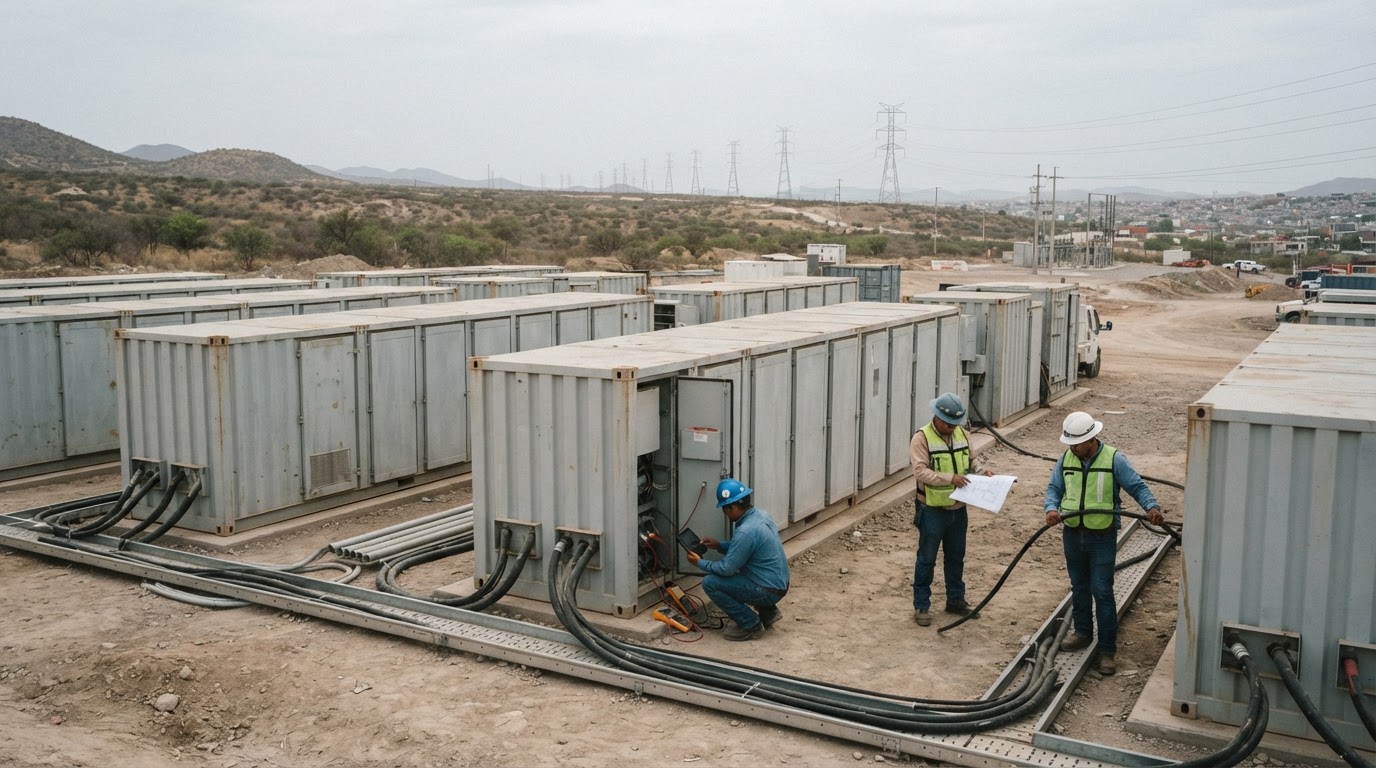
Utility-scale electrical infrastructure achieves functional competence precisely by refusing to look like public architecture. A battery compound does not welcome an audience, nor does it articulate civic hierarchy through stone or glass. It arranges standardized steel cabinets across gravel pads behind chain-link boundaries, organized solely along electrical conduits and heat dissipation channels. No welcoming portico invites scrutiny. The facility exists to isolate high-voltage systems from the surrounding territory, enforcing an absolute boundary between municipal life and electrochemical conversion.
Industrial enclosure of this kind operates without decorative ambition. The physical envelope simply protects sensitive electrochemical systems from dust, thermal saturation, and moisture. Form follows efficiency. Every panel, vent, and pad functions as an engineering calculation rather than a cultural gesture.
This deliberate spatial silence frames the commercial expansion of China-based CATL. According to reporting by Mexico News Daily, the Chinese manufacturer has signed on for a major Mexican solar project, an undertaking that coincides with Energy Ministry plans to incorporate 935 megawatts of electrical storage capacity. The ministry documents frame this storage target as a technical measure to support greater energy generation through renewable sources across Mexico. Interpreted as architecture, however, the initiative demonstrates how utility installations remain severed from civic visibility. Society celebrates solar farms and storage units as markers of ecological progress, yet state planning continues to configure them as industrial voids.
The Logic of Modular Enclosure
Unlike traditional civic power stations that announced central authority through masonry turbine halls, utility storage parcels energy into identical, transportable modules. The architecture refuses to perform symbolic labor. It solves intermittent transmission entirely through spatial repetition.
The battery compound does not welcome an audience, nor does it articulate civic hierarchy through stone or glass.
Energy infrastructure once belonged to municipal design traditions. In early industrial systems, urban substations adopted neoclassical colonnades or brick industrial trims to integrate heavy mechanical loads into working neighborhoods. The modern utility installation abandons this dialogue entirely. CATL ships self-contained steel modules whose dimensions reflect maritime freight standards rather than regional building traditions. Such containers remain indifferent to their surroundings.
This shift carries tangible spatial consequences. By treating energy storage as containerized balance-of-plant equipment, planners can locate balancing capacity wherever land acquisition proves cheapest and solar exposure runs highest. The Energy Ministry's planned 935 megawatts of storage will function invisibly, shielded behind perimeter security out of civilian view. In design terms, such layouts refuse civic transparency. They present the transition to renewable power not as an inhabited architectural precinct, but as an austere array of unmonitored metal boxes.
The Unresolved Landscape
There is an unresolved contradiction in this design economy. As national grids lean on capital equipment from Chinese manufacturers to stabilize variable solar loads, the physical artifacts of decarbonization are steadily excluded from public architectural culture. The public encounters the energy transition through abstract policy targets and fluctuating billing tariffs, while the heavy machinery that keeps the system stable occupies remote peripheral ground.
Utility operators naturally prefer this spatial isolation. Industrial containment reduces physical vulnerabilities and insulates complex cooling equipment from civilian interference. Yet it also creates an evident landscape alienation: host communities face sprawling solar fields and lithium reserves without gaining an accessible public room or a coherent civic landmark. The infrastructure takes immense territory while offering zero social enclosure.
The deployment of 935 megawatts across Mexican utility corridors indicates that the international energy transition will not arrive dressed in monumental form. It arrives instead in factory-finished shipping profiles calibrated for rapid installation. Efficiency wins completely over architectural expression.
Sources
Newsletter
Pacific Daily
A curated briefing from Thailand, Asia-Pacific and the world.