Thai Princess’s AI Warning Spotlights Human Cost of Automation
Princess Sirindhorn's advice to graduates at Thaksin University underscores a tension between technological advancement and individual skill in the Asia-Pacific.
SINGAPORE
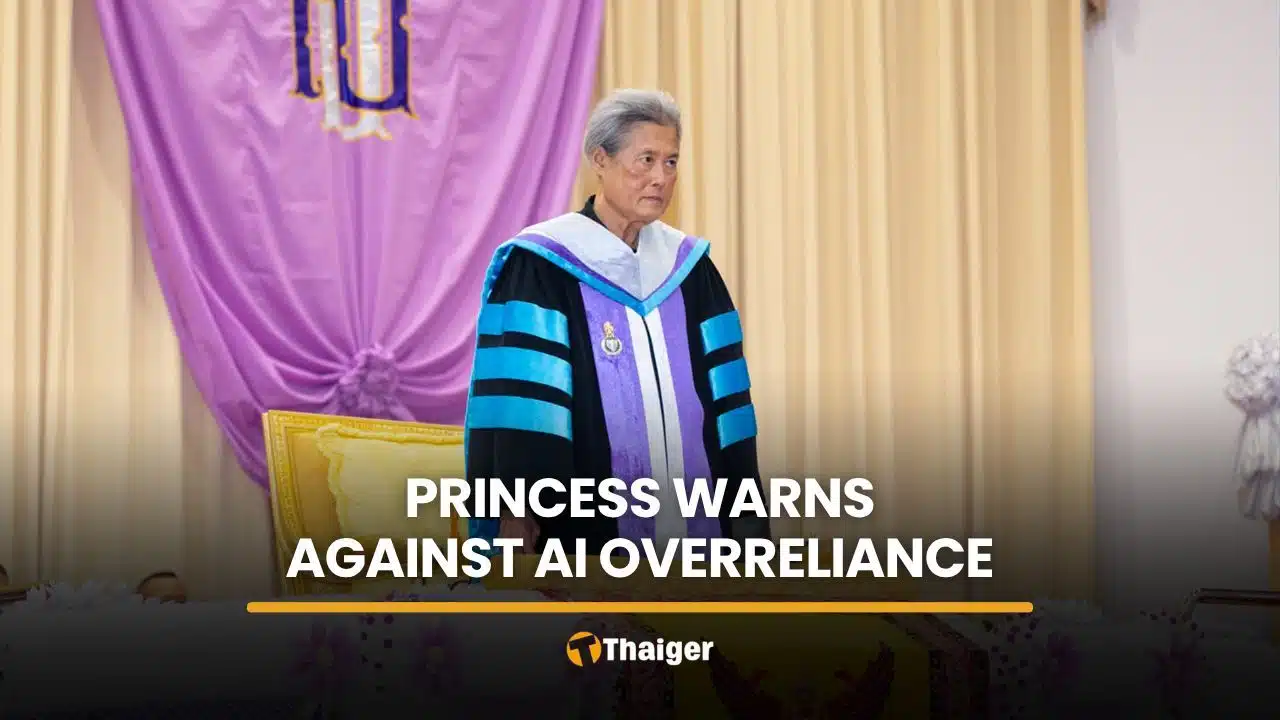
Princess Sirindhorn recently told graduates at Thaksin University's Phatthalung campus that artificial intelligence is something people built. She said it cannot hold itself to what is right, and should not be leaned on, a statement made on September 15 during a graduation ceremony where she conferred degrees on behalf of His Majesty the King. Her words, reported by The Thaiger on September 18, 2026, offer a precise observation on how society is weighing the advance of automation against the daily cost to human agency and skill.
The Princess acknowledged that AI had become an important part of everyday life and could provide significant benefits, including saving time and resources while improving people's ability to analyse and search for information. This perspective recognizes the practical advantages AI presents. However, her caution against excessive reliance on AI, warning that it could diminish graduates' own knowledge and abilities, points to a broader concern. The core argument here is that a tool, no matter how sophisticated, remains a construct of human intention and limitation. It lacks an inherent moral compass or the capacity for independent discernment of 'right' and 'wrong' that human intellect is expected to develop.
The implication for Thailand and the wider Asia-Pacific region is significant. As economies increasingly integrate AI into sectors from education to industry, the question of who carries the cost of this decision day to day becomes critical. If reliance on AI leads to a degradation of individual capacity, particularly among a graduating workforce, then the purported efficiency gains might be offset by a long-term erosion of critical thinking and problem-solving skills within the human capital itself. This is not merely an abstract philosophical point; it directly impacts the resilience and adaptability of future workforces. For instance, if an AI system optimizes agricultural processes, but individuals become less adept at foundational knowledge due to over-reliance, the societal cost could manifest as vulnerability to unforeseen challenges.
A counterargument suggests that AI, when used judiciously, enhances human capabilities rather than diminishes them. Proponents might argue that AI frees individuals from rote tasks, allowing them to focus on higher-level creative or strategic work. From this view, the Princess’s warning could be interpreted as a call for responsible integration, not outright avoidance. The evidence that AI improves analytical and information-searching abilities supports this, suggesting that it can augment human intellect. However, even if AI acts as an augmentation, the line between augmentation and replacement, or between assistance and dependence, remains fluid and largely untested across diverse societal applications.
Ultimately, the Princess's message highlights an unresolved tension. It underscores the challenge for institutions and individuals in the Asia-Pacific to navigate technological progress without sacrificing the foundational human qualities that are not quantifiable by efficiency metrics alone. The task ahead is to ensure that the tools built by people remain subservient to the development of people themselves.
Sources
Newsletter
Pacific Daily
A curated briefing from Thailand, Asia-Pacific and the world.