Smoke Over Bishan Exposes the Limits of Cross-Border Law
Singapore considers statutory action as transboundary fires return, but domestic courts cannot command regional weather or peatland economics.
SINGAPORE
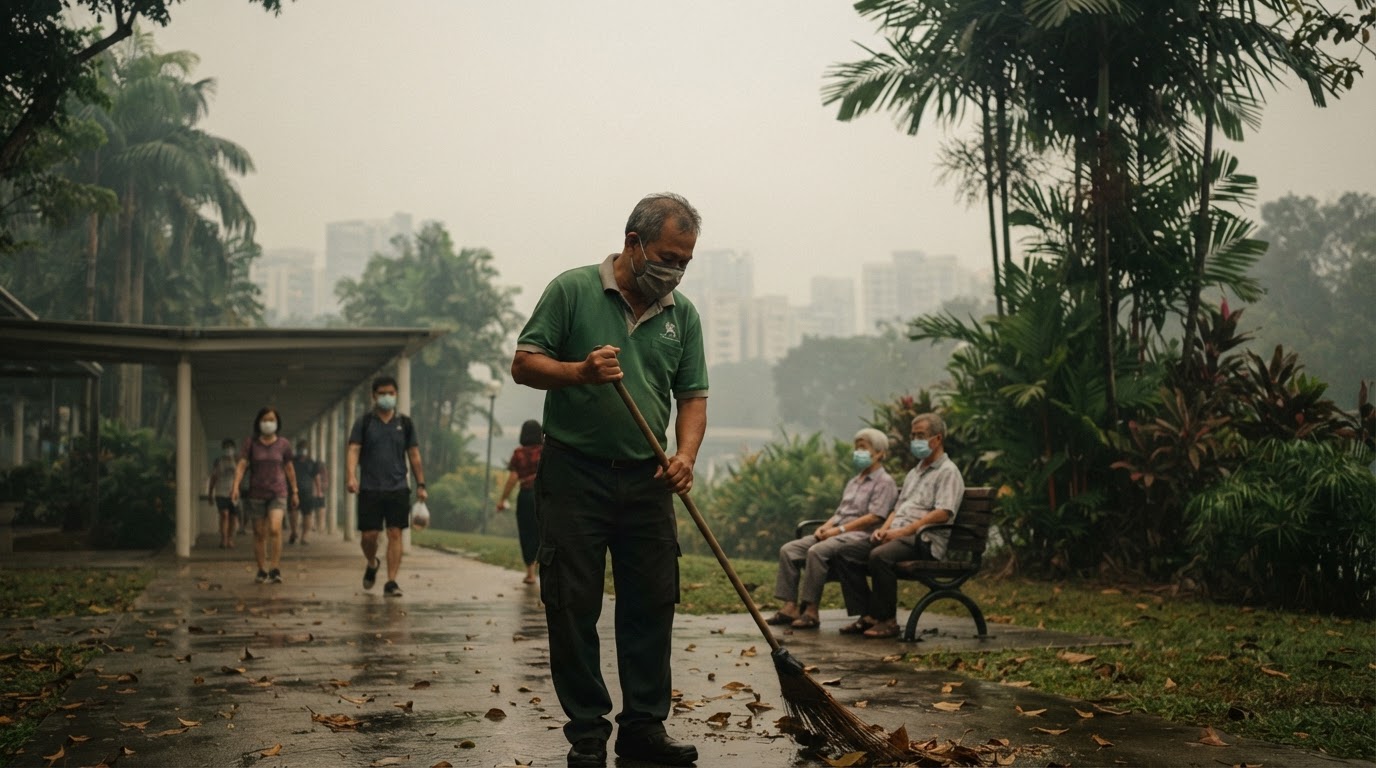
A muted haze settled over central Bishan on Thursday, October 15, 2026, blurring the clean silhouettes of housing blocks and flattening the midday glare into a pale grey sheet. Consumer air purifiers flew off retail shelves within hours as outdoor air indicators reached 203, prompting urban routines to retreat behind closed doors and mechanical ventilation. Within Singapore, where manicured park connectors and climate-controlled transit networks project total administrative order over the immediate landscape, the sudden return of peat smoke disrupts that sense of environmental mastery. The atmosphere answers to an older regional geography, impervious to municipal architecture.
Responding to the deteriorating conditions, Prime Minister Lawrence Wong announced on Thursday that Singapore is looking into which companies bear responsibility for the forest and peatland fires in Indonesia. Legal measures remain on the table, with the government exploring joint action alongside neighboring countries across the Association of Southeast Asian Nations. Singapore’s primary statutory instrument is the Transboundary Haze Pollution Act, enacted in September 2014 to penalize overseas corporate actors whose land management decisions poison air quality across the straits.
The Limits of Extraterritorial Jurisdiction
Extraterritorial legislation, however, confronts immediate friction when domestic statutes encounter sovereign territorial boundaries. On paper, the 2014 law grants Singaporean courts both civil and criminal avenues to hold foreign commercial entities accountable for pollution that drifts into domestic airspace. Proving specific corporate liability remains an extraordinary procedural challenge. Establishing an unbroken evidentiary chain linking a smoky skyline in Bishan to an individual concession trench on a remote peat dome demands high-resolution satellite imagery, accurate cadastral records, and direct ground access. Without the formal cooperation of foreign regulators, gathering such evidence tests the limits of unilateral legal authority.
Indonesian President Prabowo Subianto governs an agrarian economy where peatland drainage and commercial agricultural fires remain deeply entwined with rural production models. Local agricultural clearing persists because burning represents the most cost-effective method for preparing soil across vast concessions, driven by market demand that operates entirely apart from the environmental concerns of downstream financial centres. For authorities across the water, sovereign autonomy often functions as a diplomatic shield against foreign legal processes. Regional cooperation mechanisms within ASEAN emphasize consensus and non-interference, rarely providing the coercive enforcement mechanisms required to compel compliance from foreign businesses.
Where warranted, we will take action under Singapore’s Transboundary Haze Pollution Act, and explore joint action with other countries.
This structural imbalance explains why ministerial warnings can seem like an annual public ritual rather than a decisive deterrent. Announcing that legal options remain open provides reassurance to a domestic populace enduring throat irritation and obscured horizons, but cross-border litigation has historically struggled to transform regional commercial behaviour. Target firms based abroad often operate under complex holding structures designed to insulate primary operations from foreign legal exposure. When cross-border investigations drag through jurisdictional contestation, fires burn out naturally with monsoon rains rather than judicial orders.
Private Containment in Public Air
Consumer behaviour reflects a quiet awareness of this institutional stalemate. The immediate run on air purifiers across local appliance stores reveals how private households adapt when state-level diplomacy encounters structural resistance. Citizens do not wait for cross-border task forces or international court filings to clear their breathing space; they purchase mechanical filters and seal interior environments. Private spending absorbs the cost of regional environmental failure, converting shared outdoor air into an individually managed domestic commodity.
The pale skies over central Bishan expose the fragility of urban self-containment. Singapore has constructed sophisticated municipal infrastructure and meticulous urban landscaping, yet no domestic engineering can wall off the island from prevailing equatorial winds. Cross-border statutes assert a necessary moral standard, but clean air will not be secured by foreign court summonses alone. Until the economic incentives governing peatland agriculture undergo fundamental structural reform, the seasons, rather than the statutes, will continue to dictate what downwind cities breathe.
Sources
Newsletter
Pacific Daily
A curated briefing from Thailand, Asia-Pacific and the world.