Singapore Grand Prix Victory Reinforces Established Regional Sports Market
Max Verstappen's first win in Singapore underscores the circuit's consistent allure rather than signaling a shift in its regional economic role.
SINGAPORE
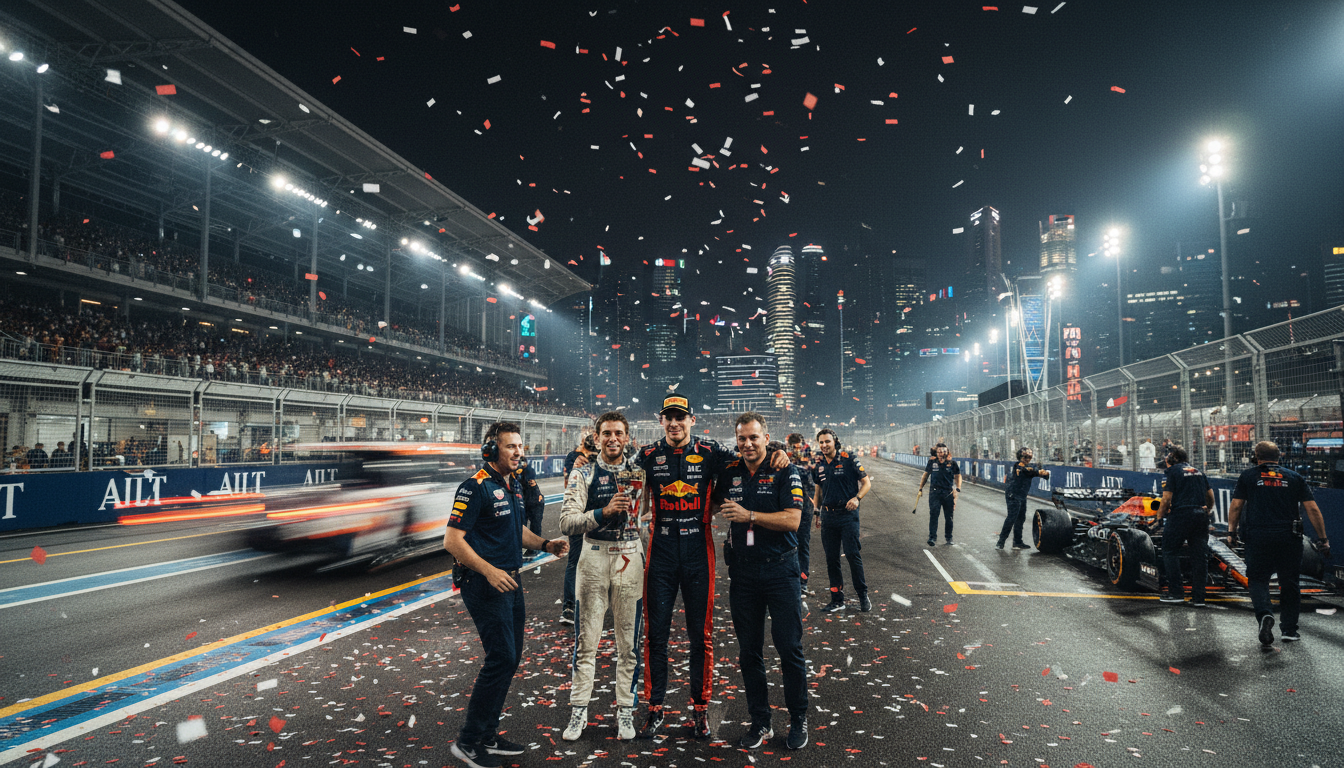
Max Verstappen secured his first Singapore Grand Prix victory on Sunday, October 11, 2026. This win for Red Bull's Verstappen concluded a weekend where he also finished first in the sprint and was on pole for both races. Red Bull's Verstappen finished 7.335 seconds ahead of Ferrari's Charles Leclerc with championship leader Kimi Antonelli third after 62 laps under the lights of the Marina Bay Street Circuit. The four-time world champion had never won or even achieved a pole position in nine previous attempts going back to his debut for Toro Rosso in 2015.
While the individual success of a prominent driver often garners attention, this victory primarily reinforces the established presence of the Singapore Grand Prix within the Asia-Pacific sports landscape. The event consistently attracts international interest and generates media exposure for Singapore, a pattern observable across its history. The specific outcome of a race, even a first-time victory for a four-time world champion, functions within this larger, stable economic framework. It reflects the ongoing competitiveness of Formula 1 but does not fundamentally alter Singapore's position as a long-term host.
For other nations in the region, including Thailand, the sustained success and infrastructure of the Singapore Grand Prix provide a clear benchmark. Countries evaluating the prospect of hosting major international sporting events must consider the substantial, continuous investment and logistical complexity such events demand. Singapore's enduring ability to host Formula 1 highlights the commitment required to maintain global visibility and attract significant tourism and investment through sports. The challenge for aspirants remains not merely hosting an event, but securing its consistent presence on the international calendar.
Some might argue that a new winner, particularly one with Verstappen’s profile, could inject new energy into the event, potentially broadening its appeal. However, the core economic proposition and operational model of the Singapore Grand Prix rely on its established brand and consistent high-level competition, rather than the identity of a specific victor. The event’s value is rooted in its reliable scheduling and the participation of leading teams. The crucial question for regional economies beyond Singapore revolves around the capital and operational requirements for replicating or competing with such an established model. These factors remain significant constraints for nations seeking a comparable impact in the global sports entertainment sector.
Sources
Newsletter
Pacific Daily
A curated briefing from Thailand, Asia-Pacific and the world.