Road Sweeper's Death Highlights Unseen Costs of Road Safety Failures in Chiang Mai
The tragic death of a municipal worker underscores the systemic disregard for public safety, revealing how drunk driving incidents impact communities and the most vulnerable.
CHIANG MAI
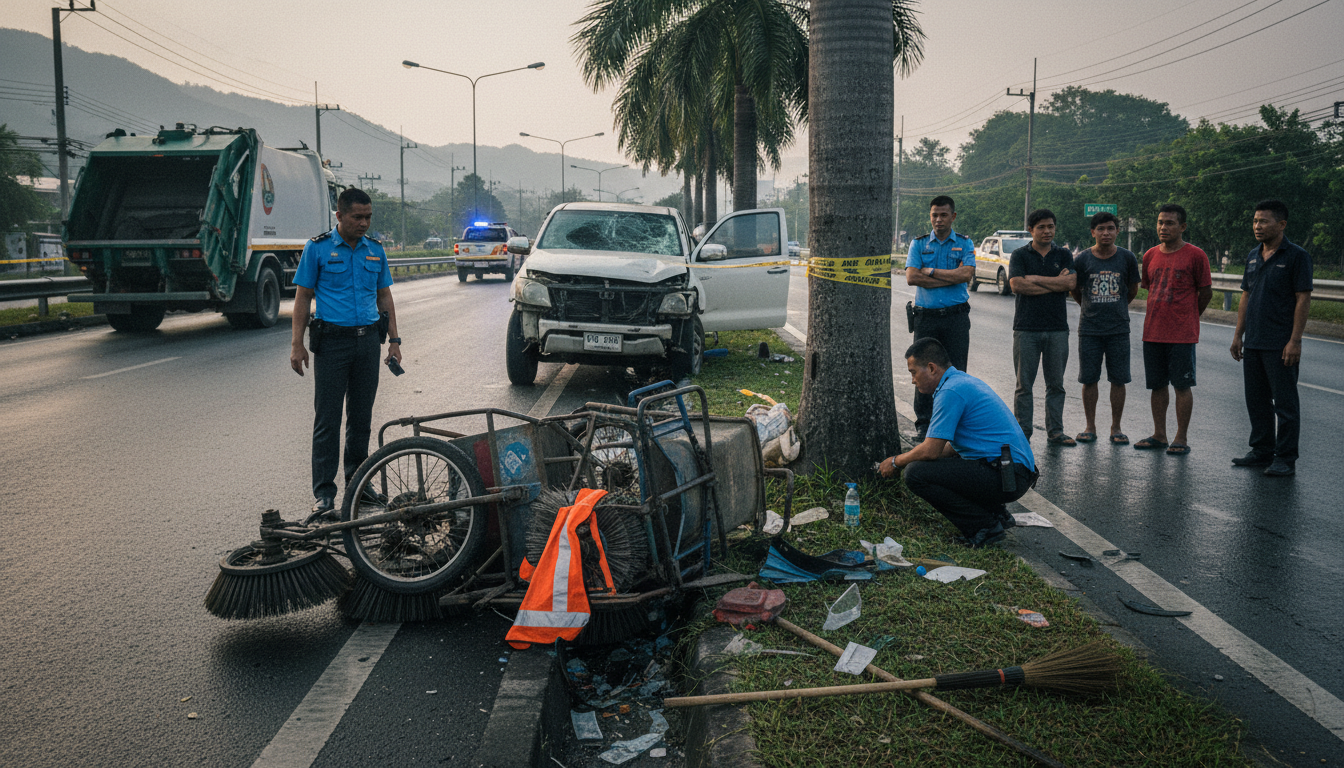
A municipal street sweeper, 67-year-old Somjit Ja-ue, died in Chiang Mai on October 5 after a hatchback struck her vehicle and dragged it over 100 metres. Police officers from Mueang Chiang Mai Police Station responded to the crash on Boon Rueang Rit Road in Si Phum Subdistrict at approximately 4:35 AM. Police found Somjit trapped underneath a grey Toyota Yaris. Rescue workers freed her using cutting equipment, provided CPR, and attempted transport to a hospital, but she died. The driver of the hatchback was found to have 172 milligrams of alcohol in his blood, according to reports from The Thaiger.
This incident in Chiang Mai, a city that recently hosted forestry leaders for discussions on a ‘Healthy Forests Feed the Future’ agenda and, according to The Japan Times, has grappled with pollution causing ‘blood clots and burning eyes,’ suggests a persistent challenge for communities: the high human cost of preventable road accidents. While attention often focuses on broader environmental or economic issues, the daily risks faced by public service workers can be overlooked. Somjit Ja-ue’s death appears to be a direct consequence of a driver operating a vehicle with a blood alcohol level significantly above legal limits.
The routine nature of Somjit Ja-ue’s work—cleaning streets in the early morning—placed her in a vulnerable position. Her occupation is essential for urban hygiene, but it also carries inherent dangers, which are compounded by impaired drivers. The act of a vehicle dragging a municipal sweeper for an extended distance points to both the force of the collision and the potential for severe impairment of the driver involved. The 172 milligrams of alcohol in the driver's blood provides a concrete measure of this impairment, as reported by The Thaiger.
Road safety campaigns frequently target drivers; however, the impact on those who maintain public infrastructure is less frequently discussed. These individuals, often working during off-peak hours, bear a disproportionate share of the risk when road safety measures fail. The Mueang Chiang Mai Police investigation into this specific case highlights the immediate aftermath of such failures.
The broader context of road safety in Thailand includes a mix of enforcement efforts and societal attitudes towards drunk driving. Despite increased awareness, incidents like this continue to occur, illustrating a gap between policy and daily practice. The burden of this gap falls heavily on individuals like Somjit Ja-ue, whose work keeps cities functioning but places them directly in harm’s way. The cost of a decision to drive under the influence extends beyond property damage; it includes the loss of life and the severe disruption to families and communities.
This event compels a closer examination of not just the immediate cause of the accident but also the systemic conditions that allow such risks to persist. It raises questions about how communities protect those who serve them in often unseen capacities. While policymakers discuss forest management and pollution control in Chiang Mai, the day-to-day safety of its municipal workers navigating the roads remains a tangible and critical concern.
Sources
Newsletter
Pacific Daily
A curated briefing from Thailand, Asia-Pacific and the world.