Prime Minister Anutin’s Objection Signals Deeper Political Tensions
A public critique of an opposition no-confidence motion's wording by Thailand's Prime Minister Anutin Charnvirakul draws attention to the ongoing dynamics between the executive and legislative branches.
SINGAPORE
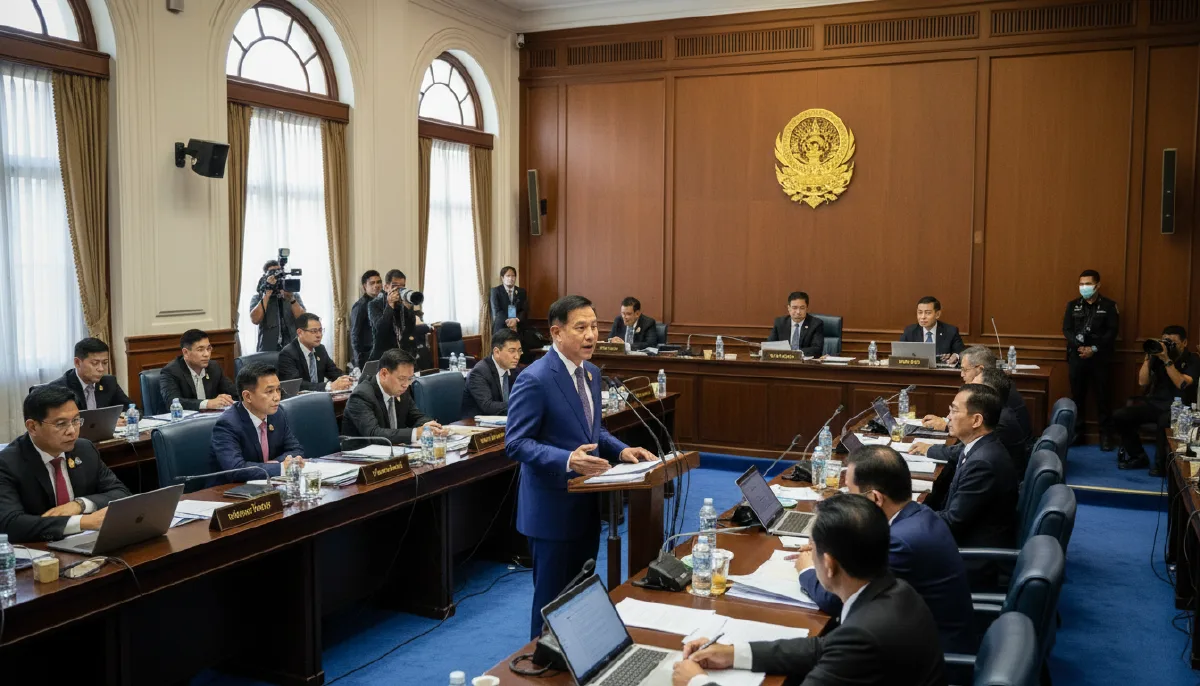
Prime Minister Anutin Charnvirakul has described the opposition's no-confidence motion as having “hazy” text. He suggests this might be why the House speaker has not yet formally notified the government. The Prime Minister stated the language of the motion may need to be polished to make it more “civilised”. This public commentary on the wording of a critical parliamentary procedure suggests an underlying friction in the legislative process.
Speaking at Government House on a Tuesday, Prime Minister Anutin said that the motion, as written, was “not quite right” and that its wording should be polished. He acknowledged he had no authority to dictate how the opposition should phrase their motion. Still, his comments focused on the perceived imprecision. The Prime Minister also noted that the House speaker had approximately a week to consider the motion. This frames the current delay as part of a review process.
This exchange arises as the opposition seeks a censure debate targeting more than 10 ministers. Commerce Minister, for instance, has already welcomed the debate as an opportunity to clarify his work. Prime Minister Anutin himself previously indicated he was ready for censure in October. The current point of contention, then, is not the debate itself, but the technicalities surrounding its formal initiation.
What may appear as a procedural quibble over language masks a more substantive political strategy. By critiquing the wording, the Prime Minister has shifted the focus from the substance of the no-confidence claims to the form in which they are presented. This can create a delay in the proceedings, buying time for the government and potentially forcing the opposition to revise their motion. The implications of this approach can be felt day to day, as the public waits for clarity on serious allegations against government ministers. It underlines how the mechanisms of parliamentary scrutiny can become entangled in disputes over presentation, affecting the accountability process.
This incident highlights a tension between the government and opposition in Thailand. Here, the initial steps of parliamentary challenge are met with questions about civility and precision. Such focus on procedural correctness, when not backed by clear guidelines for what constitutes ‘hazy’ or ‘uncivilised’ language, can be interpreted as a means to deflect or delay. The situation reflects how political power can be asserted not just through policy, but through the interpretation and application of parliamentary rules themselves. The government’s response suggests a careful management of the political narrative, even down to the lexicon of legislative challenges. What remains uncertain is whether the opposition will revise its motion or press forward with its current phrasing, and how the speaker will ultimately rule on its acceptance.
Sources
Newsletter
Pacific Daily
A curated briefing from Thailand, Asia-Pacific and the world.