Post-Elite Athletics and the Private Tour Model
Eliud Kipchoge's course record in Australia demonstrates how veteran athletic capital can operate outside traditional federation governance.
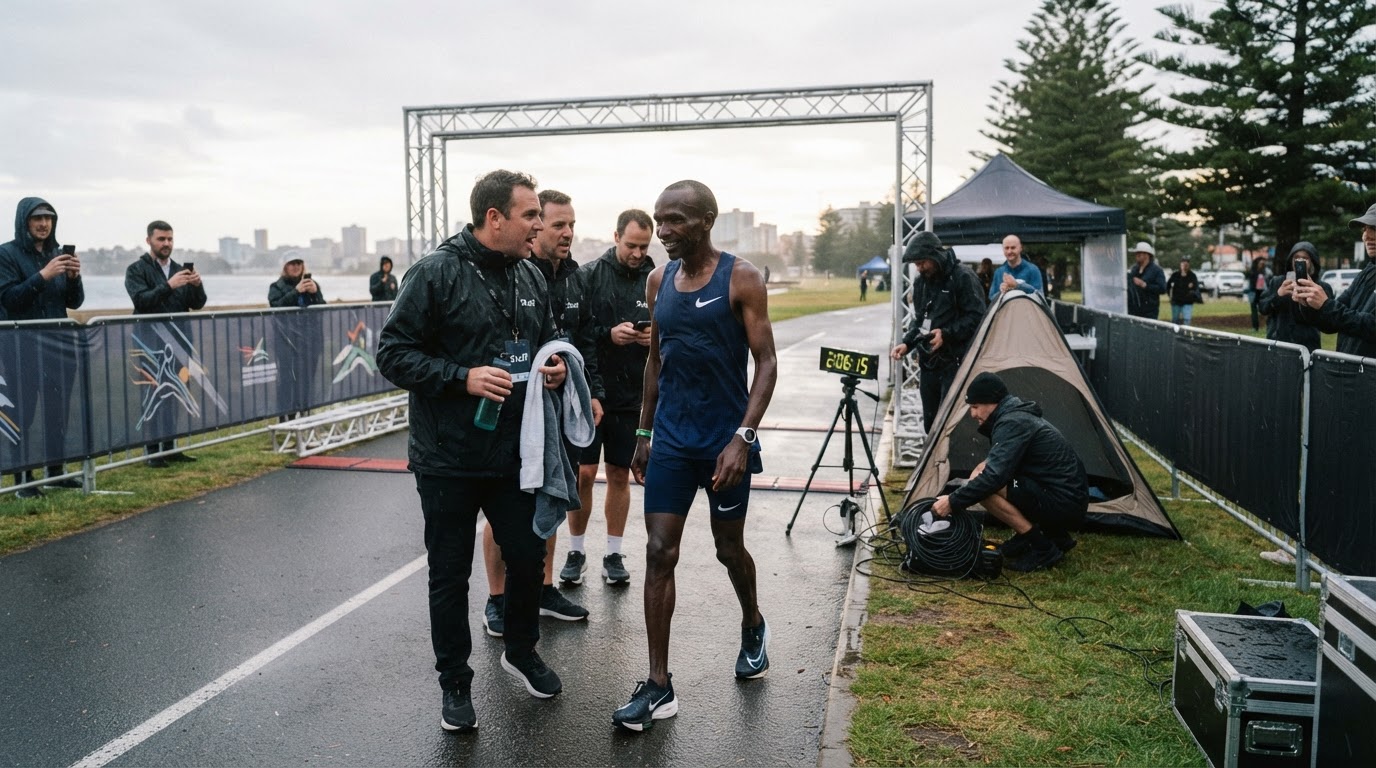
Distance running governance has long maintained a strict operational hierarchy centered on institutional sanction. For decades, international athletic federations and established championship bodies controlled competition calendars, qualification standards, and commercial revenues with minimal pushback from individual athletes. That institutional structure rested on an explicit compact: elite athletic legitimacy required strict compliance with federation schedules and formal championship cycles. When veteran athletes choose to step outside those regulatory boundaries to build self-directed global itineraries, that administrative monopoly begins to erode.
The performance recorded by Eliud Kipchoge at the Melbourne Marathon on October 11, 2026, clarifies this structural transition. Competing in Australia at age 41, the Kenyan distance runner broke the course record to capture his first marathon victory in three years. Having officially retired from elite-level racing, Kipchoge approached the Australian contest not as a sanctioned title defense within an established federation series, but as an integral fixture of his wider world tour. This initiative spans plans to contest seven marathons across seven continents over two-and-a-half years, combining community engagement with a USD 1,000,000 target for the Eliud Kipchoge Foundation.
The Autonomous Circuit
Such an operational framework alters the distribution of authority within road racing by transferring structural power from governing bodies directly to the individual athlete. Speaking to Footwear News during the New York City Marathon, Kipchoge treated his recent competitive running as part of this self-governed international program. Governing federations historically controlled the timing, geography, and commercial conditions under which top runners competed. Under Kipchoge's model, the athlete establishes an independent calendar that bypasses the rigid qualification demands of major championship circuits. The mass-participation marathon ceases to operate merely as an administrative fixture on a federation calendar; instead, it functions as host infrastructure for a sovereign personal enterprise.
For race directors and civic authorities across the Asia-Pacific region, this development presents an appealing alternative to traditional federation arrangements. Partnering with a proven champion allows the Melbourne Marathon Festival to capture global attention without incurring the heavy administrative costs and restrictive bidding protocols dictated by international governing syndicates. Municipalities secure international media visibility and high public participation. Nevertheless, this reliance on independent touring athletes introduces strategic trade-offs for regional event organizers. Local administrators inevitably subordinate long-term athletic calendar development to the scheduling priorities of an individual tour structured around independent philanthropic targets.
Commercial Realignment and Civic Boundaries
Commercial sponsors have restructured their investments to reflect this emerging balance of power. Multinational sportswear brands increasingly align marketing capital directly with private athlete initiatives and foundation goals, rather than funneling resources through federation championships. Brand partnerships of this nature enable commercial enterprises to maintain sustained visibility across diverse continental markets without confronting the restrictive uniform and promotional mandates enforced by traditional athletics bodies. Personal competitive legacy and individual platform reach have superseded institutional sanction as the primary asset for corporate athletic sponsorship.
A rigorous counterargument must recognize that such operational autonomy remains an option accessible only to an exceptionally rare tier of competitors. Bypassing federation systems and mobilizing commercial support across seven continents requires decades of accumulated athletic capital and historic recognition. The vast majority of professional distance runners lack the market leverage needed to negotiate independent civic appearances or fundraise USD 1,000,000 outside official competition grids. In reality, institutional championship structures and federation-sanctioned events remain the sole mechanism for most competitors to earn a livelihood and establish professional standing.
Even with those clear limits, the precedent established in Australia signals a lasting shift in how elite sporting careers can unfold. Kipchoge has demonstrated that competitive relevance and record-setting athletic capability can extend well past formal elite retirement. The remaining unresolved tension concerns the physical and administrative dependence of these sovereign ventures on host municipalities. While an athlete can declare independence from governing federations, the execution of any continental tour remains bound to the physical roadways, civic permits, and public services provided by the cities along the route.
Sources
Newsletter
Pacific Daily
A curated briefing from Thailand, Asia-Pacific and the world.