Hiking Japan's Peaks: A Reckoning with Responsibility Beyond the Trail
The human impulse to share natural spaces with companions, even animals, often overlooks the specific demands of terrain and ecology.
SINGAPORE
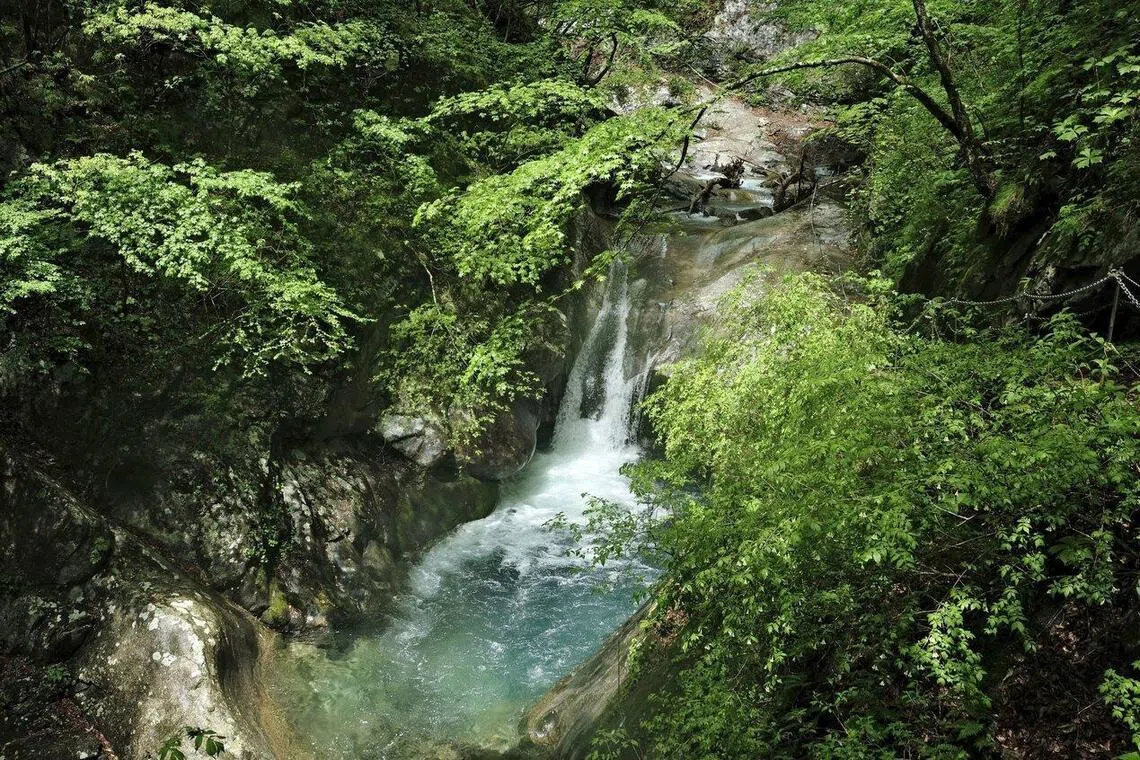
The Nishizawa Gorge, nestled in Yamanashi Prefecture, has long been a destination for those seeking the rugged beauty of Japan’s mountains. The cascading waterfalls and deep pools carve a landscape that draws many, yet it also presents inherent dangers. It was in May that a female hiker died here, reportedly after falling into a waterfall pool while attempting to rescue her dog. This incident, as reported by The Straits Times Life on September 20, 2026, spotlights a recurring tension: the personal freedom to bring pets onto trails versus the practical realities of safety in wild, unpredictable environments.
There is no national law in Japan that prohibits dogs on hiking trails. This absence of blanket legislation means that policy often defaults to local authorities, who may advise against bringing pets on narrow or dangerous paths but lack the power to enforce outright bans, particularly in national parks like Nishizawa Gorge. This creates a patchwork of regulations across the country, where some mountains, such as Mt. Mitake, explicitly welcome dogs and provide guidelines, while others offer only warnings.
This incident at Nishizawa Gorge is not an isolated event in the broader context of risks associated with outdoor recreation. Globally, the consequences of misjudging natural environments are evident. In 2026 alone, Reuters reported the recovery of a missing teenage hiker near Sydney in August, and The New York Times reported the deaths of three hikers following a volcano eruption in Indonesia in May. While these circumstances differ, they underscore a fundamental human vulnerability when engaging with the natural world, a vulnerability compounded when a companion, particularly an animal, is introduced.
The core of the issue lies in a divergence between expectation and reality. Many who venture into these landscapes envision a harmonious experience, an extension of daily life. For some, a dog is not merely a pet but a member of the family, and excluding them from an activity feels incongruous. However, the mountain path is not a city park. Its slopes, its sudden drops, and its unpredictable wildlife constitute a setting where human control is partial at best. When the safety of a human hinges on the rescue of an animal in such a setting, the inherent risks amplify dramatically. The emotional bond that drives such a rescue, while understandable, confronts an unforgiving physical reality.
"The specific demands of the mountain often remain secondary to the desire for shared experience."
The authorities' warnings about the risks animals pose, though not legally binding, carry weight. They reflect an understanding of the environment that extends beyond the individual's immediate desire for companionship. The challenge for Thailand, and indeed for other nations across Asia-Pacific with cherished natural parks and burgeoning outdoor tourism, is to navigate this delicate balance. How does one preserve the spirit of access and enjoyment while ensuring that the pursuit of leisure does not inadvertently lead to tragedy? This incident in Japan suggests that the conversation must shift from mere prohibition to a deeper recognition of the mountain's character, understanding that its beauty demands not just appreciation, but also a specific form of respect that acknowledges its power and its indifference to our intentions. It is in this careful calculus of enjoyment and deference that the future of responsible outdoor engagement will be forged.
Sources
Newsletter
Pacific Daily
A curated briefing from Thailand, Asia-Pacific and the world.