Great Power Direct Dialogue Displaces Traditional Multilateral Architecture in Shenzhen
The inaugural trilateral session among China, the United States, and Russia sidelines conventional regional bargaining in favour of high-stakes bilateral triage.
SINGAPORE
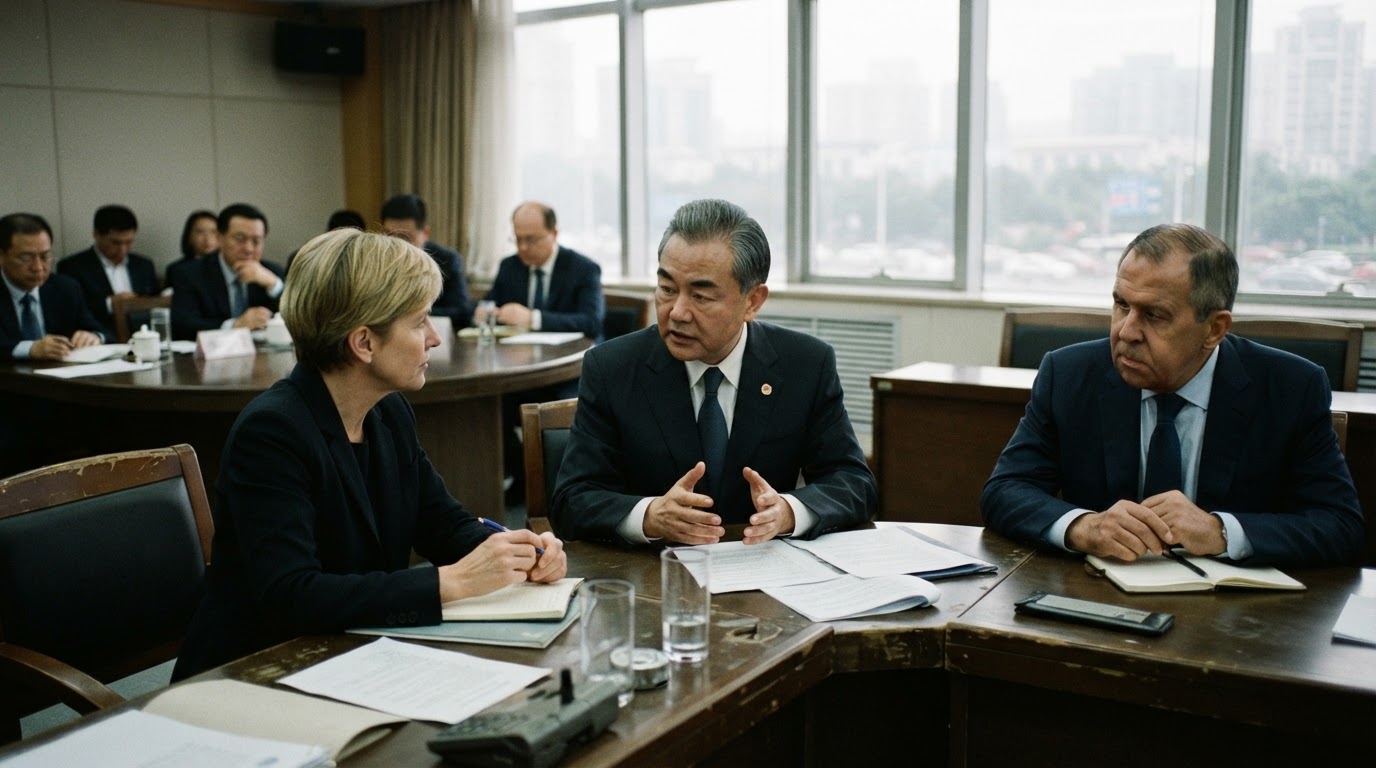
Major diplomatic summits rarely dispense with institutional scaffolding so abruptly. When Chinese President Xi Jinping, US President Donald Trump, and Russian President Vladimir Putin sat around a round table at Kylin Villa in Shenzhen on Thursday, November 19, 2026, the physical arrangement signaled a deliberate departure from customary summitry. Conducted on the sidelines of the Asia-Pacific Economic Cooperation forum, this first-ever three-way dialogue among the heads of state of China, the United States, and Russia subordinated standard multilateral deliberation to direct trilateral bargaining.
Stated agendas focused on two immediate international fractures: the war in Ukraine and nuclear arms control. Donald Trump characterised the gathering plainly, declaring: "We are really making history." Yet historical novelties in diplomatic practice often emerge when existing multilateral formats fail to contain bilateral frictions, rather than through sudden institutional harmony.
The Architecture of Direct Triage
For decades, great powers pursued strategic stability through separate bilateral channels or broader consensus-driven assemblies. Washington dealt with Moscow on strategic arsenals while treating Beijing primarily as an economic interlocutor, and China cultivated strategic ties with Russia while managing competitive friction across the Pacific. Gathering all three leaders at one table in southern China marks an explicit acknowledgement that European security questions and Pacific strategic postures can no longer be addressed as insulated theatres.
Hosting the talks within Shenzhen under an APEC umbrella introduces an acute paradox. APEC was established to lower commercial barriers and foster collective economic integration across Pacific rim economies. The bilateral and trilateral focus on war in Ukraine and strategic nuclear systems demonstrates how raw security imperatives routinely overtake trade coordination whenever systemic rivalries intensify.
Skeptics may view the choreography at Kylin Villa as theatrical convenience, designed to project personal diplomatic authority rather than deliver durable administrative treaties. Technical verification for nuclear arms control historically demands years of granular negotiation, whereas summit sessions offer immediate symbolic capital with minimal procedural binding. If the three capitals merely exchange positions without committing negotiating teams to verifiable mechanisms, the structural competition driving their rivalries will persist unaltered.
Regional Realignment and Asian Autonomy
Secondary powers across the Asia-Pacific face an altered strategic reality when global power brokers negotiate directly outside formal plenary oversight. Mid-tier economies rely historically on multilateral forums precisely because institutional rules restrict unilateral coercion by larger states. When the United States, China, and Russia choose direct trilateral forums to deliberate strategic balances, surrounding capitals risk discovering that external accords have altered regional security parameters without their participation.
This shift carries divergent consequences across regional capitals. Industrial exporters dependent on maritime commerce may welcome any nominal de-escalation that reduces immediate volatility between Washington and Beijing. Conversely, states dependent on explicit security guarantees must now calibrate whether direct communication among major capitals leaves smaller allies vulnerable to peripheral concessions.
We are really making history,
The Shenzhen talks establish a precedent where summit diplomacy operates as high-level crisis triage rather than an institutionalised consensus mechanism. While the visual cohesion of the three leaders gathered in southern China provides immediate strategic theatre, the fundamental contradictions dividing their foreign policies remain entirely unbridled by the meeting itself.
Sources
Newsletter
Pacific Daily
A curated briefing from Thailand, Asia-Pacific and the world.