European Football Consolidates Elite Competition While Global Parity Stalls
Spain enters the 2027 UEFA Women's Nations League draw with unbroken structural dominance that widens the gap with developing football ecosystems
SINGAPORE
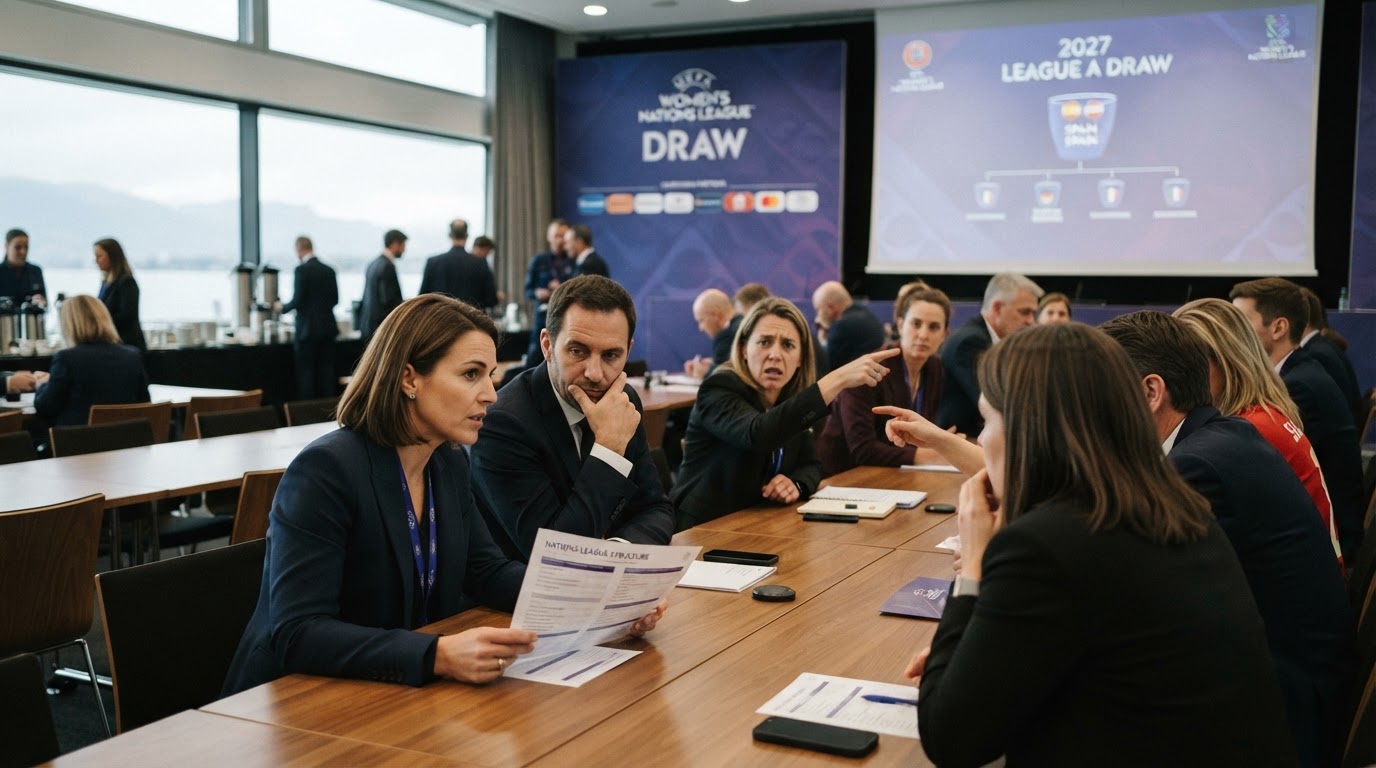
Spain has won every edition of the biennial UEFA Women's Nations League since the tournament began. That competitive record, solidified when Irene Paredes lifted the trophy after defeating Germany at Riyadh Air Metropolitano in Madrid on December 2, 2025, establishes an empirical baseline for the draw conducted on Tuesday. Allocated into Group A1 with Norway, Ireland and Switzerland for the 2027 cycle, the holders enter another two-year sequence where tournament architecture guarantees high-grade competitive volume to an exclusive cluster of European federations.
Athletic dominance reflects deliberate institutional design.
The tournament mechanism operates on compounding returns. When UEFA replaced non-competitive international friendlies with a tiered league, it manufactured continuous high-stakes encounters across its upper tier. Spain's second-leg triumph over Germany demonstrated how domestic professionalism converts into continental titles when reinforced by mandatory fixtures. The underlying ledger reveals that European national teams accumulate match density against top-tier opposition under tournament conditions, whereas external confederations must negotiate ad hoc exhibition matches or wait for the Women's World Cup.
Institutional Compounding
Advocates of the Nations League format maintain that tiering shields smaller programs from demoralising scorelines while preserving meritocratic mobility. A federation such as Ireland or Switzerland gains guaranteed testing against elite programs, theoretically raising performance floors across Europe.
Yet that logic holds only within the European perimeter. Look at the scheduling mechanics. By locking member associations into mandatory home-and-away windows, the competition effectively closes the continental calendar to external opposition. Federations outside Europe find themselves structurally locked out from arranging regular fixtures against Spain or Germany. The data demonstrates a deepening asymmetry: internal continental parity is purchased by isolating the rest of the international game from elite match exposure.
Competitive Divergence
Qualifying pathways reinforce this concentration. Pairing England and Spain in qualification cycles toward the 2027 Women's World Cup demonstrates how European sides operate in uninterrupted tournament environments. Sceptics might argue that regional confederations elsewhere could engineer equivalent structures. That argument overlooks capital concentration. UEFA controls the commercial inventory and broadcasting leverage necessary to sustain high-frequency national team tournaments, an economic luxury external federations cannot replicate under current financial allocations.
Mandatory continental schedules convert competitive frequency into an institutional moat that external federations cannot breach through talent alone.
The sporting outcome is divergence. While FIFA expanded the Women's World Cup to project an image of global diffusion, the operational engine of technical progression remains enclosed within Europe. Irene Paredes and her squad enter Group A1 backed by predictable competitive repetitions, while international rivals contend with calendar voids.
Europe has effectively solved its internal development problem by building a self-contained competitive ecosystem. Spain will test its tactical baseline against Norway, Ireland and Switzerland across the 2027 campaign with measurable institutional support. What remains unresolved is how any federation outside Europe can contest global supremacy when access to elite competitive volume remains governed by continental cartels.
Sources
Newsletter
Pacific Daily
A curated briefing from Thailand, Asia-Pacific and the world.