Empty Shelters and the Unintended Sanctuary of the Air-Conditioned Commons
Singapore built municipal refuges for transboundary smoke, but civic infrastructure reveals its limits when emergency architecture collides with daily tropical reality
SINGAPORE
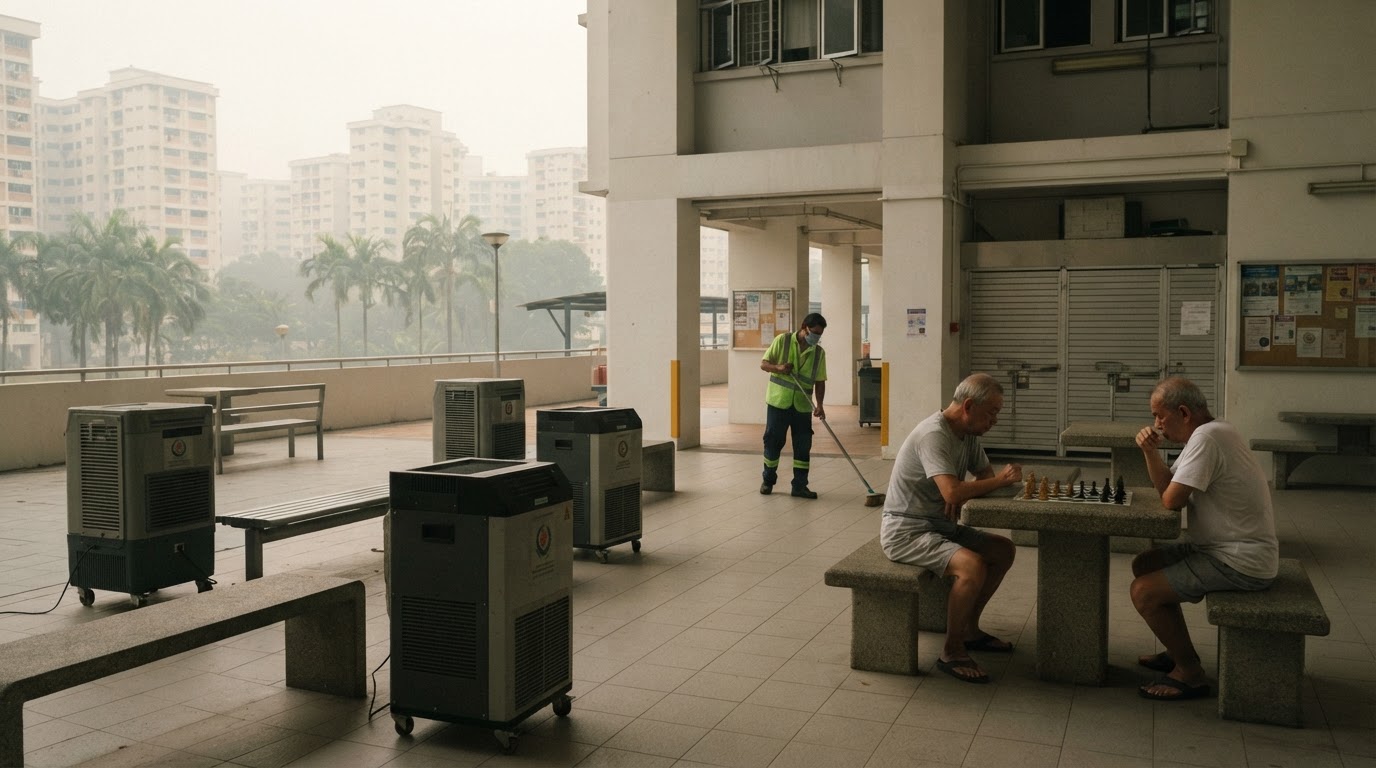
A fluorescent ceiling panel hums against the stillness of a public hall where conditioned air offers immediate physical relief from the tropical afternoon. Documented by CNA inside Toa Payoh Central Community Club on an October Saturday, retiree Low Cheng Yang, in his late 60s, sat quietly within a designated haze shelter. While Singaporean authorities probe firms over haze-causing Indonesian fires, municipal planning has framed such spaces primarily as functional barriers against acute atmospheric pollution. Yet for the few residents who actually cross the threshold, the room appears to serve a simpler and more immediate purpose: respite from ambient heat.
Civic planners across modern city-states tend to approach disaster mitigation through the lens of containment. Emergency protocols activate, air filtration units engage, and institutional buildings convert into designated safe zones on paper. When reporters from CNA inspected eight designated haze shelters across the island, however, the field reality diverged sharply from administrative intent: most facilities were locked or entirely empty. That discrepancy suggests that public resilience architecture often falters between statutory readiness and actual public habit.
The Friction of Guarded Entrances
What does a specialized crisis refuge ask of the person approaching its doors? Primarily, it appears to demand that an individual register an acute emergency before seeking access. A hall reserved explicitly for transboundary smoke creates an unspoken operational hurdle, forcing nearby pedestrians to determine whether routine physical exhaustion justifies entering a state-mandated shelter. If doors remain locked during active daytime hours, that administrative barrier turns absolute.
The grand apparatus of protective shelter, designed to shield lungs from particulate drift, stood mostly idle while daily life continued along the pavements.
This division between formal protocol and casual use illustrates a broader urban challenge across Southeast Asia. In practical terms, an emergency refuge that activates only around specific air-quality indices struggles to mesh with the daily movement of elderly populations. As observed in Toa Payoh Central, Low Cheng Yang made use of the facility not to flee particulate pollution, but to escape midday heat. The air-conditioned interior answered an immediate human need, yet its broader availability rested on a hazard designation that kept other rooms locked across the island. Public infrastructure creates genuine value only when its physical accessibility matches the practical requirements of the people walking past its exterior walls.
Repurposing the Regulated Refuge
Municipal administrations naturally favor distinct, measurable hazards. They can allocate budgets for industrial air scrubbers, track seasonal haze trajectories, and distribute guidelines to community centers. Everyday thermal strain, by comparison, remains diffuse, continuous, and harder to categorize as an acute municipal crisis. When eight inspected sites yield mostly barren benches and closed doors, the pattern indicates an operational friction rather than a community without cooling needs.
Top-down resilience models encounter real structural friction when administrative protocols take precedence over public usability. Infrastructure engineered solely for acute smoke drift risks standing underutilized throughout the year if routine neighborhood access is discouraged or physically barred. A cooling sanctuary that remains secured behind a padlock until smoke levels register danger cannot meaningfully support public welfare. It operates instead as an idle civic reserve, preserved for a narrow set of conditions that rarely match daily urban life.
Urban centers coping with warming climates require public spaces that welcome residents without demanding a categorized environmental crisis at the entrance. In Toa Payoh Central Community Club, one unlocked door provided functional relief because the machinery functioned without hindrance. Until municipal frameworks treat cooling as an everyday necessity rather than a rare emergency intervention, air-conditioned public halls risk remaining largely vacant, preserving procedural compliance while daily city life navigates the heat outside.
Sources
Newsletter
Pacific Daily
A curated briefing from Thailand, Asia-Pacific and the world.