B-Quik Under Scrutiny: When a Routine Car Service Becomes a Consumer's Nightmare
From a disputed oil change in Kanchanaburi to a customer's account of severe engine vibration in Yala, recurring complaints raise difficult questions about diagnostic standards, accountability and consumer protection in Thailand's automotive service industry.
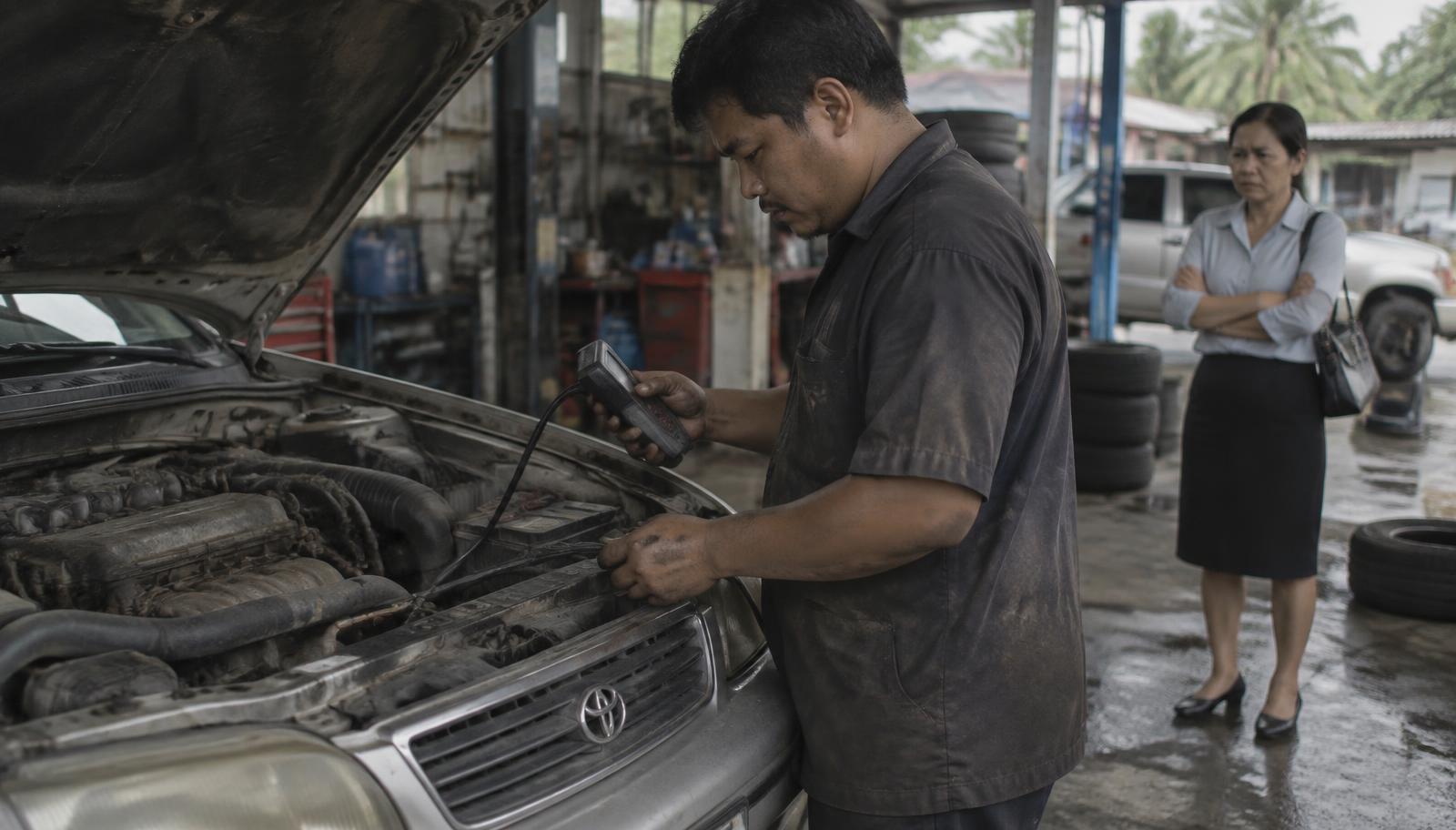
But what happens when a car enters a workshop with one problem and leaves with another — potentially more serious — one?
That question sits at the centre of a recent customer complaint involving B-Quik, one of Thailand's established automotive service brands, at its Big C Yala location.
The complaint, brought to Pacific Press Asia's attention through an account attributed to a customer identified as Ms T, describes an apparently straightforward maintenance visit that allegedly escalated into repeated interventions, severe engine vibration and an eventual referral to a Toyota service centre.
The account has not been independently substantiated through repair invoices, diagnostic records or a response from B-Quik. Nevertheless, it raises questions that deserve a documented answer.
A Visit for a Fuel Odour — Followed by a Shaking Engine
According to the account provided to Pacific Press Asia, Ms T initially sought assistance after noticing a persistent smell of fuel or automotive fluids inside her vehicle.
She selected B-Quik's Big C Yala branch primarily because of its proximity to her workplace.
The workshop is located within the Big C commercial complex on Thetsaban 1 Road, Sateng, Mueang Yala District, Yala 95000.
Ms T says the servicing employee recommended an engine-oil change.
After waiting for nearly two hours, she collected her vehicle and drove away.
It was then, she alleges, that a new and alarming symptom emerged: severe vibration originating from the engine compartment.
According to her account, the vehicle had not exhibited this degree of vibration before the service.
Rather than resolving the original concern, the experience appeared to have introduced an additional mechanical problem.
Ms T says she returned to the same workshop the following day to report the deterioration.
She alleges that the employee subsequently recommended replacing a fuel-system cap and clearing or disabling an LPG-related diagnostic fault code.
Yet the pronounced vibration reportedly continued.
With the vehicle's condition unresolved and its roadworthiness now in question, Ms T says she took it to an authorised Toyota service centre for further assessment.
According to her account, Toyota's assessment indicated that the earlier interventions had not addressed the relevant fault. She further alleges that she was left to bear the resulting repair expenses.
Pacific Press Asia has not yet obtained the Toyota diagnostic report or established whether the vibration was caused by B-Quik's work, an unrelated pre-existing defect, or a combination of mechanical conditions.
The distinction matters. A defect appearing immediately after maintenance is a legitimate reason for investigation, but timing alone does not establish technical causation.
What remains beyond dispute is the question the account raises: what diagnostic process should a professional workshop follow when a customer's vehicle develops a serious new symptom immediately after servicing?
Kanchanaburi, 2025: Another Oil-Change Dispute
Ms T's account is not the first public allegation involving a vehicle that reportedly developed problems after visiting B-Quik.
On 7 March 2025, Thai newspaper Matichon reported a dispute involving a motorist in Kanchanaburi who complained publicly that his vehicle had suffered problems following an engine-oil change.
The customer reportedly claimed that the vehicle could subsequently travel at only approximately 20 kilometres per hour.
B-Quik issued a formal statement disputing the implication that its maintenance work had caused the problem.
According to the company's explanation, its personnel found no apparent defect during their inspection before the vehicle left the service centre.
The company said it had offered further inspection and repairs without charge, arranged an assessment at an authorised vehicle service centre and offered a replacement vehicle.
B-Quik also stated that the customer had declined certain proposed arrangements, preventing the company from completing what it considered an appropriate investigation.
The company's position was that responsibility should be determined through technical examination rather than public accusation.
This response is significant.
It demonstrates that B-Quik has publicly acknowledged the need for independent technical verification in a disputed repair case.
But it also highlights a broader industry problem: when customers and workshops disagree over the origin of a mechanical fault, who should arrange the investigation, preserve the evidence and carry the financial burden while responsibility remains unresolved?
The March 2025 dispute cannot, on the available evidence, be described as a proven case of negligent repair.
It can, however, be examined as an example of the difficulties consumers face in establishing accountability following contested automotive maintenance.
Chonburi, 2023: An Explosion That Raised Safety Questions
On 20 April 2023, Thairath reported that a Suzuki Swift exploded while its owner was at a B-Quik service location in Chonburi.
The vehicle had reportedly been brought in because its air-conditioning system was not cooling properly and an engine-compartment fan was not operating as expected.
The owner was injured in the explosion.
A technician interviewed in the report described preliminary observations but did not establish the cause.
At the time of publication, it remained unclear whether the explosion originated from a vehicle component, an existing mechanical defect or another factor.
There is no verified basis in the cited report to conclude that B-Quik's maintenance procedures caused the explosion.
Nevertheless, an incident of this nature illustrates why accurate fault identification and workshop safety procedures are essential, particularly when dealing with vehicles that may have electrical, fuel-system or cooling-system problems.
Pattaya, 2016: A Vehicle Fire Minutes After Maintenance
A separate incident reported by Nation TV on 7 September 2016 involved a Toyota Vigo pickup that caught fire shortly after leaving a B-Quik branch at Big C South Pattaya.
According to the report, the vehicle had undergone maintenance involving tyres, engine oil, an air filter and air-conditioning checks, among other services.
The owner reported that smoke began emerging from the vehicle within approximately five minutes of departure.
Fire subsequently damaged the vehicle's interior.
The preliminary account suggested a possible electrical short circuit, but the definitive cause had not been established when the story was published.
The owner reportedly contacted the insurer and sought discussions with B-Quik over the damage.
The case does not prove that the service centre caused the fire. What it demonstrates is the importance of reconstructing the sequence of repairs and subsequent events when a serious incident occurs immediately after maintenance.
Beyond the Headlines: Complaints About Repair Quality and Upselling
Concerns also appear in consumer discussions.
In March 2024, a contributor to the ASEAN NOW forum questioned the quality and warranty coverage of clutch repairs carried out by B-Quik after paying approximately THB 14,000 and subsequently experiencing additional symptoms.
Other contributors alleged problems following suspension or drivetrain servicing and questioned recommendations for replacement parts.
These accounts are anonymous or pseudonymous, have not been independently verified and cannot be treated as representative of B-Quik's entire service network.
Similarly, complaints on Thailand's Pantip forum have included allegations of unexpected costs, disputed recommendations, prolonged waiting times and dissatisfaction with refund procedures.
One 2022 contributor reported waiting for service before cancelling a prepaid wheel-related maintenance booking and being advised that reimbursement could take seven to fourteen days.
Another older forum discussion alleged that a customer was charged for a wheel fastener the customer believed had already been present.
Such complaints require caution. Online testimony is evidence of reported customer dissatisfaction, not automatically evidence of misconduct.
Yet taken together, they identify issues that merit scrutiny across the automotive service industry: the quality of initial diagnosis, the justification for replacement parts, warranty transparency and the mechanisms available when a customer disputes a repair recommendation.
The Central Question: Diagnosis or a Cycle of Unresolved Repairs?
Automotive servicing creates an obvious imbalance of technical knowledge.
The technician understands the mechanical systems. The customer, in most cases, does not.
A consumer may be told that an oil change, replacement component or electronic reset is necessary without possessing the tools or expertise to determine whether the recommendation addresses the original complaint.
This information imbalance creates a particular responsibility for service providers.
A fuel odour, for example, should prompt investigation of possible fuel leakage, vapour escape, associated hoses, seals or other relevant vehicle systems.
An oil change does not, by itself, explain or resolve every possible source of a fuel smell.
Likewise, clearing an LPG-related diagnostic code does not necessarily eliminate the underlying cause of a fault.
When an intervention fails to solve the complaint, the appropriate next step should be further evidence-based diagnosis rather than an assumption that another replacement will succeed.
There are legitimate circumstances in which multiple faults coexist, particularly in older vehicles.
But the existence of mechanical complexity does not relieve a workshop of its responsibility to explain what it has tested, what it has found and why it recommends a particular repair.
This is the unresolved issue at the heart of Ms T's account.
Was the original complaint properly diagnosed? What procedures were performed? Why did severe vibration reportedly emerge after the first visit? And what evidence supported the subsequent recommendation involving the LPG system?
Without the workshop records and an independent technical assessment, these questions cannot responsibly be answered as findings of negligence or deliberate exploitation.
They should not, however, be dismissed.
A Marketing Promise Must Withstand Mechanical Scrutiny
For a major automotive service chain, brand recognition is a commercial advantage.
Customers associate familiar names, organised premises and professionally presented service centres with consistency and reliability.
Marketing can establish that expectation.
Only technical competence, transparent communication and effective complaint resolution can fulfil it.
The uncomfortable question for B-Quik is therefore not whether it invests in brand visibility. Marketing investment is a normal commercial activity.
The question is whether its operational controls, technician training and post-service accountability consistently support the confidence its brand seeks to inspire.
There is presently no verified evidence that B-Quik intentionally creates mechanical problems to generate additional repairs.
Suggesting otherwise as an established business practice would go beyond the available facts.
Nevertheless, repeated allegations of unresolved faults and disputed service recommendations make it reasonable to ask whether stronger independent oversight is necessary to protect customers from unnecessary expenditure and inadequate diagnosis.
The distinction between an honest diagnostic mistake and deliberate commercial exploitation is fundamental.
It must be established through evidence, not speculation.
Thailand's Consumer Protection Challenge
The wider regulatory environment makes these questions especially relevant.
In July 2026, Matichon reported that Thailand's Office of the Consumer Protection Board had received more than 1,700 complaints concerning automotive repair services since 2022.
The reported concerns included unclear repair charges, additional costs imposed without adequate prior notification and incomplete transaction documentation.
These figures concern the automotive repair sector generally. They are not allegations or statistics specifically attributable to B-Quik.
Thailand's consumer protection framework requires covered automotive repair businesses to provide appropriate service and payment documentation, including details of repairs, parts, costs and warranty conditions.
Such requirements are not mere administrative formalities.
They provide the documentary foundation for determining what a customer authorised, what the workshop performed and whether the completed work was consistent with the agreed service.
Where disputes involve a vehicle's mechanical condition before and after repair, the preservation of diagnostic findings, error codes, service records and replaced parts can be equally important.
An investigation into Ms T's complaint would therefore benefit from examining the original work order, the oil specification and quantity used, the pre-service inspection, the LPG diagnostic history, the rationale for subsequent replacements and Toyota's independent findings.
It should also establish whether B-Quik was notified of Toyota's assessment and given a fair opportunity to inspect or respond.
Questions B-Quik Should Answer
Pacific Press Asia considers the following questions central to a fair examination of the Yala complaint:
- What diagnosis was performed in response to Ms T's original report of a fuel or automotive-fluid odour?
- On what technical grounds was an engine-oil change recommended?
- Was the vehicle's engine condition, including any vibration, documented before and after servicing?
- What caused or contributed to the severe vibration reportedly experienced after the first visit?
- What specific LPG-related fault code was identified, and was it cleared, disabled or otherwise addressed?
- What diagnostic evidence justified the recommendation to replace the fuel-system cap?
- What findings did Toyota communicate, and did B-Quik have an opportunity to review them?
- What process does the company follow when a customer alleges that maintenance caused a new mechanical problem?
- Under what circumstances will B-Quik reimburse an independent diagnosis or corrective repair?
- What internal quality-assurance procedures ensure that technical recommendations are based on verified defects rather than unnecessary parts replacement?
These are requests for accountability, not declarations of guilt.
The Case for Independent Examination
Ms T's allegations remain unresolved.
That is precisely why independent technical scrutiny matters.
A thorough examination should distinguish among three possibilities: an existing defect unrelated to the service; a genuine diagnostic or repair error; or a mechanically demonstrable failure arising from the servicing process.
Each scenario carries different implications for responsibility.
Thailand's consumer protection authorities should examine substantiated complaints where there is credible documentation of disputed repairs, unexplained additional charges or unsafe post-service vehicle conditions.
If the evidence establishes professional negligence or a breach of consumer protection requirements, proportionate remedies and enforcement should follow.
If the evidence exonerates the service provider, that conclusion should likewise be made clear.
Consumer protection must be evidence-driven. So must corporate accountability.
The Trust Deficit
For motorists, the real cost of an unresolved repair is not necessarily confined to an invoice.
It may include lost working hours, alternative transportation, independent inspections, repeat repairs and the anxiety of driving a vehicle whose mechanical condition remains uncertain.
For service brands, the consequences extend beyond a single dissatisfied customer.
Confidence is built through consistency, but it is tested most severely when something goes wrong.
The Yala complaint presents B-Quik with an opportunity to explain how it distinguishes between routine maintenance, genuine mechanical diagnosis and repeat interventions that fail to resolve a customer's original concern.
The company deserves an opportunity to respond.
The customer deserves an evidence-based explanation.
And the wider motoring public deserves clarity about the standards by which automotive service providers are held accountable.
A credible repair industry should not ask customers to trust the logo more than the diagnosis.
---
Newsletter
Pacific Daily
A curated briefing from Thailand, Asia-Pacific and the world.